
 by
by Wearable air quality monitoring system market advances with smart wearables, air sensor innovation, and rising concerns about indoor outdoor pollution levels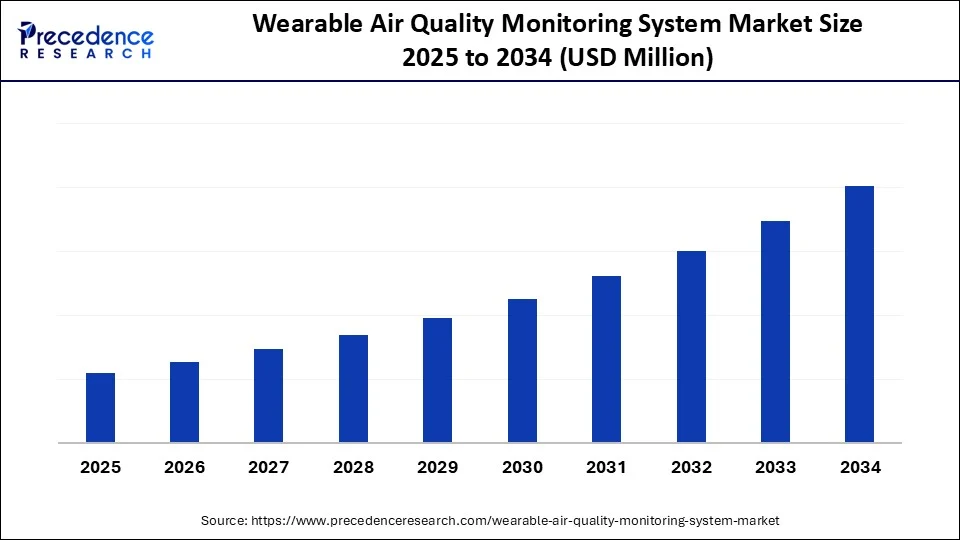
Wearable Air Quality Monitoring System Market Key Takeaways
- In 2024, North America led the market in terms of share.
- Asia Pacific is set to grow the fastest between 2025 and 2034.
- Among pollutants, particulate matter (PM) topped the list, especially the PM2.5 sub-segment in 2024.
- VOCs are expected to grow at a strong pace during the forecast period.
- Electrochemical sensors were the most widely adopted technology in 2024.
- Hybrid sensor systems are likely to grow significantly over the next decade.
- Clip-on devices held the largest share by form factor in 2024.
- Smart clothing is projected to be the fastest-growing form factor through 2034.
- Bluetooth was the leading connectivity solution in 2024.
- Cellular (LTE/NB-IoT) is predicted to see robust growth moving forward.
- Personal/consumer health monitoring led the applications in 2024.
- The industrial worker safety segment is poised for rapid expansion.
- Consumers were the dominant end users in 2024.
- Occupational safety agencies are expected to grow rapidly in the coming years.
- Online retail was the top distribution method in 2024.
- B2B sales & contracts will likely witness the fastest growth over the forecast period.
How is AI Altering the Wearable Air Quality Monitoring System Market?
Artificial intelligence is significantly enhancing air quality monitoring and management. Through machine learning, AI can rapidly process vast sensor datasets to identify pollution trends and predict future air quality issues. It also plays a key role in tracing pollution sources, enabling more focused policy responses and environmental interventions.
On an individual level, AI analyzes personal exposure data to provide customized advice, such as avoiding high-pollution areas or adjusting daily routines. This integration of AI supports more responsive environmental governance, tailored health recommendations, and robust early warning systems.
Get Sample Link @https://www.precedenceresearch.com/sample/6409
Market Overview
Viewed through a health-centric and community deployment lens, wearable air quality monitoring systems are evolving into tools for public health and epidemiological research, beyond personal wellness. These devices are being adopted by healthcare providers, researchers, schools, and environmental NGOs to monitor individual and community-level exposure to pollutants.
Crowdsourcing campaigns and citizen science projects equip participants with wearable badges to gather localized exposure data, enabling more granular mapping of pollution hotspots. Health-focused use is especially notable in urban centers with poor air quality and high rates of respiratory illnesses. Demand is growing in both developing and developed countries, spurred by policies promoting preventive health and environmental equity.
Drivers
The rise of community health awareness around pollution exposure and its link to respiratory and chronic diseases is a key driver. NGO campaigns and public-sector initiatives recognize mobile, wearable monitoring as a scalable way to gather granular exposure data across diverse populations. Additionally, healthcare providers and researchers are leveraging wearables to correlate air quality data with clinical outcomes—creating evidence-based models of how pollutant exposure triggers asthma or exacerbates COPD.
In many regions, health insurance companies see potential in preventive health monitoring, potentially reducing long-term costs by encouraging cleaner habits. Sensor cost reduction and smartphone connectivity enable large-scale deployments in schools, research studies, and public health campaigns. Real-time data sharing and visualization platforms also encourage public engagement and advocacy.
Opportunities
This framework offers rich opportunity spaces in partnerships with academic institutions, public health bodies, and NGOs to run large-scale campaigns measuring exposure in vulnerable communities. Wearables can integrate with health monitoring apps or telemedicine platforms to offer combined environmental + physiological tracking.
Crowdsourced city-level datasets can inform policy and advocacy, enabling municipal authorities to deploy remediation efforts more efficiently. Grant-funded research projects and public-private partnerships can subsidize deployment in schools, underserved areas, or regions with high pollution to build public trust and visibility. There’s also opportunity to build community-focused data platforms that anonymize exposure records, offering aggregated trends back to participants without compromising privacy.
Challenges
Scaling for community and public use brings challenges. Coordinating large-scale deployments requires logistics for device distribution, user training, calibration checks, and battery maintenance. Data aggregation and anonymization must be carefully managed to prevent privacy breaches—especially sensitive in school or healthcare contexts.
Ensuring device accuracy across varied environmental conditions is challenging; devices must be rugged, easily maintained, and periodically revalidated. Interpreting raw exposure data meaningfully for participants also requires robust app interfaces and contextual education. Securing funding and partnerships remains a hurdle for many pilot programs; leveraging distributed teams and maintaining participant engagement over time is resource-intensive.
Recent Developments
In recent months, several public health initiatives have begun deploying wearable AQ badges in school programs to monitor children’s pollution exposure during commute and classroom hours. Pilot studies in urban and peri-urban districts demonstrate how granular data can inform both parents and local authorities about hotspots requiring intervention. Major NGOs have started multi-city crowdsource campaigns, providing wearables to residents and publishing aggregated exposure maps for policy advocacy. On the research side, collaborative studies now pair wearable air monitors with personal health trackers (e.g. heart rate, lung function) to model pollutant-triggered symptom flare-ups.
These integrated datasets are supporting published research correlating short-term spikes in PM₂.₅ with asthma episodes in sensitive individuals. Some platforms now support anonymized real-time dashboards for community participants showing air quality trends and safe-route suggestions. Additionally, federated learning methods are being employed in research networks to build generalizable pollutant forecasting models while preserving participant privacy—making community-scale work more scalable and compliant with data protection regulations. Wearables used in community pilots are increasingly designed for durability, easy charging, and minimal user effort to facilitate long-term engagement.
Wearable Air Quality Monitoring System Market Companies
- Atmotube (Plume Labs – part of AccuWeather)
- Kaiterra
- TZOA (now part of Awair)
- Aeroqual Ltd.
- Clarity Movement Co.
- Qingping Technology
- Temtop (Elitech Technology, Inc.)
- uHoo
- Sensirion AG
- RAE Systems (a Honeywell company)
- Flow by Plume Labs
- Wavelet Health
- Amphenol Advanced Sensors
- AirBeam (HabitatMap)
- Purelogic Labs India
- Prana Air
- Airveda
- Bosch Sensortec
- Breezometer (acquired by Google)
- Blueair (Unilever)
Segments Covered in the Report
By Pollutant Type Monitored
- Particulate Matter (PM1.0, PM2.5, PM10)
- Volatile Organic Compounds (VOCs)
- Nitrogen Dioxide (NOâ‚‚)
- Carbon Monoxide (CO)
- Ozone (O₃)
- Carbon Dioxide (COâ‚‚)
- Temperature & Humidity Sensors
By Technology
- Electrochemical Sensors
- Optical Particle Counters
- Metal Oxide Semiconductor (MOS) Sensors
- NDIR (Non-Dispersive Infrared) Sensors
- Hybrid Sensor Systems
By Form Factor
- Wristbands
- Clip-on Devices
- Smart Clothing
- Lanyard/Brooch Form
- Helmet/Head-Mounted Devices
By Connectivity
- Bluetooth
- Wi-Fi
- Cellular (LTE/NB-IoT)
- Offline/USB Data Transfer
By Application
- Personal/Consumer Health Monitoring
- Industrial Worker Safety
- Outdoor Activity & Fitness Monitoring
- Healthcare Monitoring (Asthma, COPD)
- Academic & Field Research
By End User
- Consumers
- Occupational Safety Agencies
- Research Institutions
- Healthcare Providers
- Environmental Monitoring Agencies
By Distribution Channel
- Online Retail (DTC platforms, eCommerce)
- Offline Retail (Electronics/Medical Stores)
- B2B Sales & Contracts
By Region
- North America
- Europe
- Asia-Pacific
- Latin America
- Middle East & Africa
Also Visit@ https://www.precedenceresearch.com
