
 by
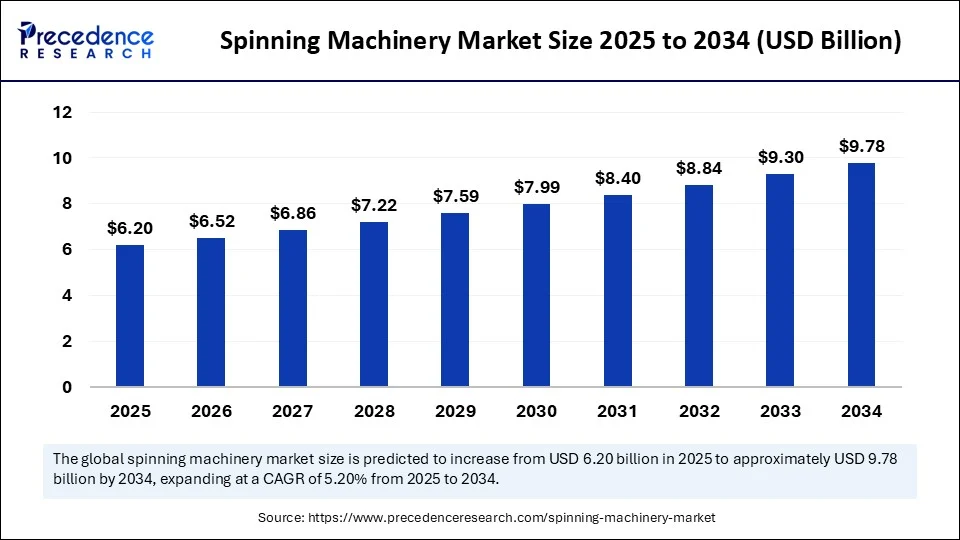
by The global spinning machinery market size is projected to hit around USD 9 78 billion by 2034 increasing from USD 5 89 billion in 2024, with a CAGR of 5 20
Spinning Machinery Market Key Takeaways
- The spinning machinery market was worth USD 5.89 billion in 2024 and is projected to grow to USD 9.78 billion by 2034.
- It is expected to grow at a steady CAGR of 5.20% from 2025 to 2034.
- Asia Pacific had the largest share in 2024 and is expected to keep growing.
- Among machine types, ring spinning machines were the most in-demand in 2024.
- Air-jet spinning machines are expected to grow the fastest during the forecast period.
- Automatic machines held the largest share by operation type in 2024 and are set to lead in the coming years.
- Natural fibers were the most widely used material type in 2024.
- Blended fibers are likely to grow at the highest CAGR moving forward.
- The apparel & fashion industry accounted for the biggest market segment in 2024.
- The industrial textiles sector is projected to grow the fastest through 2034.
- Short staple spinning led the spinning processes in 2024.
- Long staple spinning is forecasted to grow at the fastest rate.
- Direct sales was the dominant sales channel in 2024.
- Online sales are expected to expand the most between 2025 and 2034.
How is AI Transforming the Spinning Machinery Market?
The integration of AI and IoT into spinning machinery is reshaping the textile industry, enabling innovations in yarn quality, fabric consistency, pattern design, and operational efficiency. From fiber processing to final product evaluation, AI-driven automation enhances precision and reduces human error. Predictive maintenance, powered by real-time sensor data and machine learning algorithms, further ensures machinery reliability and reduces operational downtime.
Design and development are also benefiting, with AI assisting in the creation of visually appealing patterns and enabling 3D visualization of fabrics. Fabric grading is becoming more objective and consistent, driven by machine learning models. Neural networks are now accurately calculating yarn parameters such as fineness, staple length, and tensile strength—key indicators of textile quality. As these technologies continue to evolve, their full impact on the textile sector is only beginning to emerge.
Market Overview
From a sustainability and emerging‑market orientation, the spinning machinery market is transforming to support greener production and access in new regions. Historically concentrated in China, India, Turkey, and Pakistan, spinning capacity is moving into newer countries in Africa, Southeast Asia, and Latin America.
These regions often begin with secondhand or affordable ring‑spinning lines, but as domestic apparel production grows, demand is shifting to newer equipment featuring cleaner energy profiles, lower waste, and flexible fiber handling. Spiral growth of apparel manufacturing in Ethiopia, Bangladesh, and Vietnam now invites suppliers to introduce energy‑efficient compact and rotor spinning machines even into previously cost‑constrained markets. Regulatory pressures and corporate procurement standards are driving usage of certified low‑impact equipment.
Drivers
Growth is driven by two intersecting forces: rising garment exports from emerging economies as brands seek diversified sourcing hubs, and growing buyer emphasis on sustainability credentials and traceability. Energy and resource cost pressures—particularly in developing countries where power infrastructure is weak or expensive—encourage adoption of machines designed for reduced electricity, water, and lubricant use.
Additionally, regulatory and industry-led initiatives (e.g. Better Cotton Initiative, EU eco‑label requirements) increasingly demand data around resource use and environmental impact, motivating equipment upgrades. Cost declines in renewable energy and local grid improvements add incentive: mills with solar or wind onsite can pair them with energy‑optimized machinery to further cut carbon footprints.
Opportunities
The biggest opportunity lies in enabling early adoption of clean-tech spinning machines in new textile regions. Manufacturers can offer tiered machine packages—affordable basic spinning lines for entry‑level mills and premium efficient systems for growth‑oriented facilities—along with training, spare‑parts networks, and support.
Another opportunity is integrating spinning machinery into local industrial parks or textile hubs offering shared modernization facilities. Vendors can also play a role in credentialing and compliance programs—bundling machinery with carbon footprint calculators and compliance dashboards to meet buyer demands from global brands. Furthermore, geography-specific service models—spare‑part towers, mobile technicians, and digitization hubs—can differentiate providers and accelerate market penetration.
Challenges
Introducing newer machinery into cost-sensitive emerging markets is not without risk. Price pressures remain severe, and mills often default to lower‑cost legacy equipment until they scale production. Infrastructure gaps—unreliable power, lack of qualified technicians, challenges in shipping replacement parts—can deter adoption. Cultural and operational inertia also exist: many mills prefer familiar machines and are wary of new technologies unless clear productivity or quality gains are demonstrated.
Financing remains a barrier; local banks may be reluctant to lend for machinery purchases, especially in countries with limited track records. Furthermore, compliance and sustainability standards are still developing in many of these regions, so benefits of certified equipment may not yet be fully recognized or rewarded.
Get Sample Link@ https://www.precedenceresearch.com/sample/6411
Recent Developments
Recent movement in this space includes machinery vendors creating financing and leasing packages specifically designed for mills in emerging markets—keeping upfront costs manageable. Collaborations with international brands and NGOs have led to pilot programs deploying efficient spinning lines in textile clusters, with built-in impact measurement (e.g. energy per kg yarn, waste reduction). Some local machinery partners now offer modular and upgradeable lines: mills can begin with basic yarn systems and scale to compact spinning with minimal disruption.
Energy‑efficient variants of rotor and open‑end systems have been field‑tested in energy‑scarce regions, showing measurable power savings. Local content assembly and localized training hubs now ensure better support and quicker deployment. Finally, digital traceability modules are being integrated with spinning systems, enabling mills to report their carbon and resource efficiency directly to buyers via platform dashboards
Spinning Machinery Market Companies
- Rieter Holding AG
- Saurer Intelligent Technology AG
- Lakshmi Machine Works Ltd. (LMW)
- Truetzschler Group
- Marzoli Machines Textile S.r.l.
- Toyota Industries Corporation
- Murata Machinery Ltd. (Muratec)
- Savio Machine Tessili S.p.A.
- Jingwei Textile Machinery Co., Ltd.
- Zhejiang Tatian Co., Ltd.
- Jiangsu Jinlong Machinery
- Electro-Jet S.A.
- SSM Scharer Schweitzer Mettler AG
- Perfect Equipements
- A.T.E. Enterprises
- Veejay Lakshmi Engineering Works Ltd.
- TMT Machinery, Inc.
- Pacific Associates
- Bhagat Textile Engineers Pvt. Ltd.
- Zhejiang Rifa Textile Machinery Co., Ltd.
Segments Covered in the Report
By Machine Type
- Ring Spinning Machine
- Rotor Spinning Machine (Open-End Spinning)
- Air-Jet Spinning Machine
- Friction Spinning Machine
- Others (e.g., Vortex, Electrostatic)
By Operation Type
- Automatic
- Semi-Automatic
- Manual
By Material Type
- Natural Fibers (Cotton, Wool, etc.)
- Synthetic Fibers (Polyester, Nylon, etc.)
- Blended Fibers
By End-Use Industry
- Apparel & Fashion
- Home Textiles
- Industrial Textiles
- Medical Textiles
- Automotive Textiles
- Others
By Spinning Process
- Short Staple Spinning
- Long Staple Spinning
By Sales Channel
- Direct Sales
- Distributors & Dealers
- Online Channels
By Region
- Asia-Pacific
- Europe
- North America
- Latin America
- Middle East & Africa
Also Read @https://www.precedenceresearch.com
