
 by
by The global debt settlement market size is accounted to reach around USD 18 28 billion by 2034 increasing from USD 9 83 billion in 2024, with a CAGR of 6 40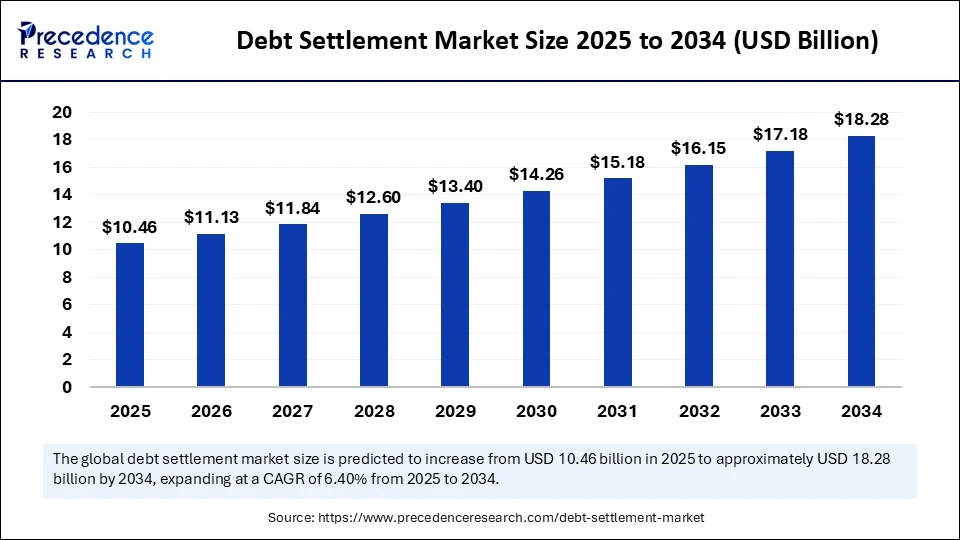
Debt Settlement Market Key Takeaways
- The debt settlement market was worth USD 9.83 billion in 2024.
- It is expected to grow to USD 18.28 billion by 2034.
- The market is growing at a 6.40% CAGR from 2025 to 2034.
- North America had the highest revenue in 2024.
- Asia Pacific is expected to grow quickly during the forecast period.
- Credit card debt settlement was the leading segment by type in 2024.
- Personal loan debt settlement is set to grow steadily through 2034.
- Debt negotiation services made up the biggest market share in 2024.
- Debt counselling is expected to expand steadily over the coming years.
- Most customers in 2024 were individual consumers.
- SMEs are projected to become a fast-growing user group.
- Offline sales channels led in 2024.
- Online platforms are expected to grow strongly between 2025 and 2034.
How is AI Impacting on Debt Settlement Solution?
The integration of Artificial Intelligence in the debt settlement sector is reshaping traditional operations. AI now plays a central role in automating debt negotiations, streamlining settlements, reducing manual intervention, and delivering tailored client solutions. While debt settlement has long depended on expert human advisors, AI is complementing these roles by enhancing both efficiency and decision accuracy.
Through advanced data analytics, AI uncovers negotiation trends and optimal strategies, allowing firms to make data-backed decisions rapidly. AI-driven standardization is emerging as a powerful tool for managing complex, high-value tasks within the industry. Debt settlement providers are increasingly turning to AI to provide continuous support, elevate customer engagement, and modernize their service offerings.
A notable example is Kikoff, which in April 2025 launched AI Debt Negotiation—a voice AI solution designed to handle debt discussions on behalf of consumers. This innovation highlights the industry’s move toward stress-free, intelligent debt management systems.
Market Overview
Viewed as part of broader financial wellness ecosystems, the debt settlement market is progressively integrating with advisory, credit repair, budgeting apps, and employer-based benefit platforms. In this hybrid model, debt settlement is one element within a larger suite of services aimed at improving financial health.
Providers in this space offer flexible, modular service bundles—ranging from standalone settlement negotiation to full financial health mentorship, credit score rebuilding, refinancing, and budgeting coaching. This model spans consumer-directed channels, employer wellness programs, community nonprofits, and fintech partnerships. With financial stress recognized as a major component of overall well-being, debt settlement is becoming embedded in holistic solutions targeting mental health, retention, and productivity.
Drivers
Driving growth within this hybrid model is the increasing intersection of financial health with digital wellness platforms. Employers and benefits providers recognize that financial stress has measurable impacts on employee performance and retention, prompting inclusion of debt relief solutions within corporate wellness packages.
Similarly, personal finance apps and fintech platforms seek to boost user retention by offering diversified services—debt settlement included—as engagement features. Social and community organizations are partnering with settlement providers to offer affordable or subsidized access, further destigmatizing utilization. Consumer demand for end-to-end solutions—financial coaching combined with negotiation—drives providers to offer integrated service models. Regulatory encouragement toward financial literacy and debt management initiatives also supports ecosystem formation.
Opportunities
This integrated ecosystem offers strong growth levers. Providers can sell modular packages to employers as part of benefits offerings or wellness stipends. Collaborations with mental health and social services providers can position settlement alongside stress counseling or financial literacy programs. Fintech apps can incorporate white-labeled settlement offerings to retain users and increase monetization. Subscription-based financial wellness memberships can include settlement as an annual or on-demand service.
There’s also opportunity to target student loan markets or specific demographic groups like healthcare workers, gig economy professionals, or lower-income households, by bundling settlement with budgeting or income smoothing tools. Educational content and peer support communities add value for brand-building and retention.
Get Sample Link @https://www.precedenceresearch.com/sample/6405
Challenges
However, this hybrid-ecosystem approach brings challenges. Coordinating multi-disciplinary services demands robust operational workflows, provider partnerships, and compliance protocols. Aligning settlement outcomes with financial coaching may complicate pricing and performance measurement. Data privacy across domains—credit profiles, health stress markers, employer relationships—must be carefully handled.
Resistance from consumers who prefer standalone settlement or distrust bundled offerings can occur. Regulatory complexity increases for providers operating both as financial advisors and debt negotiators, especially in jurisdictions with strict licensing rules. Integration with app or employer platforms may require significant tech development and legal agreements. Finally, pricing models must balance affordability with the cost of delivering bundled services, and contingency fees must be clearly disclosed to maintain credibility.
Recent Developments
Recently, several debt settlement providers have launched partnerships with financial wellness apps, allowing users to access settlement negotiation tools directly alongside budgeting and credit-tracking dashboards. Some fintech platforms now embed debt settlement offers alongside refinancing or debt consolidation options, giving consumers multiple paths and comparison transparency.
Employer-based pilot programs are offering debt settlement as an on-demand benefit—especially in industries with high turnover or stress. Educational nonprofits have begun issuing subsidized vouchers for settlement services bundled with financial coaching. Hybrid firms are increasingly offering outcome analytics, showing participants how debt reduction progress impacts projected credit score recovery and long-term savings. Additionally, new pricing innovations include deferred fees, sliding scales, and partial refunds tied to settlement success metrics, encouraging trust and reducing upfront barriers for users.
Debt Settlement Market Companies
- Freedom Debt Relief
- CuraDebt
- Pacific Debt Inc.
- New Era Debt Solutions
- Accredited Debt Relief
- National Debt Relief
- American Financial Solutions
- Beyond Finance
- CreditAdjusters
- Consolidated Credit Counseling Services
- Alliance Credit Counseling
- DMB Financial LLC
Best Debt Settlement Companies are Consumer Reviews
- Freedom Debt Relief: Consumers have highlighted the company as the most trusted.
- National Debt Relief: Best for credit card balances
- Accredited Debt Relief: Best company for flexibility and communication
- CuraDebt: Best for tax and business debt relief
- Pacific Debt Relief: Best for personal support
(Source: https://www.stltoday.com)
Segment Covered in the Report
By Type
- Credit Card Debt Settlement
- Mortgage Debt Settlement
- Student Loan Debt Settlement
- Medical Debt Settlement
- Personal Loan Debt Settlement
- Others
By Service Type
- Debt Negotiation Services
- Debt Counseling Services
- Debt Management Plans
- Legal Assistance for Debt Settlement
- Others
By End-user
- Individual Consumers
- Small and Medium Enterprises (SMEs)
- Large Enterprises
By Distribution Channel
- Online/Digital Platforms
- Offline/Traditional Channels
By Region
- North America
- Europe
- Asia-Pacific
- Latin America
- Middle East & Africa
Also Read@ https://www.precedenceresearch.com
