
 by
by The global exosuit materials market size was evaluated at USD 190 25 million in 2024 and is predicted to hit around USD 572 17 million by 2034, growing at a CAGR of 11 64%.
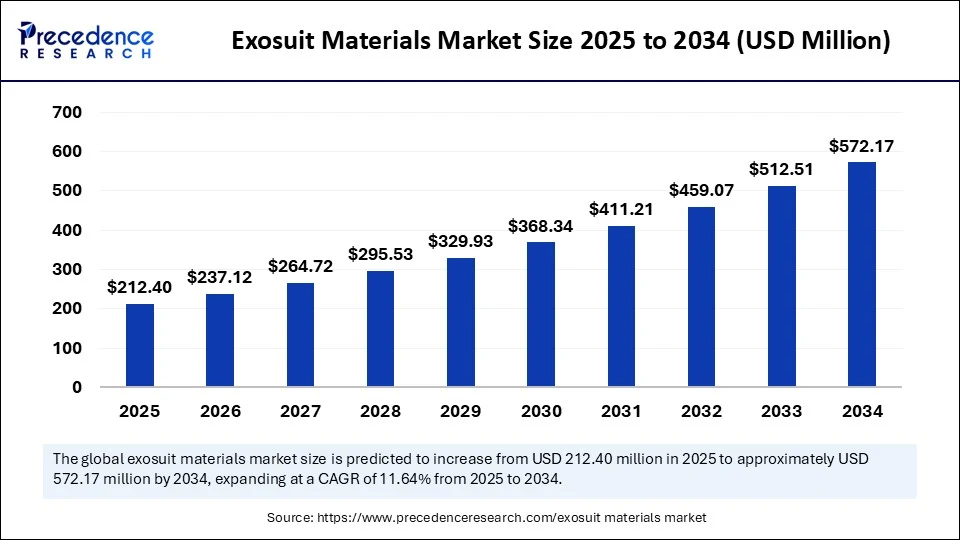
- In 2024, the global exosuit materials market was valued at USD 190.25 million, and it is projected to expand to USD 572.17 million by 2034, reflecting a compound annual growth rate (CAGR) of 11.64% between 2025 and 2034.
- North America held the leading position with a 37% share in 2024, while the Asia Pacific region is expected to experience the most rapid growth during the forecast period.
- Looking at material types, soft and flexible materials captured the largest market share at 45% in 2024, and sensor-integrated materials are expected to register the fastest CAGR in the coming years.
- In terms of suit types, soft exosuits accounted for 53% of the market in 2024, while hybrid designs are projected to grow at the fastest rate.
- The medical and rehabilitation application segment dominated the market with a 49% share in 2024, whereas the industrial/occupational segment is anticipated to expand most rapidly.
- Among end-users, hospitals and rehab centers contributed the highest share at 43% in 2024, while manufacturing companies are expected to grow at the highest CAGR over the forecast period.
What Role Does AI Play in Advanced Exosuit Materials?
Artificial intelligence is revolutionizing the exosuit materials industry by enabling more adaptable, intelligent, and efficient wearable systems. This enhances user comfort, performance, and safety, particularly in rehabilitation and healthcare. AI accelerates material innovation, allowing materials to be pre-designed for specific conditions and optimized for durability, flexibility, and weight. In addition, AI algorithms are used to design and optimize exosuit materials. They can analyze vast datasets to identify the best materials and configurations for specific applications, improving performance and reducing costs.
Get Sample Link@ https://www.precedenceresearch.com/sample/6416
Market Overview
Soft and flexible materials held the largest material‑type share at 45 percent in 2024; sensor‑integrated materials are forecast to grow fastest. Soft exosuits represented 53 percent of market share by suit type, with hybrid designs poised for accelerated growth. In terms of applications, medical and rehabilitation lead with 49 percent share, while industrial and occupational uses are the fastest growing segment.
Among end‑users, hospitals and rehab centers held 43 percent share in 2024; manufacturing companies are expected to post the highest growth. North America led the market in 2024 with 37 percent share, while Asia‑Pacific is projected to be the most dynamic region through 2034.
Key Market Drivers
-
Healthcare demand: Aging populations and rising prevalence of mobility impairments boost adoption of exosuit materials in therapeutic and assistive settings.
-
Workforce safety & efficiency: Industrial sectors are increasingly investing in wearable assistance to reduce injury and improve productivity—driving interest in sensor‑integrated exosuit materials.
-
Smart materials innovation: Integration of flexible sensors, actuators, and adaptive fabrics fuels growth of performance‑enhancing exosuits.
-
Public research funding: Government and institutional support accelerates advances in material science and wearable robotics.
Strategic Opportunities
-
Geographic expansion: Penetration in Asia Pacific and Latin America presents major opportunity—particularly where healthcare access and industrial automation are expanding.
-
New verticals: Military, agriculture, logistics, and sports performance markets are adjacent spaces ripe for soft exosuit material application.
-
Customized product development: Personalization of exosuit materials—through modular, size‑adjustable systems—can distinguish product portfolios.
-
Digital ecosystem integration: Embedding IoT and wearables into exosuit materials unlocks new service models around monitoring, analytics, and remote care.
-
Hybrid material platforms: Development of hybrid soft‑rigid systems combining comfort and mechanical benefit positions companies to lead in the next generation of exosuits.
Challenges to Address
-
Cost barriers: High investment needed for R&D, prototyping, testing, and scaling advanced sensor fabrics and hybrid composites.
-
Regulatory complexity: Navigating medical device, safety equipment, and industry compliance frameworks remains time‑consuming.
-
Technical reliability: Ensuring durability, washability, and long‑term consistency of soft fibers and sensor grids is technically demanding.
-
User behavior: Adoption depends on wearer comfort, ease of use, and cultural acceptance in both healthcare and industrial settings.
-
Systems integration: Merging materials with electronics, power systems, and control units increases engineering complexity and points of potential failure.
Recent Developments & Strategic Moves
-
Launches of smart textile products: Firms have rolled out soft exosuit materials incorporating sensing and actuation for rehabilitation and industrial use.
-
Industrial trials of hybrid designs: Pilot programs are evaluating hybrid exosuits in warehousing and automotive assembly settings to balance support and comfort.
-
Clinical trials & healthcare partnerships: Multiple clinical trials in North America and Europe are assessing soft exosuits for stroke rehabilitation, post‑surgical recovery, and gait restoration—with early evidence of improved outcomes.
-
Regional R&D hubs in Asia: Korea, Japan, China lead in government‑sponsored R&D for low‑cost exosuit materials aimed at eldercare and domestic medical markets.
-
Standardization efforts: Emerging consensus among standards bodies on performance testing protocols for exosuit materials (durability, sensor accuracy, safety).
-
Funding & strategic acquisitions: VCs and wearable robotics firms are investing in startups with proprietary materials, while established companies are acquiring material science innovators to secure supply chain and IP advantage.
Exosuit Materials Market Companies
- DuPont
- Toray Industries
- Hexcel Corporation
- Teijin Limited
- Solvay S.A.
- 3M
- BASF SE
- Arkema
- DSM
- Sabic
- Covestro AG
- Owens Corning
- Parker Hannifin
- Gore Fabrics (Gore-Tex)
- Lubrizol
- Eastman Chemical Company
- E-textiles by Myant Inc.
- StretchSense Ltd.
- Xsens Technologies
- Conductive Composites Co.
Market segment Covered in the Report
By Material Type
- Soft & Flexible Materials
- Textiles (Nylon, Polyester, Kevlar)
- Elastomers (Silicone, TPU, Neoprene)
- Smart Fabrics / E-textiles
- Rigid & Structural Materials
- Carbon Fiber Composites
- High-Strength Aluminum Alloys
- Titanium Alloys
- Engineering Plastics (Polycarbonate, PEEK)
- Sensor-Integrated Materials
- Piezoelectric Materials
- Graphene-based Materials
- Liquid Metal Alloys
- Flexible Printed Circuits (FPCs)
- Energy Storage Materials
- Thin-Film Batteries
- Solid-State Batteries
- Supercapacitor Materials
By Suit Type
- Soft Exosuits
- Fabric-based actuation systems
- Pneumatic / Hydraulic textiles
- Rigid Exoskeletons
- Powered upper/lower body frames
- Passive support structures
- Hybrid Designs
- Mixed soft–rigid architectures
By Application
- Medical & Rehabilitation
- Post-stroke therapy
- Spinal cord injury
- Elderly mobility assistance
- Defense & Military
- Load carriage
- Endurance enhancement
- Injury prevention
- Industrial / Occupational
- Logistics
- Construction
- Assembly lines
- Consumer & Sports
- Mobility aid for the elderly
- Athletic enhancement (early-stage)
By End-User
- Hospitals & Rehabilitation Centers
- Defense Organizations / Military
- Manufacturing Companies
- Construction Firms
- Individuals (Home Care / Personal Use)
By Region
- North America
- Europe
- Asia Pacific
- South America
- Middle East & Africa
Also Read@ https://www.precedenceresearch.com/
