
 by
by The global power SCADA market size is valued to reach around USD 5.65 billion by 2034 from USD 2.75 billion in 2024, with a CAGR of 7.47%
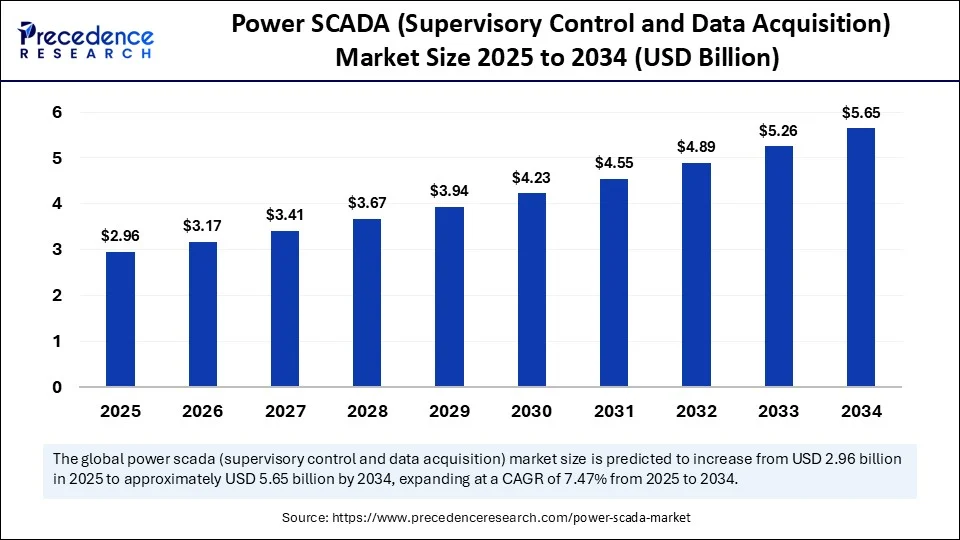
Power SCADA (Supervisory Control and Data Acquisition) Market Key Takeaways
- In terms of revenue, the global power SCADA (Supervisory Control and Data Acquisition) market was valued at USD 2.75 billion in 2024.
- It is projected to reach USD 5.65 billion by 2034.
- The market is expected to grow at a CAGR of 7.47% from 2025 to 2034.
- North America dominated the power SCADA (Supervisory Control and Data Acquisition) market with the largest market share of 42% in 2024.
- Asia Pacific is expected to grow at the fastest CAGR in the upcoming years.
- By component, the hardware segment held the biggest share in 2024.
- By component, the software segment is observed to grow at the fastest CAGR during the forecast period.
- By architecture, the open system architecture (OSA) segment generated the highest market share in 2024.
- By architecture, the closed system architecture segment is expected to grow at the fastest CAGR in the coming years.
- By deployment model, the on-premises segment captured the highest market share in 2024.
- By deployment model, the cloud-based is emerging as the fastest growing segment during the forecast period.
- By end-use industry, the power generation segment generated the major market share in 2024.
- By end-use industry, the non-renewables segment is emerging as the fastest growing.
How does artificial intelligence enhance operational efficiency of power SCADA systems?
Artificial intelligence substantially boosts the operational efficiency of power SCADA systems by enabling advanced data analytics, predictive maintenance, and real-time decision-making. AI models sift through high-volume SCADA data to uncover trends, anomalies, and inefficiencies that traditional monitoring typically misses.
This empowers operators to minimize energy loss across the grid, optimize load distribution, and anticipate equipment failures. Furthermore, AI enables automated control adjustments and dynamic demand forecasting—significantly improving system reliability and responsiveness.
Get Sample Link @https://www.precedenceresearch.com/sample/6341
Market Overview
The global Power SCADA market encompasses integrated systems that provide real‑time monitoring and control of electric power generation, transmission, and distribution infrastructure. These systems include hardware (such as master terminal units, RTUs, PLCs, communication devices and HMIs), software platforms for data acquisition and control, and services for integration and maintenance.
SCADA enables utilities to detect faults, balance loads, reduce downtime, and optimize energy usage across substations and grid networks. Traditional SCADA platforms are undergoing transformation toward modular, standards‑based, cloud‑enabled, and edge‑driven architectures that better address rising complexity. Hardware continues to dominate in revenue terms, but software and cloud platforms are growing rapidly in functionality and adoption.
Key Drivers
-
Grid modernization and infrastructure investment: Aging grid infrastructure globally, especially in North America and Europe, spurs demand for SCADA upgrades to support higher reliability, automation, and integration with renewables. Governments globally are pouring resources into smart grid and digital transformation initiatives.
-
Integration of renewable energy and distributed generation: The fast growth of solar, wind and energy storage, along with microgrids and DERs, requires sophisticated SCADA systems to manage variability, ensure stability and coordinate grid responses.
-
Digitalization, IoT and analytics: SCADA systems are increasingly integrated with IoT sensors and big‑data analytics. This allows predictive maintenance, real‑time fault detection, asset health monitoring and optimization of grid operations.
-
Cybersecurity imperatives: As SCADA systems become more interconnected, utilities face heightened risk of attacks. Regulatory requirements and cyber‑resilience mandates are driving deployment of secure SCADA platforms with intrusion detection, encryption and zero‑trust architecture.
-
Demand growth and operational efficiency needs: Electrification (from EVs, AI data center demand, industrial loads) pushes utilities to adopt SCADA tools that enhance load balancing, reduce losses, and speed up fault response.
Opportunities
-
Shift to cloud‑based and edge‑based SCADA: As traditional SCADA adopts open, modular and cloud‑ready architectures, utilities can benefit from remote access, improved scalability, and lower capital expenditure. Edge computing complements by processing critical data close to field devices.
-
AI and machine learning: Embedding AI into SCADA systems enhances predictive analytics, anomaly detection and dynamic system optimization. This enables self‑healing, demand forecasting, and advanced operational insight.
-
Growth in emerging markets: Regions such as Asia Pacific (especially India and China), Latin America, and the Middle East are aggressively investing in grid infrastructure modernization, substation automation and renewable integration, creating rich opportunity for SCADA adoption.
-
Microgrid and DER orchestration: SCADA offerings tailored for decentralized microgrids and behind‑the‑meter DER coordination represent new product and services niches.
-
Bundled hardware/software service offerings: Vendors that can supply integrated RTU/HMI platforms, communication gateway hardware plus accompanying cloud‑based analytics and managed services can capture more stakeholder value.
Challenges
-
High capital and maintenance costs: The initial setup and integration of SCADA—including securing hardware, software, communications and operator training—can be costly and act as a barrier for smaller utilities or those in developing markets.
-
Cybersecurity vulnerabilities: SCADA systems suffering outdated firmware, insecure protocols, or limited segmentation are prime targets for sophisticated cyberattacks. Protecting critical infrastructure demands constant vigilance.
-
Skills gap: Operating and managing modern SCADA requires specialized IT‑OT expertise, knowledge of protocols (IEC 61850, DNP3, Modbus), and proficiency in cybersecurity and analytics—a shortage in the labor force slows deployment.
-
Legacy systems integration: Utilities with existing analog or closed‑architecture systems face challenges integrating next‑gen SCADA solutions—leading to complex hybrid environments that require careful transition strategies.
-
Regulatory fragmentation: Varying standards across jurisdictions for cybersecurity, data exchange protocols, vendor certification, and cloud usage complicate global product offerings and slow adoption.
Recent Developments
-
Major vendors upgrade platforms: In early 2025, ABB integrated its OmniCore automation platform with SCADA capabilities, featuring AI‑driven analytics for real‑time grid monitoring and improved reliability. Schneider Electric upgraded its EcoStruxure SCADA platform with advanced cybersecurity features, predictive maintenance and renewable energy integration support. Siemens enhanced its MindSphere SCADA with IoT connectivity and real‑time data analytics tailored to smart grid scaling. Honeywell released an updated Experion SCADA system offering cloud‑based monitoring and improved visualization and analytics.
-
Fast‑growing cloud and edge adoption: Utilities across North America and Europe are piloting cloud‑based SCADA deployments, while edge‑computing RTUs are used for latency‑sensitive operations.
-
Regulatory and policy momentum: Governments continue to push policy frameworks favoring SCADA adoption in substations, smart grid rollouts and cybersecurity compliance.
-
Security and zero‑trust strategies: Vendors are embedding zero‑trust security models, multifactor authentication, encryption and network segmentation into SCADA products to counter rising cyber threats.
-
Regional growth in Asia Pacific: Countries like India and China are implementing extensive smart grid pilots in smart‑city frameworks and expanding rural electrification, amplifying demand for SCADA systems to manage distribution networks and DER integration.
Power SCADA Market Companies
- Siemens AG
- ABB Ltd.
- Schneider Electric SE
- General Electric Company
- Emerson Electric Co.
- Eaton Corporation plc
- Mitsubishi Electric Corporation
- Honeywell International Inc.
- Rockwell Automation, Inc.
- Hitachi Energy
- Toshiba Corporation
- Yokogawa Electric Corporation
- Larsen & Toubro Limited
- Open Systems International (OSI)
- Indra Sistemas S.A.
- ETAP (Operation Technology Inc.)
- ZIV Automation
- Ingeteam
- SCADAfence
- Advantech Co., Ltd.
Segments Covered in the Report
By Component
- Hardware
- RTU (Remote Terminal Unit)
- PLC (Programmable Logic Controller)
- HMI (Human-Machine Interface)
- Communication Systems
- Other Control Units
- Software
- Real-Time Monitoring Software
- Energy Management Systems
- Automation and Control Software
- Services
- Consulting
- Integration & Implementation
- Support & Maintenance
- Training & Education
By Architecture
- Open System Architecture (OSA)
- Closed System Architecture
By Deployment Model
- On-Premises
- Cloud-Based
- Hybrid
By End-Use Industry
- Power Generation
- Renewable Power Plants (Solar, Wind, Hydro)
- Non-Renewable (Coal, Nuclear, Gas)
- Transmission
- Distribution
- Oil & Gas
- Utilities
- Metals & Mining
- Transportation
- Manufacturing
- Others (Commercial, Data Centers, etc.)
By Region
- North America
- Europe
- Asia Pacific
- Middle East & Africa
- South America
Also Read@ https://www.precedenceresearch.com
