
 by
by 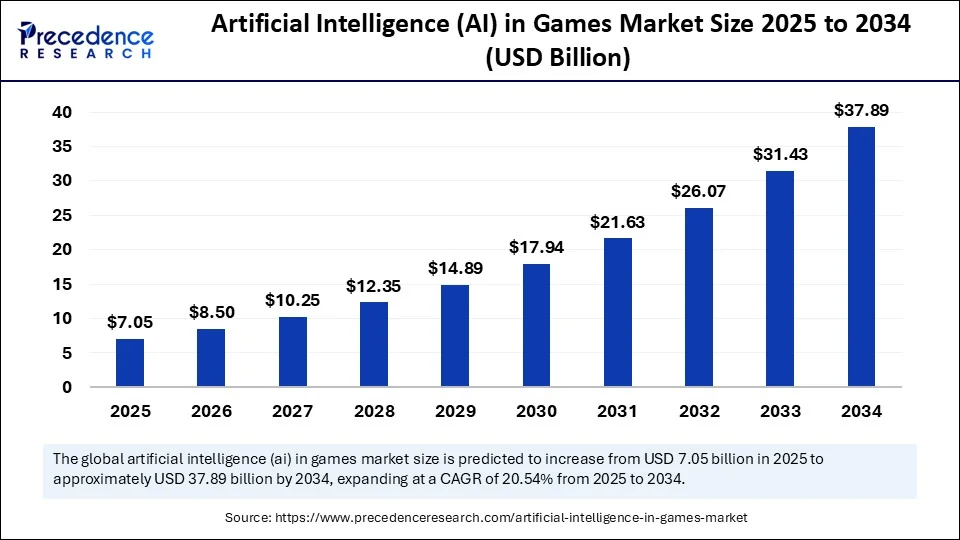
Artificial Intelligence (AI) in Games Market Key Takeaways
- The artificial intelligence (AI) in games market was valued at USD 5.85 billion in 2024 and is projected to reach USD 37.89 billion by 2034, growing at a CAGR of 20.54% from 2025 to 2034.
- North America led the market in 2024, holding the highest share among all regions, while Asia Pacific is anticipated to witness the fastest growth over the forecast period.
- Based on game genre, the action and adventure segment accounted for the largest share in 2024, whereas the simulation segment is expected to register the highest growth rate in the coming years.
- In terms of application, game development and design held the dominant share in 2024, while NPC behavior and character AI are expected to grow most rapidly moving forward.
- By component and technology, the hardware segment—specifically CPUs and GPUs—represented the largest portion of the market in 2024. Meanwhile, the software and middleware segment is set to expand at the fastest rate during the forecast period.
- When segmented by platform or device, mobile gaming on smartphones and tablets contributed the largest share in 2024, while cloud-based, virtual reality (VR), and augmented reality (AR) platforms are forecasted to experience the fastest growth.
-
Among technology types, machine learning and deep learning led in market share in 2024. Generative AI, however, is projected to be the fastest-growing technology segment over the coming years.
Market Overview
The artificial intelligence (AI) in games market is undergoing rapid transformation, fueled by continuous advancements in machine learning, deep learning, and generative technologies. AI is reshaping the gaming landscape by streamlining development workflows, enhancing visual fidelity, and delivering more immersive, responsive gameplay experiences.
One of AI’s most impactful contributions is the creation of intelligent non-player characters (NPCs), adaptive environments, and personalized game narratives. These elements significantly enhance user engagement by making gameplay more dynamic and tailored to individual players. In multiplayer settings, AI is also being used to detect and prevent cheating, ensuring fair and competitive play.
AI-powered automation is accelerating the game development process. From testing and debugging to real-time optimization, AI tools are helping developers reduce production timelines and costs. Emerging technologies such as cloud computing, augmented reality (AR), virtual reality (VR), and generative AI are pushing the boundaries of what’s possible in gaming. AR and VR, in particular, are enabling highly immersive experiences that increasingly blur the line between the digital and physical worlds. Experts suggest that future improvements in computing power and graphics processing units (GPUs) will make virtual environments so realistic that distinguishing them from real-world settings could become challenging.
The impact of AI is also changing the economics of game development. Traditionally, building high-quality games required substantial resources large development teams, specialized hardware, and long production cycles. Today, generative AI and agent-based tools have democratized game creation. With the help of prompt engineering, even individual creators with limited technical backgrounds can build fully functional games. At the same time, professional developers are using these tools to speed up workflows and develop complex gaming experiences more efficiently.
Artificial Intelligence (AI) in Games Market Growth Factors
- The rising demand for personalized gaming experience boosts the growth of the market. AI is revolutionizing gaming by enabling realistic gameplay, dynamic storytelling, and more autonomous NPCs, creating an adaptive and personalized environment for players. Moreover, AI integration in AR and VR enhances immersion, adaptability, and personalization, creating a more realistic gaming experience.
- Advancements in ML, deep learning, and natural language processing provide tools to create more sophisticated AI systems for gaming. These advancements allow for more complex NPC behaviors, improved game environments, and realistic player interactions.
- The growing popularity of online games is likely to support market growth. Integrating AI algorithms into gaming platforms helps analyze player performance, predict outcomes, and create training tools for esports players.
Opportunity
Generative AI Unlocking New Frontiers in Game Development
Generative AI is opening up transformative possibilities in the gaming industry by enabling the creation of limitless, dynamic game worlds. This technology facilitates the real-time generation of game content, delivering personalized experiences tailored to individual player behavior while streamlining development workflows. As a result, it enhances player engagement, reduces production costs, and supports the development of more immersive and adaptive gaming environments.
With generative AI, procedural content can be uniquely generated, allowing games to evolve dynamically based on player input. Gameplay difficulty can be adjusted in real time by analyzing user patterns, while non-player characters (NPCs) can exhibit context-aware, responsive behavior. Storylines can also adapt intelligently to reflect individual player interests, creating more engaging and emotionally resonant narratives.
In addition to enhancing gameplay, generative AI significantly improves the development process. It can accelerate coding tasks, automate testing, and quickly detect and resolve bugs, ultimately shortening development cycles and reducing overhead. By integrating AI across both creative and technical stages, game developers can build richer, more complex gaming experiences with greater efficiency than ever before.
Recent Developments
- In July 2025, Dell Technologies expanded its consumer and gaming portfolio in India with the launch of its new Dell Plus AI PC range and Alienware Area-51 and Aurora gaming laptops. This launch underlines Dell’s focus on delivering powerful performance, immersive experiences, and next-generation AI capabilities to Indian users.
- In November 2024, Elon Musk announced the creation of an AI-powered games studio, which will revolutionize the gaming industry. As per the initiative taken by Musk, it will leverage cutting-edge AI to develop innovative games to challenge current industry norms.
Artificial Intelligence (AI) in Games Market Top Companies
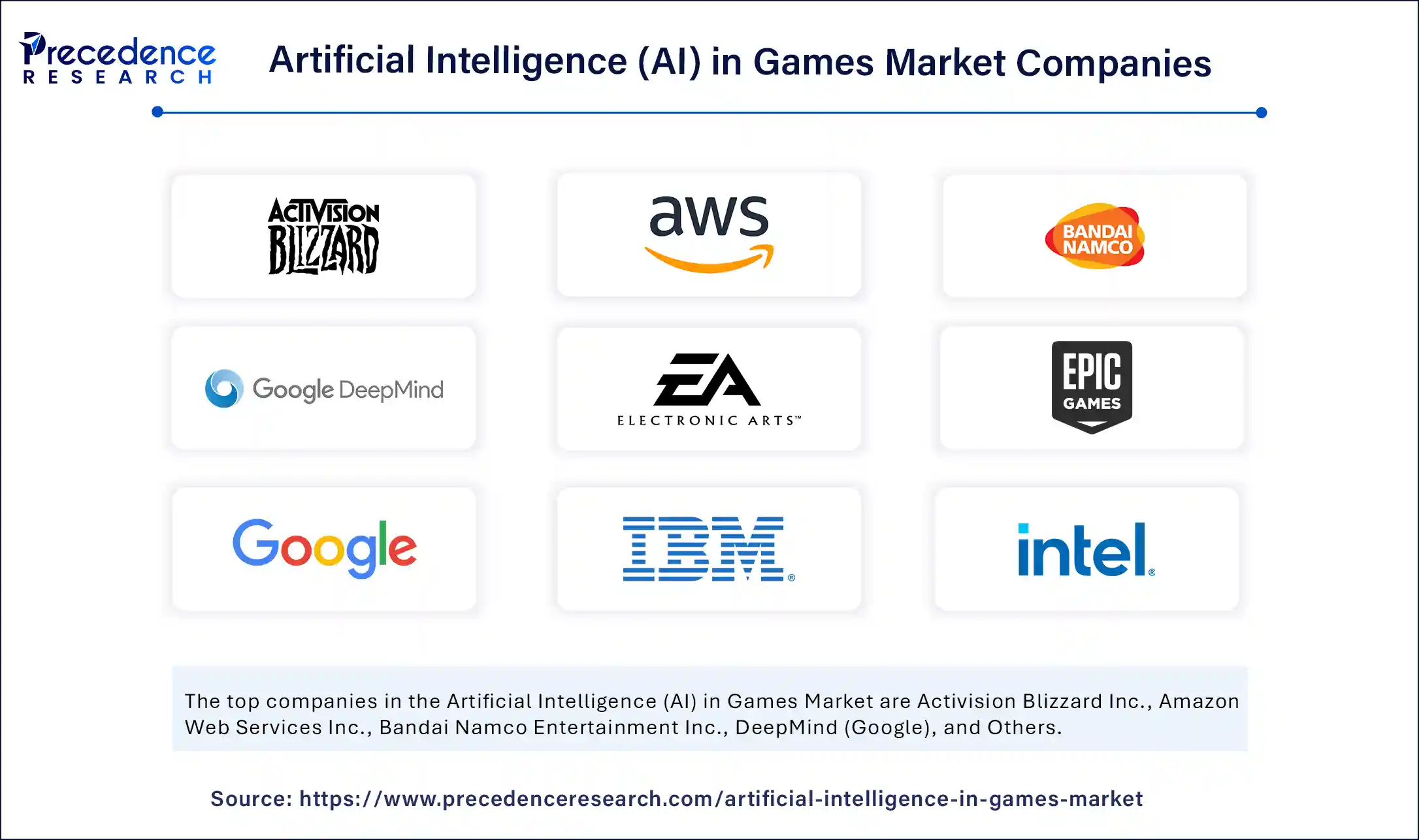
- Activision Blizzard Inc.
- Amazon Web Services Inc.
- Bandai Namco Entertainment Inc.
- DeepMind (Google)
- Electronic Arts Inc.
- Epic Games Inc.
- Google LLC
- IBM Corporation
- Intel Corporation
- Microsoft Corporation
- NetEase Inc.
- Niantic Inc.
- NVIDIA Corporation
- Sony Interactive Entertainment
- Square Enix Holdings Co. Ltd.
- Supercell Oy
- Take-Two Interactive Software Inc.
- Tencent Holdings Limited
- Ubisoft Entertainment SA
- Unity Technologies
Also Read: Artificial Intelligence Robots Market
