
 by
by The global smart pole market size is valued to reach around USD 46.92 billion by 2034 increasing from USD 11.76 billion in 2024, with a CAGR of 14.84%.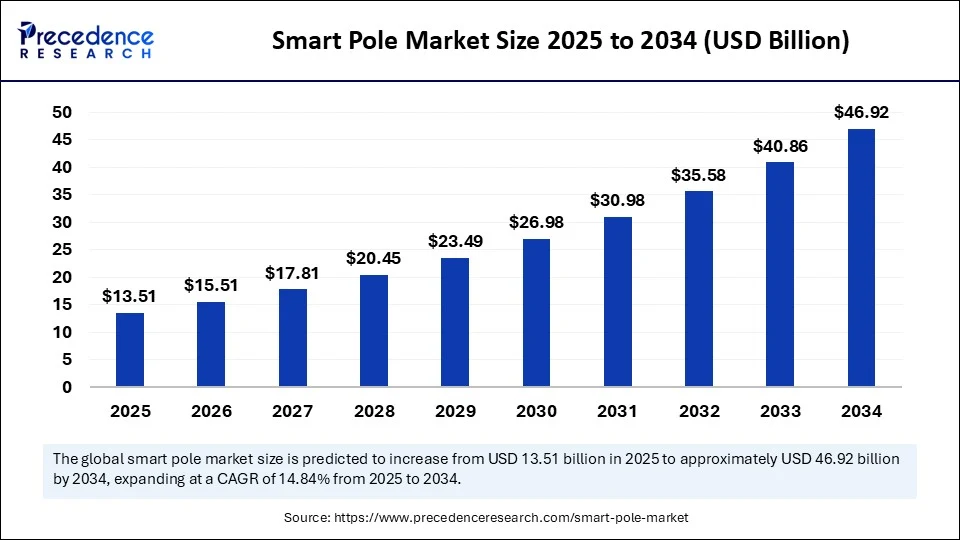
Smart Pole Market Key Takeaways
- In terms of revenue, the global smart pole market was valued at USD 11.76 billion in 2024.
- It is projected to reach USD 46.92 billion by 2034.
- The market is expected to grow at a CAGR of 14.84% from 2025 to 2034.
- North America dominated the largest smart pole market share of 34% in 2024.
- Asia Pacific is expected to grow at the fastest CAGR of 20.8% during the foreseeable period.
- By offering, the hardware segment accounted for the biggest market share in 2024.
- By offering, the software segment is expected to grow at the fastest CAGR of 22% during the foreseeable period.
- By installation type, the retrofit segment contributed for the highest market share in 2024.
- By installation type, the new installation segment is expected to grow at the fastest CAGR during the foreseeable period.
- By application, the highways and roadways segment captured the remarkable market share in 2024.
- By application, the public places segment is expected to grow at the fastest CAGR of 20% during the foreseeable period.
- By connectivity tech, the cellular (4G/5G/NBIoT) segment accounted for the largest market share in 2024 and expected to sustain its position during the foreseeable period.
- By material, the metallic segment generated the major market share of share in 2024.
- By material, the composite segment is expected to grow at the fastest CAGR of 21% during the foreseeable period of 2025-2034.
How is AI Transforming the Smart Pole Market?
The integration of AI with smart poles is reshaping city planning by enabling predictive traffic management, adaptive lighting, and real-time surveillance. AI can analyze historical and live traffic data to identify potential congestion and recommend alternative routes to maintain smooth traffic flow. It also optimizes energy use by adjusting LED lighting levels based on real-time pedestrian and vehicle activity, reducing unnecessary consumption and light pollution while enhancing urban safety through intelligent threat detection.
Market Overview
The global smart pole market has been witnessing rapid acceleration, evolving from traditional street‑lighting and traffic‑control installations into multifunctional, intelligent infrastructure anchors. Smart poles integrate LED lighting with advanced technologies such as IoT sensors, 5G small cells, Wi‑Fi access points, environmental monitoring devices, surveillance cameras, EV chargers, digital signage, and more.
While early deployments were modest pilot projects in smart city initiatives, the market today spans municipal, campus, commercial, and industrial ecosystems. Annual global revenues have surged into the billions, with strong compound annual growth rates driven by urban modernization strategies, sustainability goals, and telecom densification.
Mature markets in North America, Europe, and parts of Asia‑Pacific led early adoption, but accelerating implementations in Latin America, the Middle East, and Africa are now fueling broader global penetration. Small‑ and mid‑sized cities are increasingly recognizing smart poles not just as lighting fixtures but as digital infrastructure platforms capable of delivering connectivity, analytics, and public value in a consolidated footprint.
Get Sample@ https://www.precedenceresearch.com/sample/6419
2. Market Drivers
-
Smart city strategies and urban modernization: Cities around the world are embedding smart pole installations within their wider digital transformation efforts, aiming to improve energy efficiency, public safety, connectivity and service delivery. Smart poles are seen as high‑visibility, multifunctional enablers that align with sustainability and resilience goals.
-
Need for connectivity densification: With 5G and emerging IoT networks, there is intense demand for edge sites and low‑latency access points. Smart poles provide ideal real‑estate for hosting small cells, Wi‑Fi, and cellular repeaters, helping carriers and municipalities meet coverage and capacity requirements without heavy civil works.
-
Energy savings and efficiency: Many smart poles employ intelligent LED lighting with adaptive dimming, motion‑triggered illumination, and solar or battery power – reducing operational energy usage and maintenance costs significantly versus traditional street lights. Municipalities motivated by cost savings and ESG mandates find these benefits compelling.
-
Safety and analytics: Built‑in sensors and surveillance systems support traffic monitoring, environmental data collection (air quality, noise, temperature), and public safety incident detection. These analytics help city managers monitor congestion, pollution hotspots, and vulnerabilities in real time.
-
Revenue‑generating capabilities: Digital signage, EV charging stations, Wi‑Fi monetization, and advertising options create new revenue streams for municipalities or service providers using the poles. Monetization of digital display space—especially in high‑foot‑traffic urban areas—helps offset deployment costs.
3. Market Opportunities
-
Integration with EV charging infrastructure: As electric vehicle adoption increases, smart poles with built‑in or attachable EV charging points represent a significant opportunity. Urban planners can leverage existing street pole infrastructure to host charging kiosks in residential and commercial zones, lowering installation barriers.
-
Roll‑out of smart lighting as retrofits: Many cities have aging lampposts that can be retrofitted with smart pole modules and IoT add‑ons rather than replaced entirely. Retrofit opportunities are abundant in older urban areas, offering cost‑effective modernization with minimal disruption.
-
Public–private partnerships and as‑a‑service models: Capex costs of deploying smart poles are significant. Innovative financing through public–private partnerships, concession models, or Infrastructure‑as‑a‑Service offerings allow municipalities to roll out systems without large upfront budgets. Vendors are increasingly providing hardware, connectivity, management software, analytics and ongoing maintenance in bundled offerings.
-
Edge computing and AI-enabled services: Next‑generation smart poles will host edge compute nodes, running AI algorithms for video analytics (e.g. object detection, traffic flow optimization, crowd counting). This opens avenues for services in smart policing, traffic violation detection, city planning analytics, and local advertising based on real‑time footfall.
-
Multi‑domain utility convergence: There is potential to co‑locate multiple utility services in smart pole structures—like public Wi‑Fi, EV charging, air‑quality sensors, weather stations, etc.—creating convergence platforms. Municipalities seeking to maximize return on street infrastructure footprint see consolidation as efficient and future‑proof.
4. Market Challenges
-
High upfront capital and long ROI cycles: Initial costs of smart pole hardware, integration, software, connectivity, installation, and commissioning remain obstacles—particularly for smaller cities or developing markets. Return on investment can span multiple years, which may deter budget‑constrained authorities.
-
Complex integration and interoperability issues: Smart poles combine technologies from various vendors (lighting, telecom, sensors, software). Integration architecture, communication protocols, and system interoperability present technical challenges, often requiring customization and long deployment cycles.
-
Maintenance and operational overhead: Smart poles require ongoing monitoring, firmware/software updates, sensor calibration, and physical maintenance of diverse hardware elements. Ensuring reliable long‑term performance demands comprehensive asset management systems and technical support capabilities.
-
Privacy, data governance, and public acceptance: Video surveillance, environmental monitoring, and Wi‑Fi tracking generate citizen concerns over data collection and privacy. Cities must navigate public‐policy frameworks, comply with regulations (e.g. GDPR in Europe), and implement robust governance mechanisms to ensure ethical use of citizen data.
-
Physical and regulatory constraints: Locating smart poles in dense urban areas may face regulatory hurdles (rights of way, heritage zones, aesthetic restrictions), especially where street furniture is tightly controlled. Municipal approvals, public consultations, and local bylaws may slow deployments.
5. Recent Developments
-
Major city‑wide deployments: In 2024 and 2025, several major metros globally have announced comprehensive smart pole rollouts. These include large deployments of poles integrating 5G small cell kits with LED lighting and multiple sensor modalities in city centers, transit corridors, and public parks.
-
Partnerships with telecom providers: Smart pole manufacturers have signed multi‑city contracts with telecom operators to co‑install 5G small cells and Wi‑Fi nodes on smart poles. These telco‑municipality alliances reduce infrastructure overlap and share revenue streams.
-
Technological enhancements: Vendors are introducing next‑generation pole units featuring edge AI modules, solar‑backed energy storage, modular sensor bays, dynamic digital signage with touchscreen interactivity, and biometric access features for limited applications.
-
Retrofit kits gaining traction: Adoption of retrofit smart‑pole kits, designed to attach to existing lamppost bases, has surged especially in European mid‑sized cities. This approach cuts civil works costs and speeds deployment.
-
Focus on sustainability and net‑zero alignment: Smart pole solutions are increasingly designed with sustainable materials, carbon‑footprint tracking, recycled plastics, and integration with renewable energy generation (e.g. solar panels, micro wind turbines), aligning with cities’ net‑zero pledges.
-
Pilot‑to‑scale transitions: Cities that ran early pilots now scaling up from dozens to hundreds or thousands of smart pole installations based on positive trial outcomes. Some deployments now include analytics dashboards for traffic and air‑quality data, with APIs open for third‑party developers to build services.
Smart Pole Market Companies
- Acuity Brands Lighting
- American Tower Corporation
- Bivocom
- Cree Inc.
- Efftronics Systems
- ELKO EP
- GE (General Electric)
- HUB Group
- iRam Technologies
- Kesslec
- Lumca Inc.
- Mobile Pro Systems
- Norsk Hydro ASA
- Signify Holding
- Shanghai Sansi Electronic Engineering
- Siemens AG
- Sunna Design
- Telensa Limited
- Wipro Lighting
- Zumtobel Group
Segments Covered in the Report
By Offerings
- Hardware (poles, luminaires, sensor modules, communication devices, controllers)
- Software (management, analytics platforms)
- Services (installation, maintenance)
By Installation Type
- New Installation
- Retrofit Installation
By Application
- Highways & Roadways
- Public Places (parks, plazas)
- Railways & Harbors
By Connectivity Technology
- Cellular (4G/5G/NBIoT)
- Wi-Fi, Zigbee, Bluetooth, Fiber, PLC
By Material
- Metallic (steel, aluminum)
- Composite (emerging lightweight materials)
By Region
- North America
- Europe
- Asia Pacific
- Latin America
- Middle East & Africa
Also Read: https://www.precedenceresearch.com/
