
March 6, 2026

Aluminum Silicon Carbide Market Size to Hit USD 1,366.89 Mn by 2034

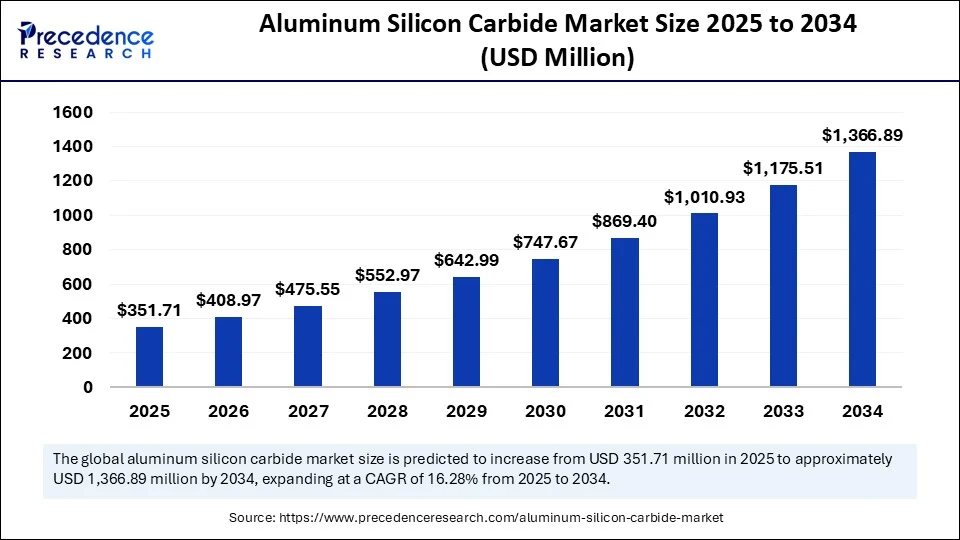
The global aluminum silicon carbide market size was evaluated at USD 302.47 million in 2024 and is predicted to hit around USD 1,366.89 million by 2034, growing at a CAGR of 16.28%.
Aluminum Silicon Carbide Market Size 2025 to 2034

Aluminum Silicon Carbide Market Key Takeaways

  • In terms of revenue, the global aluminum silicon carbide market was valued at USD 302.47 million in 2024.
  • It is projected to reach USD 1,366.89 million by 2034.
  • The market is expected to grow at a CAGR of 16.28% from 2025 to 2034.
  • Asia Pacific dominated the aluminum silicon carbide market with the largest market share of 41% in 2024.
  • North America is expected to grow at a notable CAGR between 2025 and 2034.
  • By product type, the Al-SiC with medium SiC content (31–60%) segment held the biggest market share of 48% in 2024.
  • By product type, the Al-SiC with high SiC content (>60%) segment is observed to grow at the fastest CAGR during the forecast period.
  • By matrix type, the aluminum alloy matrix segment captured the highest market share of 63% in 2024.
  • By matrix type, the pure aluminum matrix segment is expected to grow at the fastest CAGR in the upcoming period.
  • By SiC particle size, the micro-sized (1-100µm) segment contributed the major market share of 60% in 2024.
  • By SiC particle size type, the nano-sized (<1 µm) segment is emerging as the fastest-growing during the forecast period.
  • By manufacturing process, the stir casting segment generated the biggest market share of 35% in 2024.
  • By manufacturing process, the additive manufacturing segment is expected to grow at the fastest CAGR during the forecast period.
  • By application, the thermal management segment held the largest share of 30% in 2024
  • By application, the electronics segment is observed to grow at the fastest rate during the forecast period.
  • By end use industry, the electronics & semiconductors segment accounted for significant market share of 38% in 2024.
  • By end user, the aerospace and defense segment is emerging as the fastest growing during forecast period.
How Artificial Intelligence Is Revolutionizing Aluminum Silicon Carbide (Al-SiC) Manufacturing

Artificial intelligence (AI) is transforming the aluminum silicon carbide (Al-SiC) manufacturing process by enhancing precision, efficiency, and quality control. AI systems optimize key production parameters such as temperature, pressure, and SiC distribution during casting and infiltration to ensure consistent material properties and minimize defects. Machine vision combined with deep learning enables real-time detection of cracks, porosity, and structural flaws, significantly reducing waste and improving overall product reliability.

In addition, AI-driven generative design and simulation tools are accelerating the development of customized Al-SiC composites for high-performance applications in electric vehicles and aerospace. Predictive maintenance technologies powered by AI are also helping manufacturers prevent equipment failures, reduce downtime, and lower operational costs. By improving energy efficiency and minimizing material waste, AI is driving both economic and environmental advancements in the Al-SiC manufacturing value chain.

Market Overview

Aluminum silicon carbide (Al-SiC) is a metal matrix composite (MMC) composed of silicon carbide (SiC) particles reinforced in an aluminium matrix. It offers high thermal conductivity, a low coefficient of thermal expansion, a superior strength-to-weight ratio, and excellent wear resistance. This material is widely used in thermal management, aerospace, defence, electronics packaging, automotive, and industrial machinery.

Aluminum Silicon Carbide Market Growth Factors

The growing demand for energy-efficient electronics is a major driver of the aluminum silicon carbide market, as spintronic technologies known for their low power consumption are increasingly used in portable and battery-operated devices. The rapid expansion of cloud computing and big data is also fueling the need for high-speed, high-density memory solutions like MRAM, where Al-SiC components play a crucial role.

Advancements in materials science, particularly in the understanding of magnetic materials and spin dynamics, are accelerating innovation and product development. Moreover, spintronics is becoming essential in next-generation computing applications such as neuromorphic and quantum computing, thanks to its non-volatility and fast-switching capabilities. Strong research and development support from governments and private sectors is further boosting the market, as efforts intensify to commercialize advanced spintronic devices.

Opportunities

Rising Demand for Thermal and Structural Components in EVs

The global surge in electric vehicle (EV) production is driving the need for advanced materials that can withstand intense thermal and mechanical stress while remaining lightweight. Aluminum Silicon Carbide (Al-SiC) is emerging as an ideal solution for key EV components such as battery enclosures, inverters, and power control units. Its excellent thermal conductivity and structural rigidity support battery longevity and overall thermal management. As automakers continue to innovate in battery efficiency and vehicle performance, Al-SiC presents a strong opportunity for material suppliers to secure long-term positions in EV manufacturing supply chains.

Adoption in 5G Infrastructure and RF Technologies

With the rapid rollout of 5G networks and high-frequency telecom systems, there is growing demand for materials that offer both electrical insulation and high thermal reliability. Al-SiC is well-suited for use in RF modules, microwave systems, satellite components, antennas, and base stations. Its ability to effectively dissipate heat while maintaining dimensional stability ensures enhanced signal quality and longer device lifespan. As global telecom infrastructure expands, Al-SiC is positioned to become a go-to material for next-generation communication technologies.

Recent Developments

  • On 13 December 2024, the U.S. Commerce Department & Bosch announced a preliminary agreement to provide $225 million in subsidies supporting bosh planned SiC chip manufacturing facility in California. This investment will augment U.S. SiC semiconductor capacity, bolstering future AI SiC substrate and thermal management supply chains.
  • On 5 December 2024, Mersen delayed its financial growth targets by two years, citing a temporary slowdown in EV and SiC semiconductor demand. This slowdown affects materials supply chains including AI-SiC compacities for power electronics.

Aluminum Silicon Carbide Market Key Players

Aluminum Silicon Carbide Market Companies
  • Materion Corporation
  • CPS Technologies Corp.
  • DWA Aluminum Composites
  • CeramTec GmbH
  • Surmet Corporation
  • Denka Company Limited
  • Showa Denko Materials Co., Ltd.
  • Schunk Group
  • Ferrotec Holdings Corporation
  • Morgan Advanced Materials
  • Toyo Tanso Co., Ltd.
  • 3M Advanced Materials
  • Treibacher Industrie AG
  • Mitsubishi Materials Corporation
  • Alvant Ltd
  • Hitemco
  • PLANSEE SE
  • BAE Systems (Advanced Materials Division)
  • Ametek Specialty Metal Products
  • Advanced Composite Materials LLC

Neha bidwe

Specializes in creating search-optimized, high-quality digital content that enhances organic reach and audience engagement. Experienced in keyword research, SEO strategy, and industry-focused writing, helping organizations strengthen their online visibility through effective and informative content.

View all posts by Neha bidwe →