
 by
by 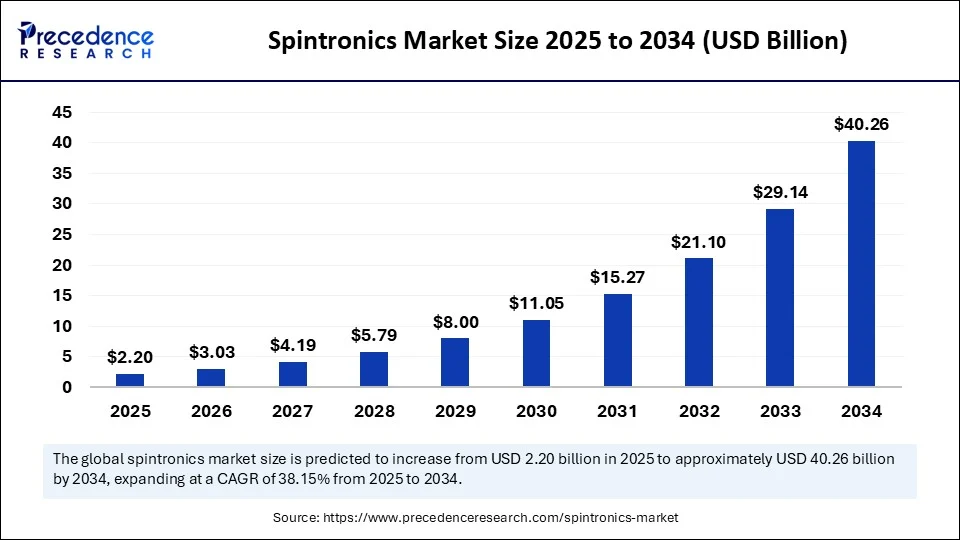
Spintronics Market Key Takeaways
- In terms of revenue, the global spintronics market was valued at USD 1.59 billion in 2024.
- It is projected to reach USD 40.26 billion by 2034.
- The market is expected to grow at a CAGR of 38.15% from 2025 to 2034
- Asia Pacific dominated the spintronics market with the largest share of 46% in 2024.
- North America is expected to grow at a notable CAGR in the coming years.
- By device type, the metal-based devices segment dominated the market, under which the tunnel magneto resistance (TMR) sub-segment held the largest share of 38% in 2024.
- By device type, the semiconductor-based devices segment is expected to grow at the fastest rate, under which the spin field effect transistors (Spin-FETs) segment is leading the charge.
- By application, the memory devices segment led the market, under which MRAM sub-segment held the largest share of 42% in 2024.
- By application, the logic devices segment is expected to grow at the fastest CAGR, under which the spin logic gates sub-segment is expected to lead the charge in the coming years.
- By material, the ferromagnetic materials segment held the largest market share of 35% in 2024.
- By material, the graphene and 2D materials segment is emerging as the fastest growing.
- By end user, the consumer electronics segment captured the biggest market share of 33% in 2024.
- By end user, the automotive segment is expected to grow at the fastest CAGR during the forecast period.
How Artificial Intelligence is Transforming the Spintronics Market
Artificial Intelligence (AI) is playing a pivotal role in revolutionizing the spintronics market by accelerating innovation, enhancing design processes, and improving device performance. Through machine learning, AI can analyze vast datasets to identify materials with optimal spintronic properties, significantly reducing the reliance on traditional trial-and-error methods. It enhances simulation accuracy and enables faster, more cost-effective prototyping. In advanced applications like neuromorphic computing, AI boosts the adaptability and efficiency of spintronic devices through real-time learning. Moreover, AI is driving breakthroughs in emerging spintronic technologies, including quantum computing, next-generation sensors, and non-volatile memory. By streamlining experimentation and enabling intelligent design, AI is not only shortening development cycles but also paving the way for the next generation of spintronic innovations.
Market Overview
Spintronics, or spin-based electronics, is a cutting-edge field that utilizes the intrinsic spin of electrons along with their magnetic moment in addition to their charge, to develop advanced solid-state devices. Unlike conventional electronics that depend solely on electron charge, spintronics harnesses both charge and spin, enabling benefits such as non-volatile data storage, faster processing speeds, and lower power consumption. The spintronics market is centered around key devices like magnetic sensors, spin-transfer torque memory (STT-MRAM), and spin diodes. These technologies are increasingly being adopted across diverse sectors, including data centers, automotive, consumer electronics, and industrial applications, owing to their superior performance and energy efficiency.
Spintronics Market Growth Factors
- Energy Efficiency: Spintronic devices consume less power, making them ideal for modern, low-energy electronics.
- Data Storage Demand: The growing need for fast, non-volatile memory, such as MRAM, is boosting its adoption.
- Automotive Applications: Used in EVs and ADAS for reliable sensing and performance.
- R&D Investments: Increased funding in nanotech and quantum tech is accelerating innovation.
- Semiconductor Integration: Compatibility with CMOS is driving the development of new processor designs.
Opportunities
Growing Adoption of MRAM for Data Centers and AI Workloads
Magneto-Resistive Random-Access Memory (MRAM) offers fast, non-volatile, and energy-efficient data storage, making it an ideal solution for the evolving demands of AI and machine learning workloads. As these workloads become more data-intensive, MRAM’s ability to reduce latency and power consumption is attracting significant interest from data centers. Its durability and performance under continuous operation make it particularly suitable for high-performance computing environments, where reliability and energy efficiency are critical.
Expansion into Flexible and Wearable Electronics
Advancements in flexible materials are enabling the integration of spintronic memory and sensors into bendable and wearable electronics. This creates new opportunities in areas such as smart textiles, flexible displays, and health-monitoring wearables. With its low power consumption and robust durability, spintronics is well-suited for real-time, continuous monitoring applications. As the demand for compact and efficient wearable technologies grows, spintronics is poised to become a key enabler in the next generation of smart and flexible electronics.
Recent Developments
- On 5 July 2025, Renesas announced that it launched its RA8P1 AI MCU, integrating 1Mb embedded MRAM, targeting edge AI and real-time analytics applications built on TSMC’s 22 nm process.
- On 12 June 2025, A Danish-German research team launched a major quantum spintronics project to develop foundational tech for the future quantum internet, marking a significant leap in the field.
- On 17 January 2025, University of Utah & UC Irvine announced the discovery of a novel anomalous Hall torque, a new spin-orbit torque mechanism that enables advanced neuromorphic and spin-based computing.
Spintronics Market Companies
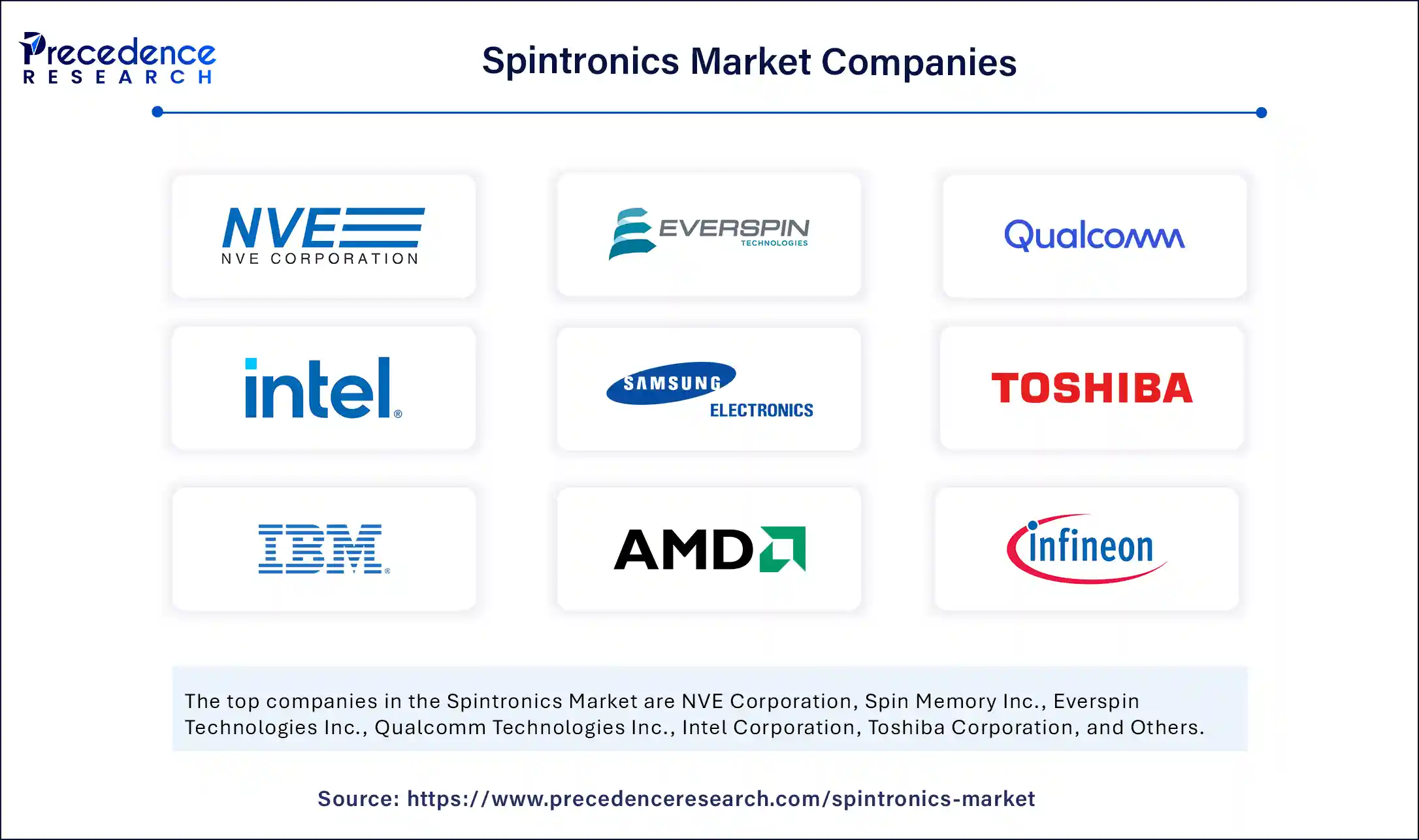
- NVE Corporation
- Spin Memory Inc.
- Everspin Technologies Inc.
- Qualcomm Technologies Inc.
- Intel Corporation
- Samsung Electronics Co. Ltd.
- Toshiba Corporation
- IBM Corporation
- Advanced Micro Devices Inc. (AMD)
- Infineon Technologies AG
- STMicroelectronics N.V.
- Honeywell International Inc.
- Applied Spintronics Technology, Inc.
- SK hynix Inc.
- Micron Technology, Inc.
- Renesas Electronics Corporation
- Hitachi Ltd.
- Canon Inc.
- Fujitsu Ltd.
- Western Digital Technologies, Inc.
