
 by
by 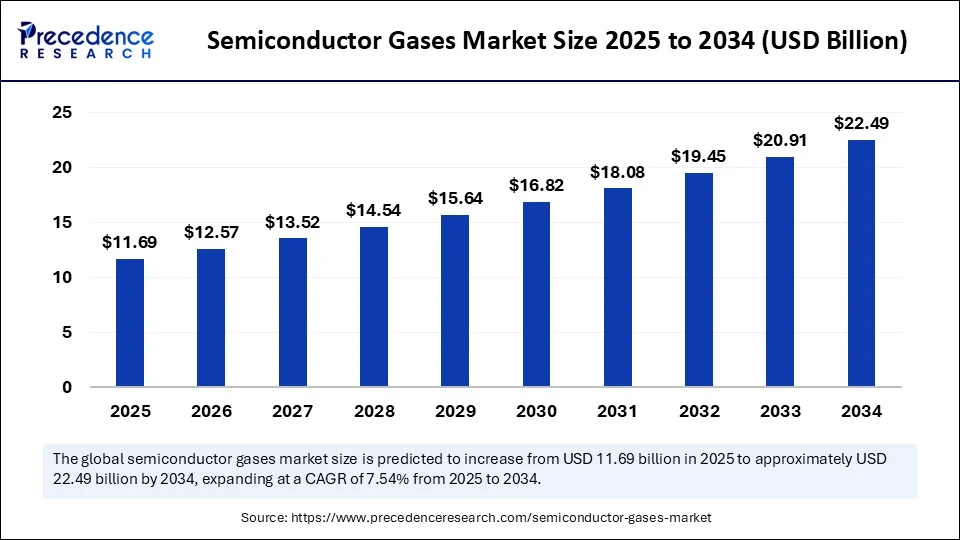
Semiconductor Gases Market Key Takeaways
- In terms of revenue, the global semiconductor gases market was valued at USD 10.87 billion in 2024.
- It is projected to reach USD 22.49 billion by 2034.
- The market is expected to grow at a CAGR of 7.54% from 2025 to 2034.
- Asia Pacific dominated the semiconductor gases market with the largest share of 45% in 2024.
- North America is expected to expand at the fastest CAGR between 2025 and 2034.
- By type of gas, the specialty gases segment held the biggest market of 35% in 2024.
- By type of gas, the etching gases segment is expected to grow at a remarkable CAGR between 2025 and 2034.
- By end-use application, the semiconductor manufacturing segment captured the highest market share of 40% in 2024.
- By end-use application, the solar cells manufacturing segment is expected to grow at a notable CAGR between 2025 and 2034.
- By delivery mode, the cylinder and liquid segment contributed the biggest market share of 50% in 2024.
- By delivery mode, the on-site gas generation segment is expected to grow at a remarkable CAGR between 2025 and 2034.
- By gas phase, the gas phase gases segment generated the major market share of 55% in 2024.
- By gas phase, the liquid phase gases segment is expected to grow at the fastest CAGR between 2025 and 2034.
- By purity level, the ultra-high purity (UHP) segment accounted for the significant market share of 60% in 2024,
- By purity level type, the high purity gases segment is expected to grow at the fastest CAGR between 2025 and 2034.
Impact of AI on the Semiconductor Gases Market
Artificial Intelligence (AI) is transforming the semiconductor gases market by driving improvements in efficiency, quality, and sustainability. AI technologies are optimizing gas production processes, reducing energy consumption, and minimizing material waste. In semiconductor fabrication, AI-powered analytics enable precise control over gas usage, improving yield rates and lowering operational costs. Machine learning algorithms play a key role in real-time impurity detection, ensuring higher product purity and minimizing production downtime. Furthermore, AI enhances supply chain management by forecasting demand trends and identifying potential logistical disruptions. As chip architectures become increasingly complex, AI also supports the simulation of gas behavior at the nanoscale, enabling better process control. Together, these advancements are paving the way for more sustainable and cost-effective semiconductor manufacturing.
Market Overview
The semiconductor gases market encompasses a range of high-purity specialty gases essential to semiconductor manufacturing an industry foundational to modern electronic devices. These gases are integral to critical fabrication processes such as deposition, etching, ion implantation, and chamber cleaning. Common applications include chemical vapor deposition (CVD), plasma etching, and oxidation, where precision and purity of gases directly impact the yield, performance, and reliability of semiconductor components.
The market is witnessing strong growth, fueled by increasing demand for consumer electronics, electric vehicles, and the global rollout of 5G infrastructure. Key gases such as silane, nitrogen trifluoride, and hydrogen are vital for producing advanced memory chips and processors. As manufacturers strive for smaller process nodes and higher transistor densities, the demand for ultra-high-purity gases is surging. Significant investments from both governments and private players in semiconductor fabrication facilities are further accelerating market expansion. Growth is particularly pronounced in regions with high concentrations of foundries, while evolving regulatory standards around gas purity and emissions are reshaping the competitive dynamics of the industry.
Semiconductor Gases Market Growth Factors
- Rising Adoption of EUV Lithography: The increasing implementation of extreme ultraviolet (EUV) lithography in advanced chip production is driving demand for high-purity specialty gases critical to this process.
- Demand for Eco-Friendly, Low-GWP Gases: Growing environmental concerns and regulatory pressures are fueling the adoption of gases with lower global warming potential (GWP), further accelerating market growth.
- Investments in Localized Chip Manufacturing: Governments and private players are investing heavily in domestic semiconductor fabs, particularly in Asia, North America, and Europe, driving demand for process gases.
- Automation and IoT Integration in Fabs: Smart manufacturing technologies, including IoT-based monitoring and automation, are enhancing gas usage efficiency and real-time flow control in fabrication facilities.
- Surging Demand for Logic and Memory Chips: Rapid growth in AI, IoT devices, and automotive electronics is increasing the need for advanced semiconductors, in turn boosting the consumption of specialty gases.
- Strategic Partnerships: Collaborations and long-term supply agreements between gas providers and semiconductor manufacturers are reinforcing market stability and enabling capacity expansion.
Opportunities
Meeting Specific Fabrication Needs
The semiconductor gases market is ripe with opportunities for innovation and strategic growth. With increasing global investment in localized semiconductor manufacturing, suppliers have the chance to deliver high-purity gases tailored to the precise requirements of advanced fabrication processes. The accelerating push toward sustainability further opens doors for the development of eco-friendly gases with low global warming potential (GWP), aligning with evolving environmental regulations.
Rapid industrial expansion in emerging regions—particularly across the Asia Pacific—has led to a surge in new semiconductor fabrication facilities, creating a robust demand for reliable and specialized gas solutions. Moreover, the integration of automation, IoT, and AI within fabs is paving the way for smart gas monitoring and delivery systems, significantly improving process control and operational efficiency.
Collaborations between gas producers and semiconductor manufacturers are also emerging as a key growth driver, fostering the co-creation of next-generation materials and technologies that support the continued evolution of the semiconductor industry.
Semiconductor Gases Market Key Players
- Air Products and Chemicals Inc.
- Linde plc
- Praxair (now part of Linde)
- Messer Group GmbH
- Taiyo Nippon Sanso Corporation
- Air Liquide S.A.
- Tessenderlo Group
- BASF SE
- The Linde Group
- Honeywell International
- Sumitomo Seika Chemicals Co.
- Kanto Denka Kogyo Co., Ltd.
- Matheson Tri-Gas Inc.
- Mitsubishi Gas Chemical Company, Inc.
- Fujifilm Corporation
- Samsung Electronics Co. Ltd.
- LG Chem Ltd.
- Kureha Corporation
- Nihon Inorganic Chemical Co. Ltd.
- Shandong Linyi Gaoxin Gas Co. Ltd.
Segments Covered in the Report
By Type of Gas
- Specialty Gases
- Nitrogen (Nâ‚‚)
- Argon (Ar)
- Hydrogen (Hâ‚‚)
- Oxygen (Oâ‚‚)
- Carbon Dioxide (COâ‚‚)
- Acetylene (Câ‚‚Hâ‚‚)
- Precursors
- Silane (SiHâ‚„)
- Ammonia (NH₃)
- Trifluoromethane (CHF₃)
- Tetramethylsilane (TMS)
- Trichlorosilane (TCS)
- Etching Gases
- Hydrogen Chloride (HCl)
- Chlorine (Clâ‚‚)
- Sulfur Hexafluoride (SF₆)
- Process Gases
- Phosphine (PH₃)
- Silicon Tetrafluoride (SiFâ‚„)
By End-Use Application
- Semiconductor Manufacturing:
- Wafer Processing
- Thin Film Deposition
- Etching & Lithography
- Packaging
- LCD/LED Manufacturing
- solar cells manufacturing
- Display Technology
By Delivery Mode
- Cylinder and Liquid
- Bulk Gas Delivery Systems
- On-site gas generation
By Gas Phase
- Solid Phase Gases
- liquid phase gases
- Gas Phase Gases
By Purity Level
- Ultra-High Purity (UHP) Gases
- High Purity Gases
- Industrial Grade Gases
By Region
- North America
- Latin America
- Europe
- Asia Pacific
- MEA
