
 by
by 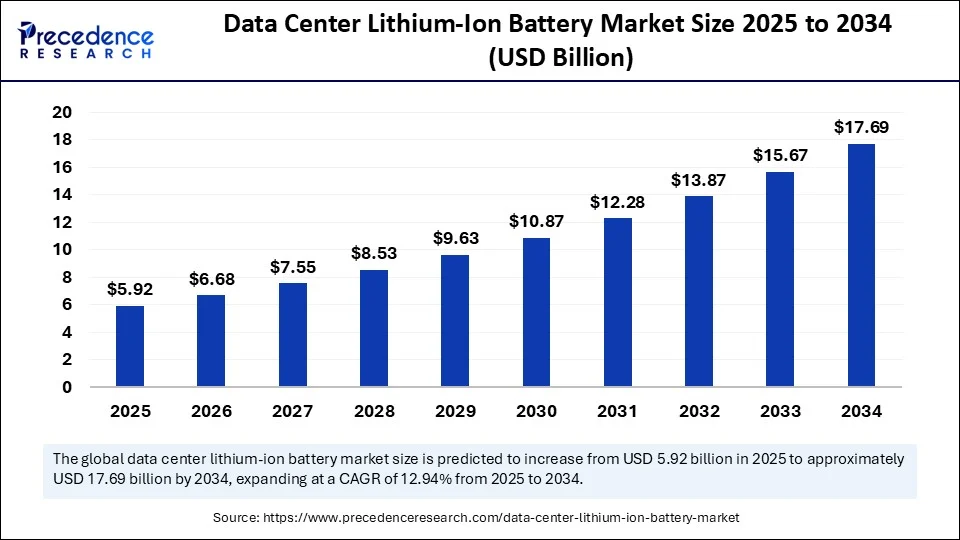
Data Center Lithium-Ion Battery Market Key Takeaways
- In terms of revenue, the global data center lithium-ion battery market was valued at USD 5.24 billion in 2024.
- It is projected to reach USD 17.69 billion by 2034.
- The market is expected to grow at a CAGR of 12.94% from 2025 to 2034.
- North America dominated the data center lithium-ion battery market in 2024.
- By region, Asia Pacific is expected to experience the fastest growth during the foreseeable period.
- By battery chemistry, the lithium-iron phosphate segment led the global market in 2024.
- By battery chemistry, the lithium nickel manganese cobalt (NMC) segment is expected to grow at the fastest CAGR during the forecast period.
- By data center type, the hyperscale data centers segment captured the biggest market share in 2024.
- By data center type, the edge/micro data centers segment is expected to expand at the fastest CAGR during the projection period.
- By application, the uninterruptible power supply segment contributed the largest market share in 2024.
- By application, the energy storage system segment is expected to showcase the fastest growth during the forecasted years.
- By component, the battery racks/modules segment held the highest market share in 2024.
- By component, the battery management systems segment is expected to grow at the fastest CAGR between 2025 and 2034.
- By end user, the cloud service providers segment generated the major market share in 2024.
- By end user, the telecom operators segment is expected to grow at the fastest CAGR during the forecast period.
How AI Is Transforming the Data Center Lithium-Ion Battery Market
Artificial intelligence is playing an increasingly vital role in the evolution of lithium-ion battery systems used in data centers, particularly within battery management systems (BMS). The BMS is critical to maintaining battery health, minimizing degradation, and preventing hazardous events such as thermal runaway. By integrating AI, data centers can enhance battery performance, improve safety, and extend operational lifespan.
AI algorithms enable real-time monitoring of key battery parameters, including voltage, current, temperature, and state of charge. These tools analyze data from the BMS to detect anomalies, predict failures, and recommend corrective actions before critical issues arise. This predictive maintenance approach helps reduce downtime and operational risks.
Furthermore, AI optimizes energy consumption by dynamically managing battery usage in response to real-time energy demand, grid fluctuations, and the availability of renewable energy sources. This intelligent energy allocation improves efficiency and lowers operating costs for data centers.
AI techniques such as machine learning, deep learning, and neural networks are increasingly being adopted to further enhance battery analytics, usage forecasting, and automated control systems, positioning AI as a key enabler in the future of lithium-ion battery management for mission-critical infrastructure.
Market Overview
The data center lithium-ion battery market encompasses the global industry dedicated to providing lithium-ion (Li-ion) battery systems for backup power and energy storage in data centers. These batteries are steadily replacing traditional valve-regulated lead-acid (VRLA) batteries, owing to their superior characteristics such as longer operational lifespan, compact size, faster charging capabilities, improved temperature tolerance, and reduced total cost of ownership.
Li-ion battery systems play a vital role in uninterruptible power supply (UPS) units, ensuring continuous operation during power outages or during transfers between power sources. Their application is growing across various types of data centers, including edge, colocation, hyperscale, and enterprise facilities, where reliability, efficiency, and scalability are essential. As digital infrastructure continues to expand, lithium-ion solutions are becoming increasingly integral to the resilience and performance of data center power systems.
Key Trends in the Data Center Lithium-Ion Battery Market
- Development of Next-Generation Solid-State Batteries: A major trend driving market evolution is the advancement of next-generation solid-state lithium-ion batteries. These batteries offer enhanced safety, greater energy density, and broader operating temperature ranges. Their rapid recharge capabilities reduce downtime and ensure a more reliable power supply, making them highly suitable for modern data center environments.
- Integration of Automation in Power Infrastructure: The adoption of automated control systems is reshaping power management in data centers. By leveraging smart grid technologies and integrating renewable energy sources, data centers are improving energy efficiency and operational reliability. These intelligent systems allow for better load balancing and real-time decision-making to optimize battery usage.
- Exploration of New Battery Chemistries: Ongoing research into alternative lithium-ion battery chemistries is another significant trend. Innovations in chemical formulations aim to extend battery lifespan, enhance thermal stability, and increase safety. The exploration of new materials and blends could lead to breakthroughs that improve performance and reduce operational risks in high-demand data center applications.
Drivers
Increasing Rack Density Driven by Complex Technologies
The rapid adoption of advanced computing technologies has led to a surge in rack density within data centers. As more powerful servers and high-performance equipment are consolidated into compact spaces, the need for reliable and efficient backup power systems becomes critical. Lithium-ion batteries, known for their quick recharge times, smaller physical footprint, and high energy efficiency, are ideally suited to support these high-density environments. Their superior cycle life and operational reliability make them a strategic choice for data centers striving to ensure uptime and reduce energy overhead, especially as sustainability and space optimization become top priorities.
Restraint
Safety Concerns and High Initial Costs
Despite their advantages, lithium-ion batteries pose notable challenges. One key concern is the risk of thermal runaway, which can lead to fires or system failures, particularly if the batteries are improperly managed or exposed to extreme conditions. Additionally, the environmental impact associated with lithium extraction and the complexities of battery disposal raise sustainability concerns. From a financial standpoint, the higher upfront cost of lithium-ion systems compared to traditional lead-acid alternatives may deter adoption among smaller data centers or those with limited budgets.
Opportunity
Integration of Renewable Energy and Microgrid Systems
A promising growth avenue lies in the integration of lithium-ion UPS systems with renewable energy sources and microgrid infrastructure. Data centers are increasingly deploying hybrid energy models that pair lithium-ion battery arrays with solar, wind, or hydrogen-based power systems. This shift not only enhances energy resilience and reduces dependence on the main grid, but also supports carbon reduction goals and long-term cost savings. As environmental regulations tighten and energy efficiency becomes a competitive differentiator, the role of lithium-ion batteries in facilitating green, grid-independent operations will continue to expand.
Recent Developments
- In March 2025, Google revealed that it has deployed more than 100 million Lithium-ion (Li-ion) cells across its global fleet of data centers since 2015.
- In June 2024, Delta launched a transforming series of lithium-ion battery systems, named UZR Gen3 series for the power management of data centers.
Data Center Lithium-Ion Battery Market Key Players
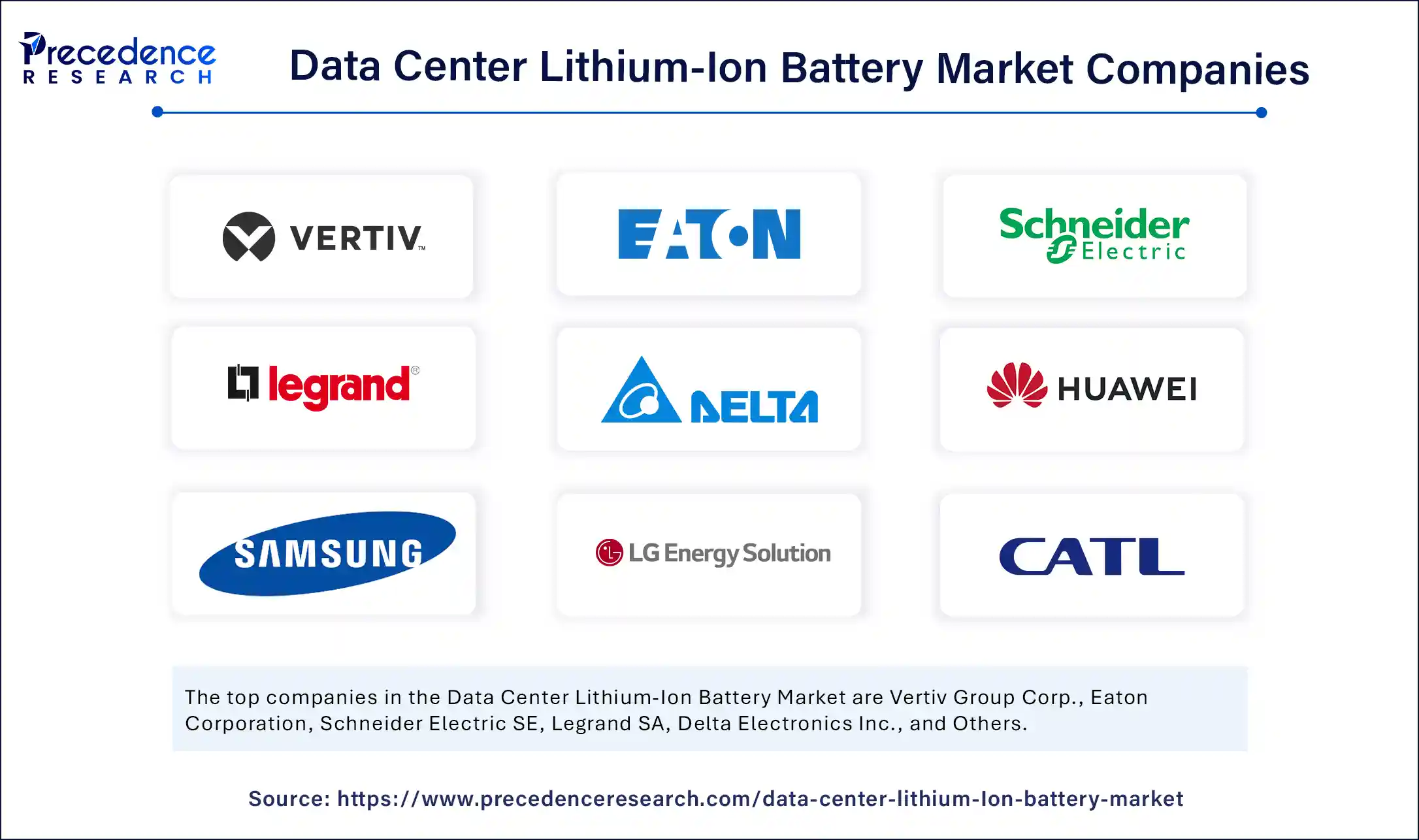
- Vertiv Group Corp.
- Eaton Corporation
- Schneider Electric SE
- Legrand SA
- Delta Electronics Inc.
- Huawei Technologies Co., Ltd.
- Samsung SDI Co., Ltd.
- LG Energy Solution
- Contemporary Amperex Technology Co. Ltd. (CATL)
- BYD Company Limited
- Toshiba Corporation
- Tesla, Inc.
- Panasonic Holdings Corporation
- Narada Power Source Co., Ltd.
- Lithium Energy Storage
- Saft Groupe S.A. (TotalEnergies)
- ZincFive Inc.
- Exide Technologies
- Hitachi Energy Ltd.
- Riello UPS (RPS S.p.A.)
