
 by
by 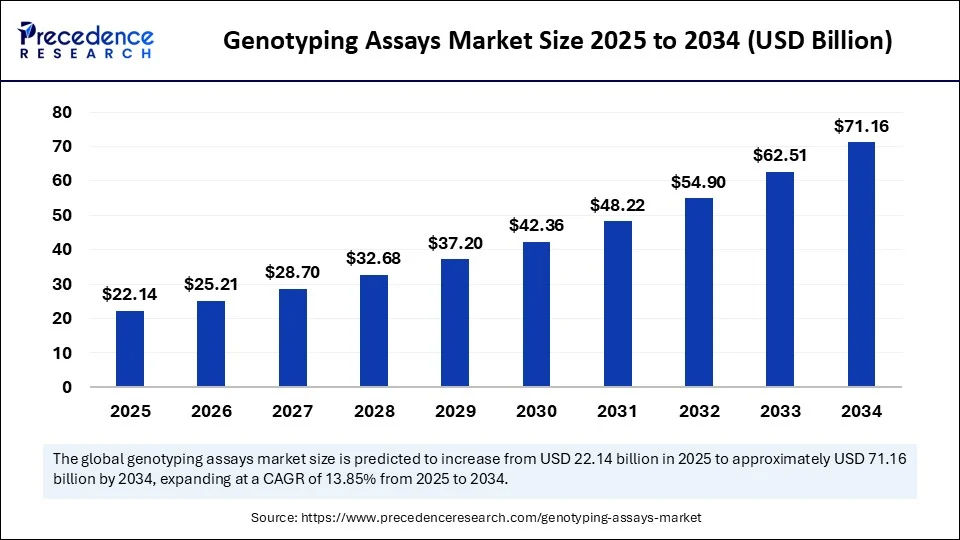
Genotyping Assays Market Key Takeaways
- In terms of revenue, the global genotyping assays market was valued at USD 19.45 billion in 2024.
- It is projected to reach USD 71.16 billion by 2034.
- The market is expected to grow at a CAGR of 13.85% from 2025 to 2034.
- North America dominated the global genotyping assays market with the largest market share of 41.5% in 2024.
- Asia Pacific is anticipated to witness the fastest growth during the forecast years.
- By technology, the polymerase chain reaction (PCR) segment captured the biggest market share of 32.8% in 2024.
- By technology, the next-generation sequencing (NGS) segment is expected to show rapid growth over the forecast period.
- By product, the reagents & kits segment contributed the highest market share of 48.2% in 2024.
- By product, the software & services segment is expected to show considerable growth over the forecast period.
- By application, the diagnostics (oncology) segment held the biggest market share of 29.6% in 2024.
- By application, the pharmacogenomics segment is anticipated to show considerable growth over the forecast period.
- By end-user, the pharmaceutical & biopharmaceutical companies segment generated the major market share of 34.4% in 2024.
- By end-user, the contract research organizations segment is anticipated to show considerable growth over the forecast period.
- By application, the DNA amplification segment accounted for significant market share of 27.9% in 2024.
- By application, the data analysis & interpretation segment is anticipated to show considerable growth over the forecast period.
How is AI Integration Transforming the Genotyping Assays Market?
Artificial intelligence is transforming the genotyping assays market by enabling faster, more accurate, and scalable analysis of genomic data. AI-driven tools enhance the precision of genotype calling, minimize human error, and identify complex patterns that may otherwise go undetected. These capabilities support earlier and more accurate diagnoses, facilitate personalized treatment plans, and accelerate biomarker discovery. Additionally, AI improves quality control processes, automates data curation, and streamlines real-time decision-making, significantly advancing both clinical and research applications.
Market Overview
The genotyping assays market encompasses a global network of technologies, instruments, reagents, and services designed to detect and analyze genetic variations, including single-nucleotide polymorphisms (SNPs), insertions, deletions, and copy number variations (CNVs). These assays play a vital role in research, diagnostics, pharmacogenomics, agriculture, and personalized medicine by enabling high-throughput and precise genetic profiling.
Utilizing advanced platforms such as PCR, microarrays, next-generation sequencing, and mass spectrometry, genotyping assays support disease association studies, drug response prediction, and trait selection. The market is witnessing strong growth driven by the increasing prevalence of genetic disorders and rapid progress in genomic research.
In addition, the expanding demand for biomarker discovery, precision medicine, and companion diagnostics is fueling adoption. Strategic collaborations between public and private sectors are further accelerating innovation and improving access to genotyping technologies. The widening range of applications across healthcare, agriculture, and biotechnology continues to expand the market’s potential.
What Factors Are Boosting the Growth of the Genotyping Assays Market?
- Advances in Genomic Research: Continuous progress in genomics and sequencing technologies has significantly improved the accuracy, speed, and cost-efficiency of genetic analysis. These advancements have expanded the use of genotyping assays across a range of applications, including personalized medicine, drug discovery, and disease characterization, thereby fueling market growth.
- Rising Demand for Biomarker Discovery: The growing emphasis on targeted therapies and early disease detection has increased the demand for genetic biomarkers. Genotyping assays play a crucial role in identifying these biomarkers, which are essential for developing precision medicine and validating new therapeutic products. This trend is accelerating the adoption of genotyping technologies in both clinical and research settings.
- Strong Public-Private Partnerships: Collaborations between government organizations, academic institutions, and biotechnology companies are driving innovation and expanding access to genotyping technologies. These partnerships foster knowledge exchange, increase funding for research, and support large-scale genomic initiatives, ultimately contributing to the global growth of the genotyping assays market.
Drivers
Rising Demand for Personalized Medicine
The growing need for personalized medicine is a major driver of the genotyping assays market. Personalized medicine relies on understanding an individual’s genetic makeup to deliver targeted and effective medical treatments. Genotyping enables the identification of genetic variations that influence drug response, disease susceptibility, and therapeutic outcomes. With continuous advancements in genomic science and increasing financial investments from both public and private sectors, genotyping technologies are becoming more accessible and cost-effective. This has accelerated their adoption in clinical and research settings, reinforcing personalized medicine as a major growth catalyst for the genotyping assays market.
Restraint
Complexity in Data Interpretation
A significant restraint in the market is the complexity of interpreting the vast amounts of data generated by genotyping assays. These high-throughput techniques produce complex datasets that require advanced analytical tools and specialized expertise for accurate interpretation. The need for skilled professionals such as geneticists, bioinformaticians, and data scientists, along with robust computational infrastructure, can pose barriers to adoption. Additionally, challenges in integrating multi-omic data sources further complicate the analysis process, particularly in resource-limited or decentralized healthcare settings. This complexity can limit the broader use of genotyping technologies, thereby slowing market growth.
Opportunity
Expanding Use in Clinical Diagnostics
The integration of genotyping assays into clinical diagnostics presents a significant growth opportunity. In oncology, genotyping is used to detect tumor-specific genetic mutations that guide personalized treatment strategies, including identifying drug resistance. The field of pharmacogenomics is also expanding, enabling clinicians to select safer and more effective medications based on a patient’s genetic profile. As healthcare systems increasingly embrace precision medicine, the clinical utility of genotyping is expected to broaden across therapeutic areas such as cancer, cardiovascular disease, and inherited conditions. This growing clinical integration, supported by expanded reimbursement policies, will enhance diagnostic precision and patient outcomes.
Genotyping Assays Market Companies
- Thermo Fisher Scientific
- Illumina Inc.
- Bio-Rad Laboratories Inc.
- Agilent Technologies
- QIAGEN
- Danaher Corporation
- PerkinElmer Inc.
- Roche Diagnostics
- Takara Bio Inc.
- Fluidigm Corporation
- Luminex Corporation
- Pacific Biosciences
- BGI Genomics
- Genewiz (Part of Azenta Life Sciences)
- Sequenom (A Laboratory Corporation of America Holdings subsidiary)
- Affymetrix (now part of Thermo Fisher)
- Eurofins Genomics
- Analytik Jena
- Merck KGaA
- New England Biolabs
