
 by
by 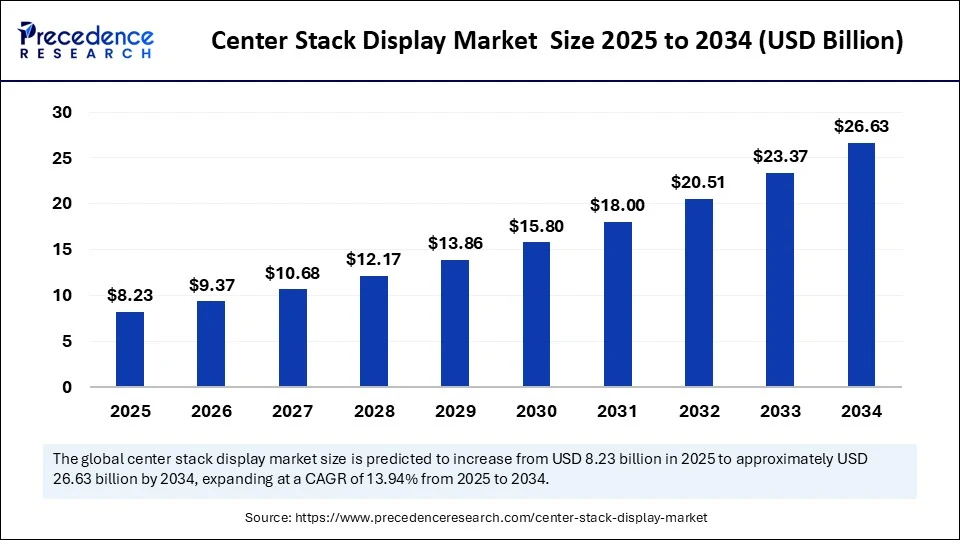
Center Stack Display Market Key Takeaways
- In terms of revenue, the global center stack display market was valued at USD 7.22 billion in 2024.
- It is projected to reach USD 26.63 billion by 2034.
- The market is expected to grow at a CAGR of 13.94% from 2025 to 2034.
- Asia Pacific dominated the global center stack display market with the largest market share of 50% in 2024.
- By region, North America is anticipated to grow at the fastest CAGR during the forecast period.
- By display technology, the TFT-LCD / TFT-LCD with IPS segment led the market in 2024.
- By display technology, the OLED / AMOLED segment is expected to grow at the fastest CAGR during the forecast period.
- By screen size, the 7–10 inches segment accounted for a considerable share in 2024.
- By screen size, the above 10 inches (large / tablet-style) segment is projected to experience the highest growth CAGR between 2025 and 2034.
- By resolution & image performance, the standard resolution segment led the center stack display market in 2024.
- By resolution & image performance, the high resolution segment is set to experience the fastest CAGR from 2025 to 2034.
- By touch & HMI input type, the capacitive multi-touch segment captured the biggest market share in 2024.
- By touch & HMI input type, the haptics/force feedback touch segment is anticipated to grow with the highest CAGR during the studied years.
- By user interface/software, the connected infotainment segment generated the major market share in 2024.
- By user interface/software, the voice + AI adaptive UI segment is predicted to witness significant growth over the forecast period.
- By connectivity & integration, the vehicle networks segment captured a significant revenue share in 2024.
- By connectivity & integration, the automotive ethernet segment is predicted to witness significant growth over the forecast period.
- By automotive grade/functional safety, the non-safety critical segment contributed the highest market share in 2024.
- By automotive grade/functional safety, the safety-aware segment enjoyed a prominent position during forecast period.
- By vehicle type/application, the passenger cars segment held the largest market share in 2024.
- By vehicle type/application, the electric vehicles segment is expected to grow at the fastest CAGR during the forecast period.
- By form factor & mounting, the integrated flush-mount displays segment accounted for significant market share in 2024.
- By form factor & mounting, the floating tablet segment is projected to experience the highest growth CAGR between 2025 and 2034.
How AI is Shaping the Future of the Center Stack Display Market
Artificial Intelligence is transforming the center stack display market by creating more personalized, intuitive, and predictive user experiences. AI-powered voice assistants now enable drivers to interact with infotainment and vehicle systems hands-free, enhancing both safety and convenience. At the same time, machine learning algorithms are being used to anticipate driver preferences—ranging from navigation routes to music choices—delivering a more seamless in-car experience.
AI is also playing a crucial role in integrating center stack displays with advanced driver assistance systems (ADAS), helping to improve situational awareness and decision-making on the road. Natural language processing further strengthens human–vehicle communication by making voice commands more accurate and responsive. Looking ahead, as vehicles move toward higher levels of autonomy, AI-powered center stack displays are set to evolve into intelligent control and entertainment hubs, shaping the future of connected mobility.
Market Overview
Center stack displays (CSDs) are the central in-vehicle display units positioned on the dashboard’s center stack, acting as the primary interface for infotainment, navigation, connectivity, and vehicle controls such as HVAC, seating, and system settings. These advanced systems integrate multiple technologies, including display hardware (LCD/TFT, OLED/AMOLED, projection, or bonded touch panels), intuitive input methods like touch, gesture, or haptic feedback, dedicated display controllers, and embedded software. They are also connected to vehicle networks such as CAN, MOST, and Automotive Ethernet, as well as external networks like Wi-Fi, Bluetooth, and cellular. Produced by Tier-1 suppliers alongside display and semiconductor/software providers, CSDs have become the cornerstone of modern cockpit architectures across internal combustion, hybrid, and electric vehicles.
The center stack display market is undergoing rapid transformation as automakers increasingly integrate advanced information and control systems to meet consumer expectations. Positioned at the heart of the digital cockpit, these displays are now essential for navigation, entertainment, and climate management, while also supporting enhanced human–machine interaction. Rising consumer demand for connected vehicles and seamless digital experiences is fueling adoption in both passenger and commercial segments. Moreover, growing emphasis on safety, convenience, and driver assistance is strengthening the role of CSDs in modern vehicles. Beyond functionality, automakers are leveraging center stack displays to differentiate models, enhance aesthetics, and deliver premium user experiences. With digital transformation accelerating in the automotive sector, the center stack display market is set for sustained and robust growth in the years ahead.
Market Key Trends
One of the most prominent trends shaping the center stack display market is the growing integration of multi-display cockpits, which provide a seamless digital environment for both drivers and passengers. By connecting the center stack display with digital instrument clusters and passenger displays, automakers are creating more intuitive, immersive, and connected in-car experiences.
Another key trend is the rising adoption of OLED and AMOLED technologies, favored for their superior brightness, contrast, and image clarity compared to traditional LCDs. These displays are increasingly being used in premium vehicles, where design and visual quality are central to enhancing the driving experience. At the same time, manufacturers are experimenting with large-format displays featuring curved or flexible screens, offering more futuristic and customizable cockpit layouts.
The market is also witnessing a surge in touchless control technologies such as gesture recognition and AI-powered voice commands. These innovations not only enhance convenience but also improve safety by reducing driver distraction. Additionally, the growing use of over-the-air (OTA) updates is transforming the way center stack displays evolve, enabling continuous improvements, software upgrades, and the introduction of new features without the need for dealership visits.
Sustainability has also become a significant focus, with automakers and suppliers investing in energy-efficient display technologies that reduce power consumption and align with broader green mobility goals. Collectively, these trends are driving the transformation of center stack displays from simple information screens to intelligent, adaptive, and sustainable hubs at the core of the modern vehicle.
Market Drivers
Connected Cars Driving the Display Revolution
The rapid adoption of connected cars is one of the most powerful drivers of the center stack display market. Modern consumers expect their vehicles to replicate the seamless digital experiences they enjoy on smartphones and tablets, making advanced displays an essential feature. Center stack displays now serve as a central hub for navigation, entertainment, and real-time communication, while also integrating with cloud-based services and mobile applications. Automakers are leveraging these displays to deliver personalized experiences, from music streaming and social media access to in-car e-commerce. The rollout of 5G networks is further accelerating this trend by enabling ultra-fast data transmission and low-latency services. As connectivity continues to evolve into a core aspect of vehicle design, center stack displays will remain at the forefront of the digital transformation of mobility.
Market Opportunity
Autonomous Vehicles Opening New Display Horizons
The rise of autonomous and semi-autonomous vehicles presents an unprecedented opportunity for the center stack display market. In self-driving cars, the purpose of displays expands beyond driver assistance to encompass passenger entertainment, productivity, and immersive experiences. This shift is driving demand for larger, high-resolution screens capable of delivering advanced multimedia functions, interactive applications, and seamless connectivity. Emerging technologies such as augmented reality (AR) and virtual reality (VR) are expected to integrate into center stack systems, redefining how passengers engage with in-car environments. Furthermore, fleet operators and shared mobility providers are likely to adopt enhanced displays as a differentiator to attract customers. As the line between transportation and entertainment blurs, center stack displays are poised to become a critical enabler of the next-generation mobility ecosystem.
Market Restraints
High Cost and Reliability Concerns
Despite strong growth prospects, the center stack display market faces key challenges, particularly in terms of cost and reliability. Advanced systems incorporating OLED and AMOLED panels, haptic feedback, and gesture recognition significantly increase vehicle production costs, limiting adoption in entry-level models. In addition, automotive environments expose displays to extreme conditions such as heat, vibration, and continuous use, raising durability and reliability concerns. Failures in these systems can disrupt essential vehicle functions and compromise safety, making quality assurance critical. Another pressing issue is cybersecurity, as connected displays may be vulnerable to hacking and data breaches, posing risks to both vehicle safety and user privacy. Addressing these challenges will be essential for sustaining long-term growth and ensuring that center stack displays evolve as both safe and cost-effective solutions.
Center Stack Display Market Key Players
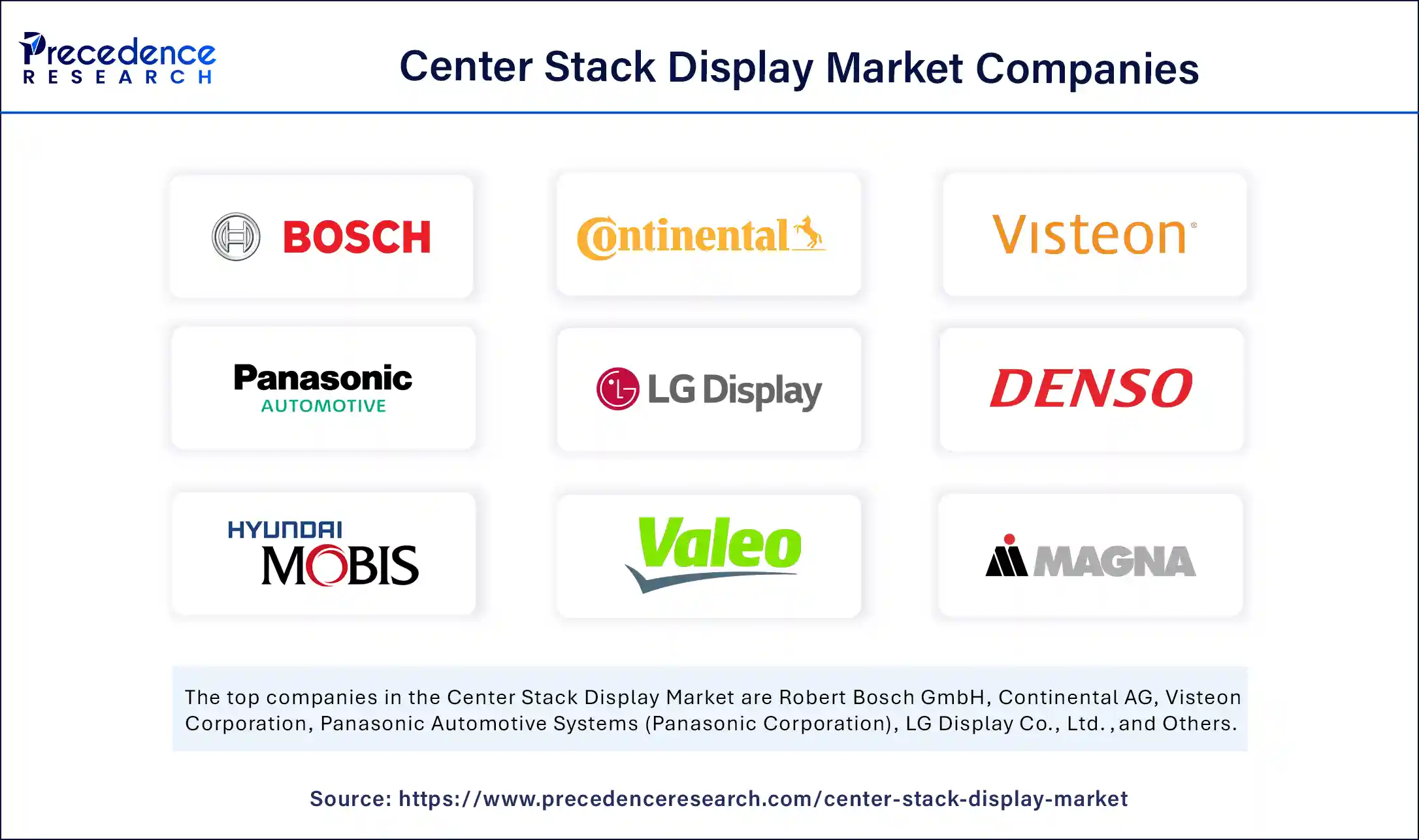
- Robert Bosch GmbH
- Continental AG
- Visteon Corporation
- Panasonic Automotive Systems (Panasonic Corporation)
- LG Display Co., Ltd.
- Denso Corporation
- Hyundai Mobis Co., Ltd.
- Valeo SA
- Magna International Inc.
