
 by
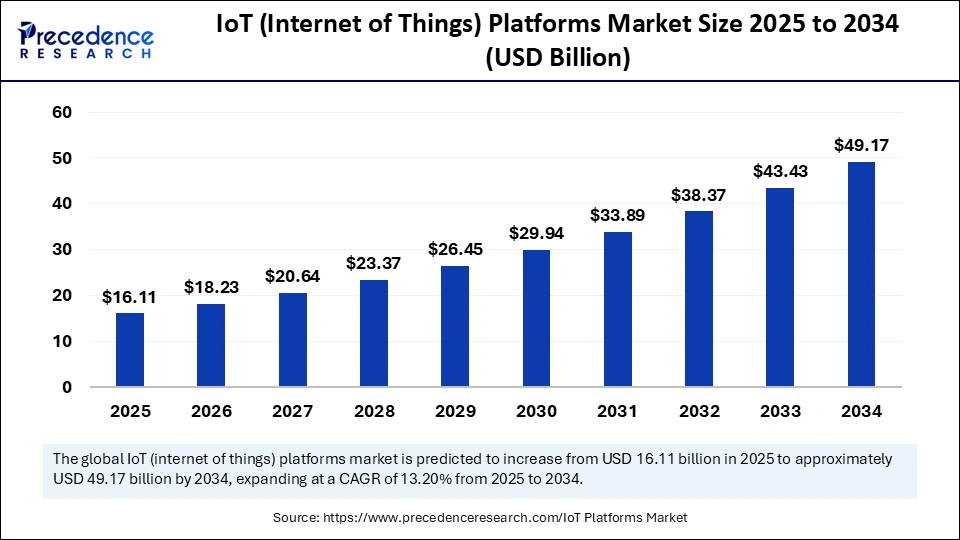
by The global IoT (Internet of Things) platforms market is rapidly expanding, expected to reach approximately USD 49.17 billion by 2034 from USD 16.11 billion in 2025, growing at a CAGR of 13.2%. This robust growth is driven by increased adoption of connected devices across sectors, AI and machine learning integration, cloud-based deployments, and the rise of edge computing, creating vast opportunities for digital transformation worldwide.
IoT Platforms Market Key Insights
-
The market was valued at USD 16.11 billion in 2025 and forecasted to hit USD 49.17 billion by 2034 at a CAGR of 13.2%.
-
North America led the market with a 38% share in 2024, while Asia Pacific is the fastest-growing region with 15% CAGR expected through 2034.
-
Platform software accounted for the largest component share of 55% in 2024, while the cloud-based SaaS deployment mode held 60% market dominance.
-
Cellular connectivity technologies lead with 40% market share, with LPWAN expected to grow fastest at 14% CAGR.
-
Manufacturing is the largest industry vertical, representing 28% of market share, with healthcare & life sciences growing fastest at 13.5% CAGR.
What is Driving the Rapid Expansion of IoT Platforms?
The IoT platforms market fundamentally supports the connected device ecosystem by providing software solutions that connect, manage, and analyze data from diverse devices, enabling IoT’s seamless functionality. Growth is amplified by technological convergence particularly the infusion of AI and machine learning allowing platforms to harness real-time insights, predictive analytics, and automation to optimize operations across industries such as manufacturing, healthcare, transportation, and smart city deployments.
How is AI Shaping the Future of IoT Platforms?
AI integration is revolutionizing IoT platforms by enabling real-time streaming data analysis, predictive maintenance, anomaly detection, and consumer behavior forecasting. These capabilities allow businesses to proactively manage assets, reduce downtime, and enhance user experiences through automated decision-making processes. AI-powered IoT platforms empower enterprises with actionable insights from vast datasets, accelerating innovation cycles and driving exponential growth.
IoT Platforms Market Growth Factors
Key drivers include the surge in connected devices, expansion of 5G and satellite IoT connectivity, increased adoption of cloud-based SaaS models, and investments in smart infrastructure and Industry 4.0 automation. Sustainability trends like circular economy initiatives and environmental monitoring also fuel market growth as organizations seek IoT-enabled solutions for compliance and resource optimization. Furthermore, demand for hybrid cloud deployments rises due to their balanced approach to security and flexibility.
IoT Platforms Market Scope
| Report Coverage | Details |
| Market Size in 2025 | USD 16.11 Billion |
| Market Size in 2026 | USD 18.23 Billion |
| Market Size by 2034 | USD 49.17 Billion |
| Market Growth Rate from 2025 to 2034 | CAGR of 13.20% |
| Dominating Region | North America |
| Fastest Growing Region | Asia Pacific |
| Base Year | 2025 |
| Forecast Period | 2025 to 2034 |
| Segments Covered | Component, Deployment Mode, Connectivity Technology, End User / Industry Vertical, Application, Platform Type, and Region |
| Regions Covered | North America, Europe, Asia-Pacific, Latin America, and Middle East & Africa |
What Emerging Opportunities and Trends Are Shaping the Market?
How is cloud technology reshaping IoT platform adoption?
Cloud-based platforms dominate the market thanks to scalability, cost-efficiency, and seamless integration with AI and analytics tools, enabling real-time device management and global accessibility.
Why is Asia Pacific experiencing extraordinary growth?
Government initiatives, rapid urbanization, and investments in 5G and smart city infrastructure underpin strong regional demand, especially in China, India, and Japan.
What role does sustainability play?
IoT platforms offer real-time environmental monitoring and asset lifecycle tracking, supporting regulatory compliance and circular economy efforts.
IoT Platforms Market Segment Insights
Component Insights: Platform Software Leads the Market
The platform software segment dominated the IoT (Internet of Things) platforms market with a 55% share in 2024, serving as the core layer that connects, manages, and analyzes data from diverse devices. Its capabilities in analytics, secure communication, and system interoperability enable enterprises to streamline operations and gain actionable insights. The services segment is projected to grow at the fastest CAGR of 13%, driven by the rising need for expert deployment, integration, and maintenance as IoT ecosystems become increasingly complex.
Deployment Mode Insights: Cloud-Based Segment Dominates
The cloud-based / SaaS segment held a 60% market share in 2024, owing to its scalability, cost-effectiveness, and compatibility with AI and machine learning technologies. It allows real-time analytics, remote device management, and seamless updates across global operations. Meanwhile, the hybrid deployment model is expected to expand at a CAGR of 12.5%, offering a balanced solution that combines security, low latency, and flexibility—ideal for industries with strict compliance and data sovereignty needs.
Connectivity Technology Insights: Cellular / Mobile Leads
The cellular/mobile segment (2G–5G NR) led the market with a 40% share in 2024, thanks to its extensive coverage and reliability across large-scale applications like smart cities, logistics, and fleet management. These networks ensure consistent connectivity even in remote regions. The LPWAN segment is projected to record the fastest growth at a CAGR of 14%, supported by demand for low-power, long-range, and cost-efficient solutions for applications in agriculture, utilities, and asset tracking.
End-User Insights: Manufacturing Holds the Largest Share
The manufacturing segment held the largest share of 28% in 2024, driven by IoT’s role in enhancing automation, predictive maintenance, and supply chain efficiency. Manufacturers are leveraging IoT for real-time monitoring and data-driven process optimization. The healthcare & life sciences segment is forecasted to grow at the fastest CAGR of 13.5%, fueled by rising chronic disease cases, aging populations, and the increasing need for remote health monitoring and personalized care.
IoT Platforms Market Regional Insights
North America dominated the global IoT platforms market with a 38% share in 2024, supported by advanced infrastructure, early adoption across industries, and the presence of major tech companies such as AWS, Microsoft, Google, and IBM. In the U.S., 5G expansion, AI integration, and cloud-based innovation are accelerating the shift toward predictive analytics and automation.
Asia Pacific is expected to grow at the fastest CAGR of 15% (2025–2034), driven by government initiatives, urbanization, and massive investments in smart cities and 5G networks. Countries like China, India, and Japan are rapidly adopting IoT in manufacturing, energy, and transportation sectors. China, in particular, benefits from initiatives like “Made in China 2025” and “Internet Plus”, reinforcing its leadership in IoT infrastructure.
Europe is also witnessing steady growth due to strong digitalization, sustainability goals, and regulatory frameworks supporting IoT innovation. Germany stands out with its Digital Jetzt initiative and compliance-driven IoT platforms optimized for industries like healthcare and finance.
What Are the Latest Innovations from Leading Companies?
Recent breakthroughs include AT&T and Ericsson’s AT&T IoT Marketplace launched in October 2025, enhancing IoT service innovation through a digital e-Commerce platform, and Telia’s new IoT platform for Nordic enterprises with AI-driven analytics and optimization capabilities.
Key players leading this innovation ecosystem include Microsoft, Amazon Web Services, Huawei, Alibaba, Oracle, Cisco (Jasper), PTC, IBM, Google Cloud, and SAP.
What Challenges and Cost Pressures Are Impacting the Market?
Key challenges include high implementation costs, complexities around data security and privacy, and interoperability issues due to fragmented standards. Additionally, managing massive data volumes and ensuring seamless integration across diverse devices remain persistent hurdles, impacting both adoption rates and ongoing operational expenses.
Case Study Highlight
Leading manufacturers leverage IoT platforms integrated with AI analytics to enable predictive maintenance, reducing unplanned downtime by up to 30% and cutting maintenance costs by 20%, thereby significantly improving operational efficiency and reducing waste.
Read Also: Air Freight Forwarding System Market
You can place an order or ask any questions. Please feel free to contact us at [email protected] |+1 804 441 9344
