
 by
by What is the Human Centric Lighting Market Size in 2026?
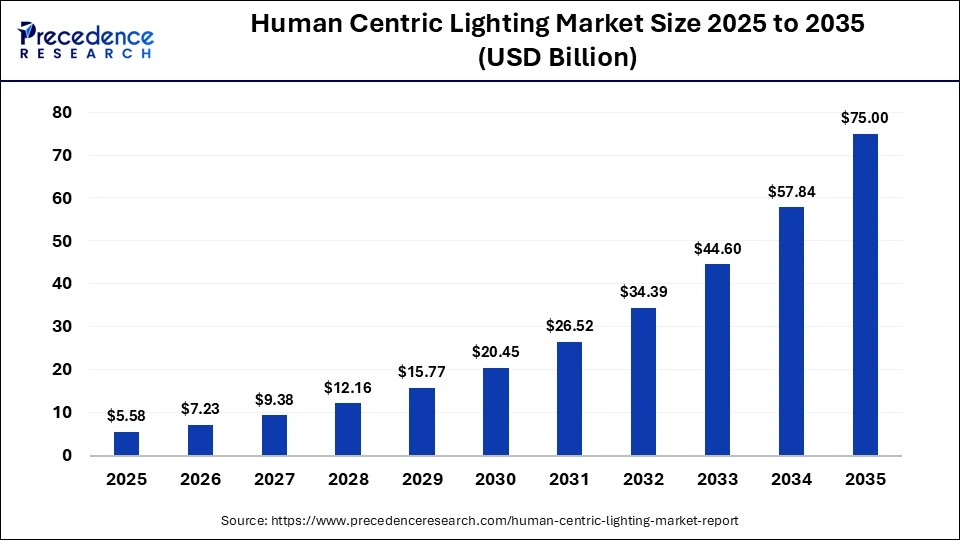
The global human centric lighting market size was anticipated at USD 5.58 billion in 2025 and is predicted to increase from USD 7.23 billion in 2026 to approximately USD 75.00 billion by 2035, expanding at a CAGR of 29.68% from 2026 to 2035.The market is experiencing unprecedented growth, driven by the growing demand for sophisticated lighting systems and rapid infrastructure development.
Key Takeaways
- Europe dominated the global market with the largest share of 39% in 2025.
- Asia Pacific is expected to expand at the fastest CAGR between 2026 and 2035.
- By product, the fixtures segment accounted for the biggest market share of 36% in 2025.
- By product, the services segment is expected to grow at the fastest CAGR between 2026 and 2035.
- By installation type, the new installation segment contributed the major market share of 68% in 2025.
- By installation type, the retrofit segment is expected to expand at the fastest growth rate between 2026 and 2035.
- By application, the commercial segment contributed the highest market share 60% in 2025.
- By application, the residential segment is expected to grow at the highest CAGR from 2026 to 2035.
Market Overview
Human-centric lighting (HCL) is an advanced lighting approach that goes beyond basic illumination to create a harmonious balance between the human body, mind, and surrounding light environment. These lighting systems are specifically designed to align with human circadian rhythms, promoting alertness during daytime hours and supporting relaxation in the evening.
Unlike conventional lighting solutions that primarily focus on brightness levels, human-centric lighting incorporates dynamic adjustments in color temperature and intensity to replicate natural daylight patterns. This innovative approach enhances overall well-being, productivity, and comfort, making it increasingly popular across residential, commercial, and healthcare settings.
Impact of Artificial Intelligence on the Human-Centric Lighting Market
The integration of artificial intelligence (AI) is emerging as a key driver in the growth of the human-centric lighting market. AI significantly enhances the efficiency and intelligence of HCL systems, accelerating their adoption across various sectors, including offices, homes, and healthcare facilities.
AI-powered lighting systems analyze environmental conditions and human presence in real time to automatically adjust brightness levels and color temperature in alignment with natural circadian cycles. For example, in office environments, AI can optimize lighting to boost alertness and focus during morning hours while creating a more relaxed atmosphere later in the day.
In addition to improving user comfort and well-being, AI-integrated lighting solutions also contribute to energy efficiency by reducing unnecessary power consumption and supporting environmental sustainability goals. As a result, AI is playing a crucial role in transforming traditional lighting systems into intelligent, adaptive solutions.
Market Scope
| Report Coverage | Details |
| Market Size in 2025 | USD 5.58 Billion |
| Market Size in 2026 | USD 7.23 Billion |
| Market Size by 2035 | USD 75.00 Billion |
| Market Growth Rate from 2026 to 2035 | CAGR of 29.68% |
| Dominating Region | Europe |
| Fastest Growing Region | Asia-Pacific |
| Base Year | 2025 |
| Forecast Period | 2026 to 2035 |
| Segments Covered | Product, Installation Type , Application, and Region |
| Regions Covered | North America, Europe, Asia-Pacific, Latin America, and Middle East & Africa |
Regional Insights
North America is a leading region in the human centric lighting market, driven by strong adoption of smart technologies and advanced building infrastructure. The growing demand for energy-efficient lighting systems and increasing awareness about employee productivity and well-being are boosting HCL adoption across commercial offices, healthcare facilities, and residential spaces. The integration of AI and IoT in smart buildings is further accelerating the deployment of intelligent lighting solutions in the region.
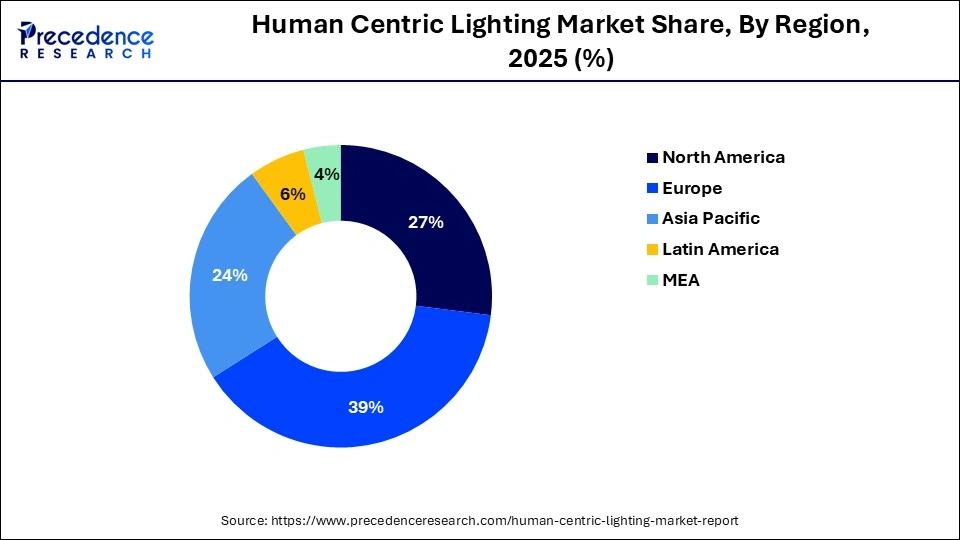
Europe is a highly progressive market for human centric lighting, supported by stringent energy efficiency regulations and a strong focus on sustainability. Countries such as Germany, the Netherlands, and the UK are actively adopting HCL systems in offices, schools, and healthcare environments to enhance occupant well-being and productivity. The region’s emphasis on green buildings and smart city initiatives is driving the integration of AI-enabled lighting solutions.
Asia-Pacific is witnessing rapid growth in the human centric lighting market due to urbanization, expanding infrastructure, and increasing investments in smart city projects. Countries like China, Japan, South Korea, and India are adopting advanced lighting technologies across commercial and residential sectors. The rising awareness of health-focused lighting and the growing penetration of AI-based smart home systems are further supporting market expansion.
The Middle East & Africa region is gradually adopting human centric lighting, particularly in premium infrastructure projects, commercial buildings, and healthcare facilities. Smart city developments and luxury real estate projects in countries such as the UAE and Saudi Arabia are driving demand for advanced lighting systems. The focus on energy efficiency and modern infrastructure is expected to support steady growth in this region.
Latin America is an emerging market for human centric lighting, with increasing adoption in commercial and residential sectors. Countries such as Brazil and Mexico are focusing on improving building efficiency and occupant comfort through advanced lighting technologies. Although awareness is still developing, growing investments in infrastructure and smart solutions are expected to drive future demand for HCL systems.
Human Centric Lighting Market Key Players
- Cree Lighting USA LLC
- Eaton Corporation
- Fagerhults Belysning AB
- Helvar
- Hubbell Lighting
- LEDVANCE GmbH
- ACUITY BRANDS, INC.
- Legrand SA
- Lutron Electronics Co., Inc
- Schneider Electric
- Signify Holding
- Trilux Group
- Wipro Lighting
- Zumtobel
Recent Developments
- In January 2024, Hyundai Mobis Co. unveiled a system that changes car interior lights depending on a driver’s mood and physical condition to improve driving safety. The company has created a human-centric lighting system for the future mobility environment. This system senses a user’s biorhythm and driving environment to automatically adjust the color, brightness, and display of automotive interior lights as required. This advanced system improves drivers’ satisfaction by reinterpreting the function and purpose of car interior lighting to meet future mobility trends, which heavily focus on personalized user experience (UX).
- In December 2025, SUNROOOF, a brand specializing in scientifically developed daylight solutions, announced the launch of its e-commerce platform to enable access to premium human-centric lighting for commercial, residential, and institutional environments in India & UAE. This platform enables customers to explore a thoughtfully curated portfolio of daylighting solutions specifically designed to elevate mood, enhance productivity, regulate day-to-day rhythms, and improve overall well-being. In a remarkable trajectory, SUNROOOF has achieved INR 15 crore revenue within just 12 months and is targeting to achieve INR 50 crore this year, driven by its expansion into larger markets and high-value projects.
Segments Covered in the Report
By Product
- Fixtures
- Controllers
- Sensors
- Drivers
- Microcontrollers
- Others
- Software
- Services
By Installation Type
- New Installation
- Retrofit
By Application
- Residential
- Commercial
- Education
- Office
- Healthcare
- Industrial
- Others
By Region
- North America
- Latin America
- Europe
- Asia-pacific
- Middle and East Africa
Get Sample Link: https://www.precedenceresearch.com/sample/8227
