
 by
by What is the AI Email Assistant Market Size in 2026?
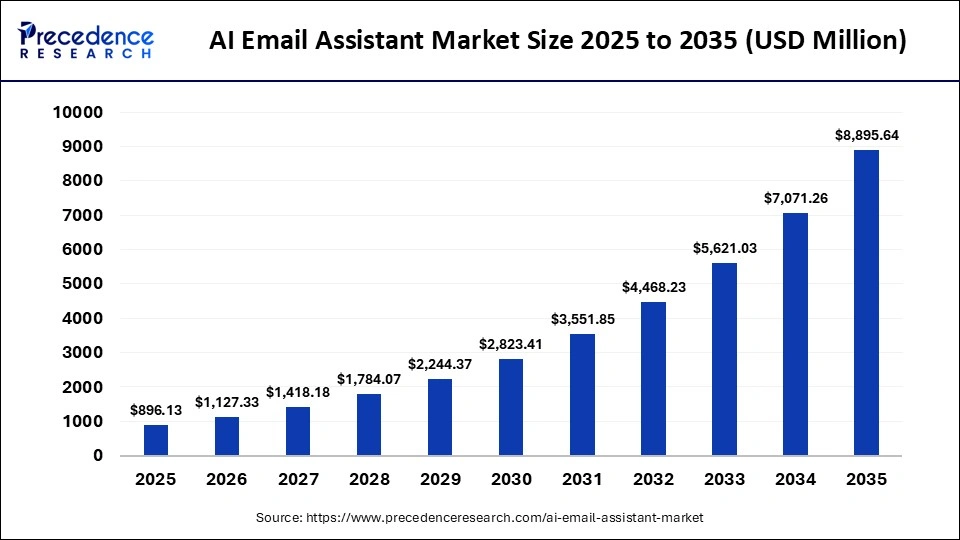
The global AI email assistant market size was calculated at USD 896.13 million in 2025 and is predicted to increase from USD 1127.33 million in 2026 to approximately USD 8895.64 million by 2035, expanding at a CAGR of 25.80% from 2026 to 2035. An AI email generator and email automation software are essential for managing inboxes, suggesting replies, organizing messages, drafting emails, prioritizing important emails, and automating tasks such as scheduling meetings.
Key Takeaways
- North America dominated the AI email assistant market in 2025, with a market share of approximately 39.6%.
- Asia-Pacific is expected to grow at the fastest CAGR in the market during the forecast period.
- By offering, the AI email drafting assistants segment held a dominant position in the market with a share of 24.7% in 2025.
- By offering, the AI shared inbox assistants segment is expected to grow at the fastest CAGR of 31.8% in the market between 2026 and 2035.
- By deployment mode, the cloud-based segment led the global market with a share of 68.6% in 2025.
- By deployment mode, the hybrid segment is expected to grow with the highest CAGR of 24.4% in the AI email assistant market during the studied years.
- By organization size, the large enterprises segment registered its dominance over the global market with a share of 63.4% in 2025.
- By organization size, the small and medium enterprises segment is expected to expand rapidly in the market with a CAGR of 27.2% in the coming years.
- By end user, the enterprises segment held the largest revenue share of 34.8% in the market in 2025.
- By end user, the customer support teams segment is expected to witness the fastest growth in the market with a CAGR of 27.9% over the forecast period.
AI Email Assistant: Transforming Modern Communication
The AI email assistant market includes advanced software solutions powered by generative AI, natural language processing (NLP), and workflow automation to streamline email management. These tools are designed to draft, summarize, prioritize, organize, and schedule emails efficiently across both personal and enterprise inboxes. They seamlessly integrate with widely used platforms such as Gmail, Outlook, and Apple Mail, enhancing communication speed, improving inbox organization, and ensuring high-quality responses. The market consists of standalone applications, built-in productivity features, and enterprise-grade email intelligence platforms, typically offered through subscription-based, usage-based, or enterprise licensing models.
AI email assistants are increasingly adopted by businesses and individuals to reduce the time spent on repetitive email tasks and to manage inbox clutter more effectively. These solutions enable intelligent email sorting, automated tagging, customized folder management, and advanced spam filtering. Additionally, AI-powered features such as those integrated into Outlook ensure strong data privacy through secure handling, transparency, and user control. Beyond automation, these tools also assist users in refining email tone, rewriting messages professionally, and simplifying complex content for better clarity and communication.
AI Email Assistant Market Trends
- Intelligent AI Email Assistants: The best AI email generators are Shortwave, Microsoft Copilot Pro for Outlook, Gemini for Gmail, Apple Intelligence for Apple Mail, Superhuman, Notion Mail, Proton Scribe, Edison Mail, and SaneBox. The primary functions of these advanced solutions revolve around AI-powered email search, improving communication, and supporting Google Workspace users, Apple customers, and many more. Furthermore, they contribute to mixing artificial intelligence generation with message templates, AI-powered inbox filtering, privacy, AI-powered security, and keeping inboxes organized.
- AI-Powered Processing of Email Content: Models like GPT-4o and Claude 4 have an inbuilt potential of understanding human language, and they analyze the content of every email. AI models are pivotal in expanding the AI email assistant industry, running sentiment and intent analysis on the message, and generating a set of tags to sort incoming emails. They are also essential to summarize the email, optimize the inbox usage, get coaching on email drafts, and detect data types. By detecting the tasks or actions in email content, these AI models extract and convert them into tasks or calendar events.
Market Scope
| Report Coverage | Details |
| Market Size in 2025 | USD 896.13 Million |
| Market Size in 2026 | USD 1127.33 Million |
| Market Size by 2035 | USD 8895.64 Million |
| Market Growth Rate from 2026 to 2035 | CAGR of 25.80% |
| Dominating Region | North America |
| Fastest Growing Region | Asia-Pacific |
| Base Year | 2025 |
| Forecast Period | 2026 to 2035 |
| Segments Covered | Offering, Deployment Mode , Organization Size, End User, and Region |
| Regions Covered | North America, Europe, Asia-Pacific, Latin America, and Middle East & Africa |
AI Email Assistant Market Dynamics
Driver
Demand for Personalization
The major growth factor for the market is the growing demand for personalized features in emails. AI tools facilitate smart email drafting and autocompletion to reduce the time taken for drafting emails. They analyze the message’s context and suggest relevant words, phrasing, and full paragraphs. They enable predictive scheduling to analyze calendar availability and suggest optimal meeting times directly within the email composition window. Moreover, AI-powered intelligent prioritization and filtering are designed to cut through the noise.
Restraint
Data Privacy Risks
The market faces formidable challenges, including data privacy risks. AI email assistants pose the risk of exposing communication patterns, sensitive data, and organizational information. This leads to the leakage of confidential data across the entire corporate sector.
Opportunity
Integration with Business Tools
The market future is promising, driven by the integration of AI email assistants into business tools, such as HR, accounting, and customer service software. This helps make email assistants a central hub for business operations. AI can detect intent and route queries directly to payroll, IT, compliance, or the right HR specialist instead of manually forwarding emails. It eliminates repetitive tasks, improves response accuracy, and reduces manual overload.
Regional Insights of the AI Email Assistant Market
North America leads the AI email assistant market due to the strong presence of major technology companies, early adoption of AI-powered productivity tools, and a highly digital workforce. Enterprises across industries actively integrate AI email assistants to enhance communication efficiency and automate workflows. The region also benefits from advanced cloud infrastructure and high awareness of workplace automation solutions, particularly in the U.S. and Canada.
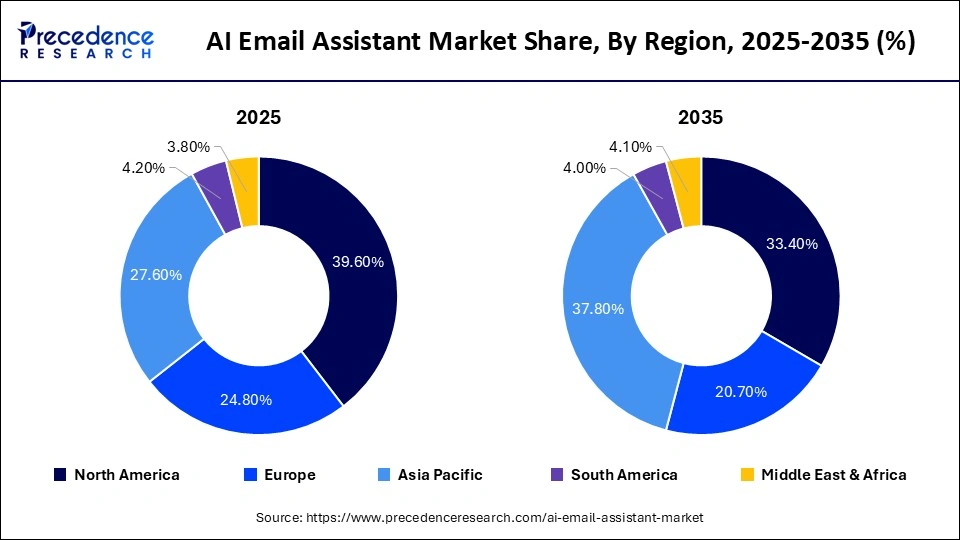
Europe is witnessing steady growth, driven by increasing adoption of AI tools in corporate environments and a strong focus on data privacy and compliance regulations such as GDPR. Organizations in countries like Germany, the UK, and France are adopting AI email assistants to improve productivity while ensuring secure data handling. The region’s emphasis on ethical AI and secure enterprise communication is shaping product innovation.
Asia-Pacific is expected to register the fastest growth due to rapid digital transformation, expanding startup ecosystems, and increasing adoption of cloud-based solutions. Countries such as India, China, Japan, and South Korea are seeing rising demand for AI-powered productivity tools among SMEs and large enterprises. The growing remote workforce and cost-efficiency of AI solutions are key drivers in this region.
Latin America is gradually adopting AI email assistants as businesses modernize their communication infrastructure. Countries like Brazil and Mexico are investing in digital tools to improve operational efficiency and reduce manual workload. However, adoption is still at a developing stage due to budget constraints and varying levels of technological maturity.
AI Email Assistant Market Key Players
- Microsoft
- Zoho
- Grammarly
- Superhuman
- HubSpot
- Mailbutler
- Shortwave
- Canary Mail
- Spark
- Front
- Missive
- Salesforce
- Boomerang for Gmail
- MailMaestro
Get Sample Link: https://www.precedenceresearch.com/sample/8223
