
 by
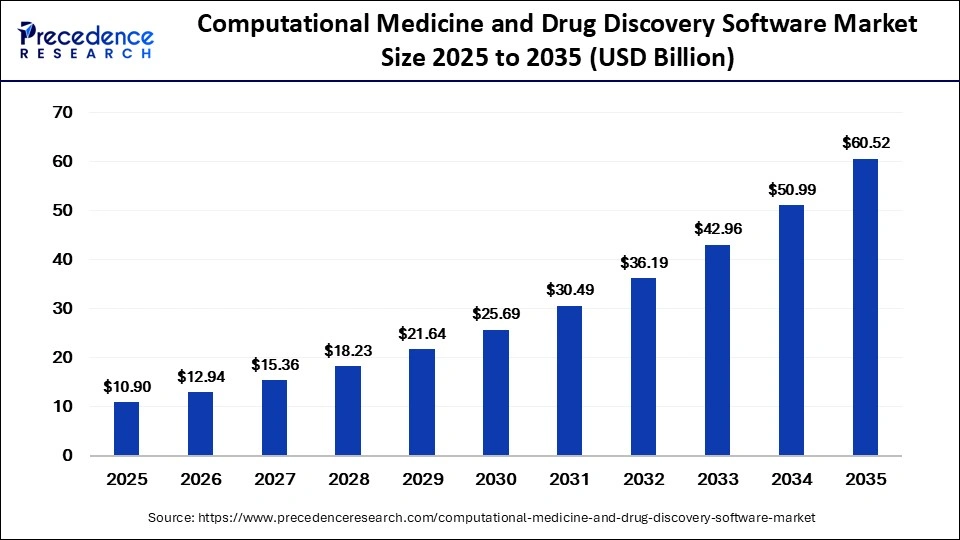
by The global computational medicine and drug discovery software market is projected to reach USD 60.52 billion by 2035 at a CAGR of 18.7%. Explore AI-driven pharmaceutical innovation, computational biology trends, market dynamics, segmentation, regional insights, and future opportunities.
Read Also: Data Center Robotics Market
Computational Medicine and Drug Discovery Software Market: Transforming Pharmaceutical Innovation Through Artificial Intelligence
The pharmaceutical and biotechnology industries are entering a new era of digital transformation driven by artificial intelligence, cloud computing, computational biology, and predictive analytics. Traditional drug discovery remains one of the most expensive and time-consuming processes in healthcare, often requiring more than a decade of research and billions of dollars in investment before a drug reaches commercialization.
To overcome these challenges, pharmaceutical companies, biotechnology firms, and research organizations are increasingly adopting computational medicine and drug discovery software platforms capable of accelerating therapeutic research, improving prediction accuracy, and reducing development failures.
These advanced software systems use:
- Artificial intelligence (AI)
- Machine learning (ML)
- Molecular modeling
- Bioinformatics
- High-performance computing (HPC)
- Cloud-based analytics
to optimize the entire pharmaceutical research lifecycle—from target identification and molecule design to clinical simulation and personalized medicine development.
As AI adoption rapidly expands across healthcare ecosystems worldwide, the computational medicine and drug discovery software market is emerging as one of the most transformative sectors within the global digital healthcare industry.
Market Overview: Strong Growth Driven by AI-Powered Drug Discovery
The global computational medicine and drug discovery software market size accounted for USD 10.90 billion in 2025 and is projected to increase from USD 12.94 billion in 2026 to approximately USD 60.52 billion by 2035, expanding at a remarkable CAGR of 18.70% during the forecast period.
The market’s rapid growth is being driven by:
- Rising demand for faster drug development
- Increasing adoption of AI-driven research platforms
- Growing pharmaceutical R&D investments
- Expansion of cloud-based computational infrastructure
- Rising use of genomics and multi-omics analysis
- Increasing demand for precision medicine
Computational software solutions are helping pharmaceutical companies reduce experimental costs, improve therapeutic prediction accuracy, and accelerate innovation across drug discovery pipelines.
What is Computational Medicine and Drug Discovery Software?
Computational medicine and drug discovery software refers to advanced digital platforms that use computational modeling and AI-driven analytics to support biomedical research and therapeutic development.
These platforms help researchers:
- Simulate biological systems
- Identify drug targets
- Analyze genomic data
- Predict molecular interactions
- Optimize clinical trial designs
- Develop personalized medicine strategies
The technology integrates multiple advanced disciplines, including:
- Computational chemistry
- Systems biology
- Artificial intelligence
- Bioinformatics
- Predictive analytics
- Digital twin modeling
By reducing dependency on lengthy laboratory experimentation, these platforms significantly improve research efficiency and lower drug development costs.
Key Market Trends
1. Artificial Intelligence Becoming the Core of Modern Drug Discovery
Artificial intelligence and machine learning dominated the market with approximately 35% market share in 2025.
AI-driven platforms are transforming pharmaceutical research by enabling:
- Predictive molecule modeling
- Automated compound screening
- Generative molecule design
- Biomarker discovery
- Clinical outcome prediction
Generative AI technologies are increasingly capable of designing entirely new therapeutic molecules with predefined biological properties.
The growing industry focus on AI-powered drug development is creating major opportunities for computational software providers. Community discussions across biotech and AI sectors increasingly highlight how AI is reducing traditional pharmaceutical research timelines and costs.
2. Rapid Expansion of AI-Driven Drug Discovery Platforms
AI-driven drug discovery platforms accounted for approximately 22% market share in 2025 and are projected to grow at the fastest CAGR of 23.5% through 2035.
These platforms are gaining rapid adoption because they:
- Accelerate molecule design
- Improve prediction accuracy
- Reduce experimental failures
- Shorten drug discovery timelines
The emergence of generative AI is significantly improving early-stage drug development workflows by enabling faster lead optimization and target validation.
3. Cloud Computing Transforming Pharmaceutical Research Infrastructure
Cloud-based deployment dominated the market with approximately 60% share in 2025.
Cloud infrastructure is enabling:
- Large-scale data processing
- Collaborative global research
- Scalable computational simulations
- Faster AI deployment
- Cost-efficient infrastructure management
Cloud platforms eliminate the need for expensive on-premise infrastructure while providing flexible access to advanced computational tools and biomedical datasets.
The cloud computing segment is expected to grow at a CAGR of 21% through 2035 due to increasing adoption across pharmaceutical ecosystems.
4. Molecular Modeling and Simulation Remaining Essential
The molecular modeling and simulation segment held approximately 25% market share in 2025, making it the leading software type category.
These platforms help researchers:
- Understand molecular interactions
- Predict drug behavior
- Analyze protein structures
- Reduce early-stage development failures
Structure-based drug design remains heavily dependent on molecular simulation technologies due to their reliability and predictive capabilities.
5. Rise of Digital Twins and In Silico Modeling
Digital twins and in silico simulation technologies accounted for approximately 10% market share in 2025 and are projected to grow rapidly.
These technologies allow researchers to:
- Simulate biological systems digitally
- Predict drug responses virtually
- Reduce laboratory experimentation
- Improve therapeutic testing efficiency
Virtual simulation models are increasingly valuable for accelerating pharmaceutical innovation while lowering development risks.
Market Dynamics
Market Drivers
Increasing Pressure to Reduce Drug Development Time
Traditional drug development is:
- Expensive
- Time-consuming
- Highly risky
Computational medicine platforms help pharmaceutical companies:
- Accelerate research workflows
- Improve candidate screening
- Reduce late-stage failures
- Lower development costs
Reducing time-to-market remains one of the strongest drivers for computational drug discovery adoption.
Growing Demand for Precision Medicine
Precision medicine relies heavily on computational analytics to identify individualized therapeutic strategies.
Advanced computational platforms support:
- Genomic interpretation
- Biomarker discovery
- Personalized therapeutic modeling
- Disease pathway analysis
The global expansion of personalized healthcare is significantly increasing demand for computational medicine software solutions.
Expansion of Genomics and Multi-Omics Research
The growing availability of:
- Genomics databases
- Proteomics datasets
- Real-world clinical evidence
- Multi-omics platforms
is creating strong demand for scalable computational analytics infrastructure.
Bioinformatics software accounted for approximately 18% market share in 2025 and continues experiencing strong growth due to increasing genomic research activity.
Rising Pharmaceutical AI Investments
Major pharmaceutical companies are significantly increasing investments in:
- AI research ecosystems
- Cloud computing infrastructure
- Generative drug discovery platforms
- Computational biology initiatives
The increasing collaboration between technology companies and pharmaceutical firms is accelerating innovation across the industry.
Market Challenges
Complexity of Human Biology
Despite advances in AI and computational modeling, accurately simulating human biological systems remains extremely difficult.
Researchers continue facing challenges related to:
- Biological variability
- Incomplete datasets
- Complex disease mechanisms
- Predictive uncertainty
These limitations can affect model reliability and drug prediction accuracy.
Data Privacy and Security Concerns
Computational medicine platforms frequently process:
- Patient genomic information
- Clinical trial data
- Biomedical research records
Organizations must comply with strict data protection regulations such as:
- HIPAA
- GDPR
- Healthcare cybersecurity standards
Ensuring secure handling of sensitive biomedical data remains a critical challenge.
Shortage of Specialized Computational Talent
The market faces growing demand for:
- Computational biologists
- AI scientists
- Bioinformatics professionals
- Cloud infrastructure engineers
The shortage of skilled professionals may slow large-scale adoption across some regions.
Regional Insights
North America – Dominant Region
North America led the market with approximately 45% share in 2025.
The region benefits from:
- Advanced pharmaceutical R&D ecosystems
- Strong AI adoption
- Mature cloud infrastructure
- Large biotechnology investments
The United States remains the leading global hub for computational drug discovery innovation.
Asia Pacific – Fastest Growing Region
Asia Pacific accounted for approximately 18% market share in 2025 and is projected to grow at the fastest CAGR of 22.5% through 2035.
Growth Drivers Include:
- Expanding biotechnology industries
- Government digital healthcare initiatives
- Increasing AI investments
- Growing pharmaceutical manufacturing ecosystems
China and India are emerging as major regional growth engines due to increasing biotech expansion and AI adoption.
Europe
Europe accounted for approximately 28% market share in 2025.
The region benefits from:
- Strong collaborative research networks
- Ethical AI governance frameworks
- Advanced pharmaceutical infrastructure
- Government-supported healthcare innovation programs
Competitive Landscape
The computational medicine and drug discovery software market is becoming increasingly competitive as:
- Pharmaceutical companies
- AI startups
- Cloud providers
- Bioinformatics firms
- Healthcare software vendors
expand computational research capabilities.
Major industry participants include:
- Schrödinger LLC
- Dassault Systèmes
- Genedata AG
- Crown Bioscience Inc.
- Chemical Computing Group Inc.
- Compugen
- Nimbus Therapeutics Inc.
Companies are increasingly focusing on:
- Generative AI drug design
- Predictive biological modeling
- Cloud-native research platforms
- Digital twin technologies
- AI-powered simulation systems
Future Outlook: Toward Autonomous Pharmaceutical Research
The future of computational medicine will increasingly depend on AI-native research ecosystems capable of automating complex pharmaceutical workflows.
Key Future Trends
- Generative AI-driven molecule creation
- Virtual biological simulations
- Autonomous research laboratories
- Multi-omics integrated analytics
- Quantum-enhanced molecular modeling
- AI-powered clinical trial optimization
As computational capabilities continue advancing, software-driven pharmaceutical research will become increasingly predictive, scalable, and automated.
Conclusion
The computational medicine and drug discovery software market is rapidly becoming a foundational pillar of next-generation pharmaceutical innovation. As artificial intelligence, cloud computing, and predictive analytics continue transforming healthcare research, computational platforms are enabling faster, smarter, and more efficient therapeutic development.
Get a Sample Copy: https://www.precedenceresearch.com/sample/8386
For inquiries regarding discounts, bulk purchases, or customization requests, please contact us at sales@precedenceresearch.com
