
 by
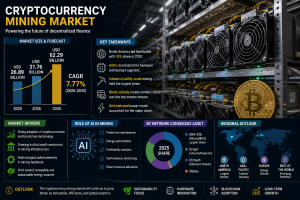
by The global cryptocurrency mining market size was valued at USD 26.89 billion in 2025 and is projected to reach approximately USD 62.29 billion by 2035, growing at a CAGR of 7.77% during the forecast period. As blockchain technology continues to expand beyond digital currencies into finance, supply chains, gaming, and decentralized applications, cryptocurrency mining remains the backbone of these ecosystems.
While public attention often focuses on cryptocurrency prices and trading activity, mining is the infrastructure layer that keeps blockchain networks secure, decentralized, and operational. The growing adoption of digital assets, increasing institutional participation, advancements in mining hardware, and rising investments in renewable energy-powered facilities are creating a strong foundation for long-term market growth.
The cryptocurrency mining industry is also undergoing a significant transformation. What was once dominated by individual enthusiasts running mining rigs from their homes has evolved into a highly sophisticated global industry supported by industrial-scale facilities, artificial intelligence, renewable energy integration, and advanced semiconductor technologies.
Cryptocurrency Mining Market Overview
The cryptocurrency mining market has become a critical component of the global digital asset ecosystem, supporting the validation of blockchain transactions and the creation of new cryptocurrencies. Mining operations use advanced computing systems to secure decentralized networks, ensuring transparency, security, and reliability across blockchain platforms. As the adoption of cryptocurrencies continues to expand among consumers, enterprises, and financial institutions, the demand for mining infrastructure is increasing steadily worldwide.
The industry has evolved significantly from small-scale individual mining activities to highly sophisticated industrial operations powered by specialized hardware, artificial intelligence, and renewable energy resources. Growing investments in blockchain technology, rising acceptance of digital currencies, and the emergence of decentralized finance applications are creating long-term growth opportunities for mining companies and infrastructure providers.
Market Scope
| Report Highlights | Details |
|---|---|
| Market Size in 2025 | USD 26.89 Billion |
| Market Size in 2026 | USD 31.76 Billion |
| Market Size by 2035 | USD 62.29 Billion |
| Growth Rate (2026–2035) | CAGR of 7.77% |
| Leading Region (2025) | North America |
Download the Sample: https://www.precedenceresearch.com/sample/2524
Why Cryptocurrency Mining Remains Essential
Cryptocurrency mining plays a fundamental role in maintaining decentralized blockchain networks by validating transactions and preventing fraudulent activities. Through the mining process, new blocks are added to blockchain ledgers, ensuring that all network participants have access to transparent and verified transaction records. Without mining infrastructure, many blockchain ecosystems would struggle to maintain security and operational efficiency.
The increasing popularity of cryptocurrencies and decentralized applications continues to reinforce the importance of mining operations. As blockchain technology expands into industries such as finance, healthcare, logistics, and digital identity management, mining will remain a crucial mechanism supporting trust, transparency, and decentralization across these networks.
As cryptocurrencies continue gaining acceptance among investors, enterprises, and financial institutions, the demand for mining infrastructure is growing simultaneously.
Mining plays a vital role in maintaining:
- Network security
- Transaction transparency
- Decentralization
- Blockchain reliability
- Digital asset creation
Without mining infrastructure, decentralized blockchain ecosystems would be unable to operate efficiently.
The Evolution from Hobby Mining to Industrial Operations
The cryptocurrency mining industry has evolved dramatically over the last decade.
Early Mining Era
- Home computers
- Individual miners
- Low entry barriers
- Minimal hardware requirements
Modern Mining Era
- Large-scale data centers
- Institutional investment
- Specialized ASIC hardware
- AI-powered optimization
- Renewable energy integration
- Publicly traded mining companies
Today, industrial mining facilities operate thousands of machines simultaneously, processing enormous amounts of computational power while optimizing efficiency and profitability.
How Artificial Intelligence Is Reshaping Cryptocurrency Mining
- Artificial intelligence is transforming cryptocurrency mining by helping operators improve efficiency, reduce costs, and maximize profitability. AI-powered systems can analyze real-time market conditions, optimize mining workloads, predict equipment failures, and manage power consumption more effectively. These capabilities enable mining companies to achieve higher operational performance while reducing downtime and maintenance expenses.
- AI also plays a critical role in energy optimization, which is one of the largest challenges facing the mining industry. By analyzing electricity prices, weather conditions, and grid availability, AI systems can automatically adjust mining operations to minimize energy costs and improve overall sustainability. As mining becomes more competitive, AI is expected to become an essential tool for both industrial and commercial operators.
AI Applications in Cryptocurrency Mining
Predictive Maintenance
AI algorithms continuously monitor mining hardware and identify performance abnormalities before equipment failures occur.
Benefits include:
- Reduced downtime
- Lower maintenance costs
- Extended hardware lifespan
- Improved operational reliability
Dynamic Energy Optimization
Electricity represents the largest operating expense for most mining facilities.
AI systems analyze:
- Electricity pricing
- Weather patterns
- Grid demand
- Energy availability
This enables mining companies to optimize power consumption and maximize profitability.
Profitability Forecasting
AI-powered analytics evaluate:
- Cryptocurrency prices
- Network difficulty
- Hash rates
- Market conditions
Mining resources can then be allocated toward the most profitable assets.
Performance Optimization
- Modern AI platforms automatically adjust hardware configurations, cooling systems, and workload distribution to improve overall mining efficiency.
- As energy efficiency becomes increasingly important, AI adoption is expected to become standard across large-scale mining operations.
Five Key Forces Driving Cryptocurrency Mining Market Growth
1. Expanding Adoption of Digital Assets
- Cryptocurrency adoption continues to rise across both developed and emerging economies.
- Growing adoption directly increases demand for mining infrastructure.
Consumers, businesses, and institutional investors increasingly view digital assets as:
- Alternative investments
- Inflation hedges
- Cross-border payment solutions
- Components of decentralized finance ecosystems
2. Rising Blockchain Technology Deployment
- Blockchain technology is no longer limited to cryptocurrencies.
- This broader adoption supports continued investment in blockchain infrastructure and mining operations.
Organizations worldwide are adopting blockchain for:
- Supply chain management
- Banking
- Healthcare
- Insurance
- Government services
3. Increasing Institutional Investment
- Major financial institutions and investment firms continue allocating capital to digital asset ecosystems.
- Large-scale investments are helping transform mining into a mainstream technology industry.
Institutional participation has improved:
- Market maturity
- Infrastructure investment
- Mining scalability
- Industry credibility
4. Demand for Transparent Financial Systems
- Blockchain networks provide transparency that traditional financial systems often struggle to deliver.
- Every transaction is permanently recorded on decentralized ledgers, increasing trust and reducing the risk of manipulation.
- This transparency continues driving blockchain adoption globally.
5. Financial Instability Supporting Cryptocurrency Adoption
- Economic uncertainty and inflation concerns have encouraged individuals and businesses to explore alternative financial assets.
- As adoption grows, mining activity expands alongside network participation.
Cryptocurrencies increasingly serve as:
- Digital stores of value
- International payment mechanisms
- Portfolio diversification tools
Emerging Trends Transforming the Industry
The cryptocurrency mining industry is experiencing a shift toward sustainable and energy-efficient operations. Mining companies are increasingly adopting renewable energy sources such as solar, hydroelectric, and wind power to reduce operational costs and meet environmental objectives. This transition is helping improve the industry’s public image while addressing concerns related to energy consumption and carbon emissions.
Another significant trend is the growing popularity of cloud mining and Mining-as-a-Service (MaaS) platforms. These solutions allow individuals and businesses to participate in mining activities without purchasing expensive hardware or managing technical infrastructure. The increasing accessibility of mining services is expected to attract a broader range of participants to the market.
Renewable Energy Mining
- Environmental concerns have accelerated the shift toward sustainable mining operations.
- Renewable-powered mining reduces both costs and environmental impact.
Mining companies are increasingly utilizing:
- Hydropower
- Solar energy
- Wind power
- Geothermal resources
- Stranded natural gas
Cloud Mining Services
- Cloud-based mining platforms are lowering barriers to entry.
- This model continues attracting retail participants.
Users can participate in mining without:
- Purchasing hardware
- Managing infrastructure
- Handling maintenance
- Paying large upfront investments
Advanced ASIC Hardware
- Application-Specific Integrated Circuits (ASICs) remain the dominant hardware architecture because of their superior efficiency and computational performance.
Modern ASIC systems deliver:
- Higher hash rates
- Lower power consumption
- Improved profitability
- Greater scalability
Growth of Privacy-Focused Networks
- Privacy-oriented blockchain ecosystems are creating new opportunities for mining networks such as RandomX-powered cryptocurrencies.
- Growing concerns regarding financial privacy are supporting adoption of decentralized privacy-focused assets.
Top Companies Operating in the Market
The cryptocurrency mining industry remains highly competitive, with companies focusing on hardware innovation, infrastructure development, cloud mining platforms, and blockchain ecosystem services.
Major market participants include:
- Advanced Micro Devices (AMD)
- Alcheminer
- Binance Holdings
- Bitfury Group
- BitGo
- Bitmain
- Bitstamp
- Canaan Creative
- Coinbase
- Ethereum Foundation
- Ifinex
- Intel Corporation
- Ledger SAS
- NVIDIA Corporation
- Ripple Labs
- Xapo
- Xilinx
Read More: Europe L7 Electric Micro Cars Market
Segments Covered in the Report
By Hardware Architecture
- Application-Specific Integrated Circuits (ASICs)
- Graphics Processing Units (GPUs)
- Field Programmable Gate Arrays (FPGAs)
- Central Processing Units (CPUs)
By Service Delivery
- Proprietary Self-Mining
- Hashpower Leasing
- Colocation & Managed Services
By Protocol Income Stream
- Block Subsidy
- Network Transaction Fees
- Maximal Extractable Value (MEV)
By Scale of Operation
- Industrial/Utility-Scale
- Mid-Tier Commercial
- Distributed/Retail
By Network Consensus Asset
- SHA-256
- Scrypt
- Etchash
- RandomX
By Power Integration Model
- Grid-Tethered
- Off-Grid/Stranded Gas
- Sustainable/Renewable-Dedicated
Final Thought
The cryptocurrency mining market is rapidly evolving from a niche technology segment into a sophisticated global infrastructure industry. As blockchain applications expand, digital asset adoption increases, and institutional investment accelerates, mining operations will remain a critical foundation supporting decentralized ecosystems worldwide. Artificial intelligence, renewable energy integration, advanced mining hardware, and cloud-based participation models are reshaping how mining operations are built and managed. These innovations are improving efficiency, reducing environmental impact, and making mining more accessible than ever before.
As governments develop clearer regulatory frameworks and blockchain technology continues entering mainstream business operations, cryptocurrency mining is positioned to play an increasingly important role in the future digital economy. The next chapter of blockchain growth will not be driven solely by cryptocurrencies themselves it will be powered by the infrastructure that makes decentralized networks possible.
You can place an order or ask any questions, please feel free to contact us at sales@precedenceresearch.com |+1 804 441 8440
