
 by
by The U.S. concierge medicine market size was valued at USD 6.55 billion in 2025 and is projected to increase from USD 6.99 billion in 2026 to approximately USD 12.75 billion by 2035, expanding at a CAGR of 6.88% from 2026 to 2035. The market is witnessing strong growth due to rising consumer demand for personalized healthcare, increasing physician burnout in traditional healthcare systems, a growing shortage of primary care physicians, and rapid integration of digital health technologies.
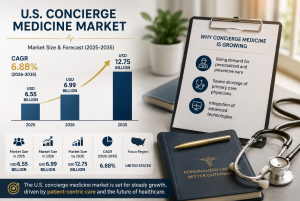
As healthcare consumers increasingly prioritize convenience, preventive care, and direct physician access, concierge medicine is emerging as a transformative healthcare delivery model across the United States. The growing adoption of membership-based healthcare services, telemedicine, AI-powered diagnostics, and wellness-focused treatment plans is expected to drive significant market expansion throughout the forecast period.
U.S. Concierge Medicine Market Overview
Concierge medicine is a membership-based healthcare model that offers patients enhanced access to physicians, personalized treatment plans, extended consultation times, same-day appointments, preventive care services, and direct communication through phone, email, text messaging, and virtual healthcare platforms. Unlike traditional healthcare systems that rely heavily on insurance reimbursement, concierge medicine focuses on patient-centered care through annual or monthly membership fees. This approach allows physicians to manage smaller patient panels, improve care quality, reduce administrative burdens, and strengthen doctor-patient relationships.
The growing popularity of direct primary care (DPC) and concierge healthcare models reflects changing consumer expectations for more accessible, personalized, and preventive healthcare experiences. Healthcare providers are increasingly integrating physician assistants, nurse practitioners, telehealth solutions, and AI-powered health management tools to improve service delivery and scalability across the U.S. healthcare ecosystem.
U.S. Concierge Medicine Market Scope
| Report Coverage | Details |
|---|---|
| U.S. Market Size in 2025 | USD 6.55 Billion |
| U.S. Market Size in 2026 | USD 6.99 Billion |
| U.S. Market Size by 2035 | USD 12.75 Billion |
| Growth Rate from 2026 to 2035 | CAGR of 6.88% |
| Base Year | 2025 |
| Forecast Period | 2026 to 2035 |
| Segments Covered | Application and Ownership |
Download the Sample: https://www.precedenceresearch.com/sample/3521
U.S. Concierge Medicine Market Growth Factors
- Rising consumer demand for personalized and preventive healthcare services.
- Growing dissatisfaction with long waiting times and limited physician access in traditional healthcare systems.
- Increasing shortage of primary care physicians across the United States.
- Growing population of aging baby boomers seeking chronic disease management and wellness services.
- Rising adoption of telehealth, remote patient monitoring, and digital healthcare platforms.
- Increasing physician interest in reducing administrative burdens and improving work-life balance.
- Growing prevalence of chronic diseases such as diabetes, cardiovascular disorders, and obesity.
- Expansion of employer-sponsored healthcare and executive wellness programs.
- Rising investments in digital health, AI-powered diagnostics, and precision medicine.
- Increased focus on proactive healthcare following the COVID-19 pandemic.
Value Chain Analysis of the U.S. Concierge Medicine Market
Service Design and Practice Development
- Healthcare providers establish concierge medicine programs, define service offerings, determine membership structures, and ensure compliance with healthcare regulations.
Physician Recruitment and Network Expansion
- Organizations recruit physicians, nurse practitioners, and healthcare specialists to build high-quality provider networks capable of delivering personalized care services.
Technology Infrastructure Development
- Implementation of telehealth platforms, electronic health records (EHR), patient portals, AI-powered analytics, and remote monitoring systems enhances service delivery and patient engagement.
Personalized Care Delivery
- Healthcare providers offer preventive care, wellness assessments, chronic disease management, diagnostics, lifestyle coaching, and coordinated specialty care through membership-based healthcare programs.
Patient Engagement and Retention
- Ongoing communication, wellness monitoring, preventive screenings, and personalized healthcare recommendations help strengthen patient relationships and improve long-term retention.
What is the Role of AI in the U.S. Concierge Medicine Market?
- Artificial Intelligence (AI) is becoming a major growth catalyst in the U.S. concierge medicine market by enhancing diagnostics, patient engagement, predictive healthcare, and administrative efficiency.
- AI-powered platforms are helping concierge physicians deliver more personalized care through advanced health analytics, predictive disease monitoring, clinical decision support, and real-time patient tracking. Virtual health assistants can provide 24/7 patient support, answer health-related questions, schedule appointments, and improve patient engagement.
- Wearable devices integrated with AI technologies are enabling continuous health monitoring, allowing concierge physicians to proactively manage chronic conditions and identify health risks before they escalate. AI is also streamlining administrative functions such as billing, scheduling, documentation, and medical record management, reducing physician burnout and improving operational efficiency.
- As digital healthcare adoption accelerates across the United States, AI-powered healthcare solutions are expected to significantly enhance the value proposition of concierge medicine practices by improving patient outcomes while lowering operational costs.
Five Key Forces Driving U.S. Concierge Medicine Market Growth
1. Rising Demand for Personalized Healthcare
Patients increasingly seek individualized healthcare experiences that offer direct physician access, customized treatment plans, longer consultations, and proactive wellness management. Concierge medicine addresses these needs by prioritizing patient-centered care.
2. Growing Physician Shortage Across the U.S.
The shortage of primary care physicians is placing significant strain on traditional healthcare systems. Concierge medicine enables physicians to manage smaller patient panels while delivering higher-quality care, making the model increasingly attractive to healthcare providers.
3. Expansion of Preventive and Wellness-Focused Healthcare
Consumers are increasingly investing in preventive healthcare services, wellness programs, and longevity-focused treatment plans. Concierge medicine emphasizes proactive health management rather than reactive disease treatment.
4. Rapid Advancement of Digital Health Technologies
- The integration of telemedicine, remote patient monitoring, electronic health records, wearable devices, and AI-powered diagnostics is improving accessibility and scalability within concierge medicine practices.
5. Growing Demand for Chronic Disease Management
- The increasing prevalence of diabetes, cardiovascular disease, obesity, and age-related health conditions is driving demand for comprehensive healthcare services that offer continuous monitoring and personalized care coordination.
- Together, these factors are expected to accelerate adoption of concierge medicine models across the U.S. healthcare sector over the next decade.
Benefits of Concierge Medicine in the U.S. Healthcare System
Enhanced Physician Accessibility
- One of the primary benefits of concierge medicine is improved access to healthcare providers. Patients can communicate directly with physicians through phone calls, text messages, emails, and virtual consultations. Same-day or next-day appointments significantly reduce waiting times and improve healthcare responsiveness.
Personalized and Preventive Healthcare
- Concierge medicine emphasizes preventive care rather than reactive treatment. Physicians develop individualized healthcare plans based on each patient’s medical history, lifestyle, genetic risk factors, and wellness goals. This personalized approach supports early disease detection and better long-term health outcomes.
Longer Consultation Times
- Unlike traditional healthcare settings where appointments are often limited to 10–15 minutes, concierge medicine practices offer extended consultations. Longer visits allow physicians to conduct comprehensive evaluations, discuss treatment options in detail, and build stronger patient relationships.
Improved Chronic Disease Management
- Patients suffering from diabetes, hypertension, cardiovascular disease, obesity, and other chronic conditions benefit from continuous monitoring and personalized care coordination. Frequent follow-ups and proactive interventions help reduce complications and hospitalizations.
Better Mental Health Support
- Many concierge practices now integrate psychiatry, behavioral health services, stress management programs, and wellness coaching into their care models. This holistic approach supports both physical and mental well-being.
Why Concierge Medicine is Becoming Increasingly Popular in the U.S.
The growing demand for personalized healthcare, increasing prevalence of chronic diseases, physician shortages, aging demographics, and rapid digital health adoption are making concierge medicine one of the fastest-evolving healthcare delivery models in the United States. As consumers continue to prioritize convenience, wellness, and preventive care, concierge medicine is expected to become an integral component of the future U.S. healthcare ecosystem.
Recent Developments in the U.S. Concierge Medicine Market
- In February 2026, MedStar Health launched Signature by MedStar, a concierge medicine program designed to provide personalized healthcare experiences and enhanced physician access.
- In June 2025, Sun Life partnered with Wellthy to offer concierge support services for end-of-life care and caregiving assistance.
- In January 2025, MDVIP expanded its healthcare offerings through a behavioral wellness initiative that integrated mental health services into concierge care.
- In December 2024, SignatureMD introduced a hybrid concierge medicine model designed specifically for rural healthcare practices.
- In October 2024, Forward Health secured USD 100 million in Series D funding to expand AI-powered virtual clinics and remote diagnostic technologies.
- Growing investments in AI-driven healthcare platforms, preventive medicine, and personalized wellness services continue to reshape the competitive landscape.
Top Companies in the Market and Their Offerings
- MDVIP: Provides membership-based primary care, preventive health assessments, wellness planning, chronic disease management, and personalized healthcare services.
- SignatureMD: Offers concierge practice management solutions, physician transition support, membership healthcare programs, and patient engagement services.
- PartnerMD: Provides executive health services, advanced physical examinations, preventive medicine programs, nutrition counseling, and personalized wellness plans.
- Castle Connolly Private Health Partners: Supports physicians in establishing concierge medicine practices while providing operational, administrative, and compliance management services.
- Priority Physicians, Inc.: Offers highly personalized primary care services, direct physician access, preventive healthcare, and chronic disease management solutions.
- Concierge Consultants and Cardiology: Specializes in concierge cardiovascular care, advanced diagnostics, personalized treatment plans, and preventive heart health management.
Read More: Whey Protein Market
Segments Covered in the Report
By Application
- Primary Care
- Cardiology
- Pediatrics
- Psychiatry
- Internal Care
- Others
By Ownership
- Independent
- Group
By Specialty
- Primary Care
- Psychiatry
By Region
- North America
- Europe
- Asia-Pacific
- Latin America
- Middle East & Africa
Future Outlook
The future of the U.S. concierge medicine market appears highly promising as healthcare consumers continue to prioritize convenience, personalization, preventive care, and direct physician relationships. Rising healthcare complexity, physician shortages, and increasing demand for wellness-focused services are expected to support long-term market growth. One of the most important trends shaping the industry is the integration of advanced digital health technologies, including AI-powered diagnostics, predictive healthcare analytics, wearable monitoring devices, and virtual care platforms. These innovations are enabling concierge medicine providers to deliver more proactive, data-driven, and personalized healthcare experiences.
Growing employer-sponsored healthcare programs, executive wellness services, and longevity-focused treatment models are expected to create additional growth opportunities. Furthermore, increasing government support for digital health adoption and healthcare modernization initiatives is likely to accelerate market expansion.
As the healthcare industry continues to evolve toward patient-centered and technology-enabled care delivery, concierge medicine is expected to play a critical role in improving healthcare accessibility, quality, and patient satisfaction across the United States over the next decade.
You can place an order or ask any questions, please feel free to contact us at sales@precedenceresearch.com | +1 804 441 8440
