
 by
by How Are AR and VR Technologies Transforming the Video Games Industry?
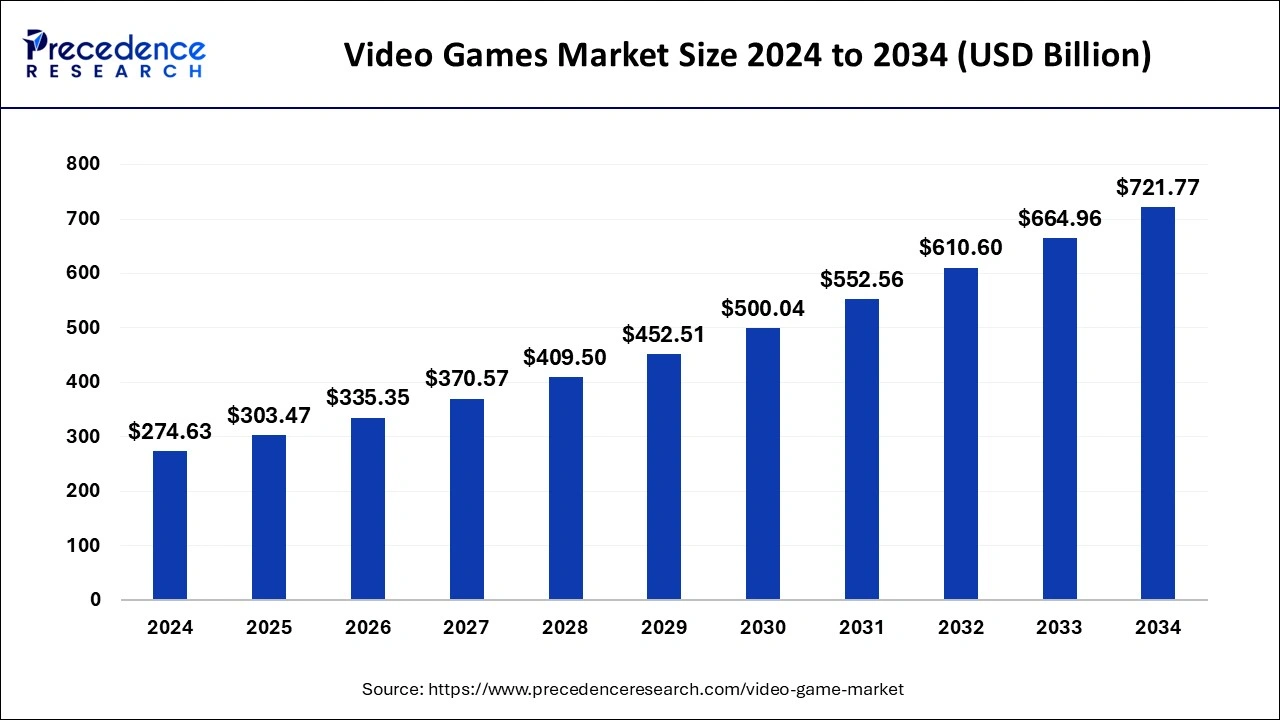
The global video games market was valued at USD 303.47 billion in 2025. The market is expected to grow from USD 335.35 billion in 2026 to approximately USD 776.95 billion by 2035, registering a CAGR of 9.86% during the forecast period from 2026 to 2035.
Key Takeaway
- By region, Asia Pacific led the video games market in 2025 with a 55% share.
- By region, Europe is expected to grow at a significant between 2026 and 2035.
- By type, the offline segment dominated the market with a 65% share in 2025.
- By type, the online segment is expected to expand at the fastest CAGR during the projection period.
- By platform, the mobile segment dominated the market with a 42% share in 2025.
- By platform, the console segment is expected to grow at a rapid pace over the projection period.
Video Games Market Overview
Video games are interactive digital entertainment experiences that allow players to engage with virtual environments using devices such as keyboards, controllers, joysticks, or touchscreens. Beyond entertainment, video games are used for relaxation, social interaction, competition, education, and skill development. Certain games can help improve cognitive abilities, fine motor skills, problem-solving, and hand-eye coordination.
The video game industry is driven by continuous innovation, as players consistently seek new and immersive gaming experiences. To meet evolving consumer expectations, developers and manufacturers invest heavily in advanced technologies, improved graphics, artificial intelligence, cloud gaming, virtual reality (VR), augmented reality (AR), and next-generation gaming consoles. This focus on innovation has accelerated the development of gaming hardware and software, contributing significantly to the growth of the global video games market.
Impact of Artificial Intelligence on the Video Games Market
Artificial Intelligence (AI) is reshaping the video games industry by improving game development processes, enhancing player engagement, and delivering more immersive gaming experiences. AI-powered non-player characters (NPCs) can dynamically adjust their behavior, dialogue, and decision-making based on player actions, creating realistic and personalized gameplay. This adaptability increases player satisfaction, retention, and replayability by ensuring that each gaming session feels unique.
AI is also transforming game development through procedural content generation (PCG), which uses advanced algorithms and generative AI technologies to automatically create game environments, characters, quests, levels, and storylines. This approach reduces development time and costs while enabling developers to build larger, richer, and more diverse virtual worlds.
Furthermore, AI-driven tools support automated game testing, bug detection, performance optimization, and personalized content recommendations. These capabilities help game studios improve game quality, accelerate development cycles, and deliver tailored experiences that align with individual player preferences. As AI technologies continue to advance, they are expected to play a critical role in driving innovation and growth across the global video games market.
Market Regional Analysis: North America, Europe, Asia-Pacific
What is the Asia Pacific Video Games Market Size?
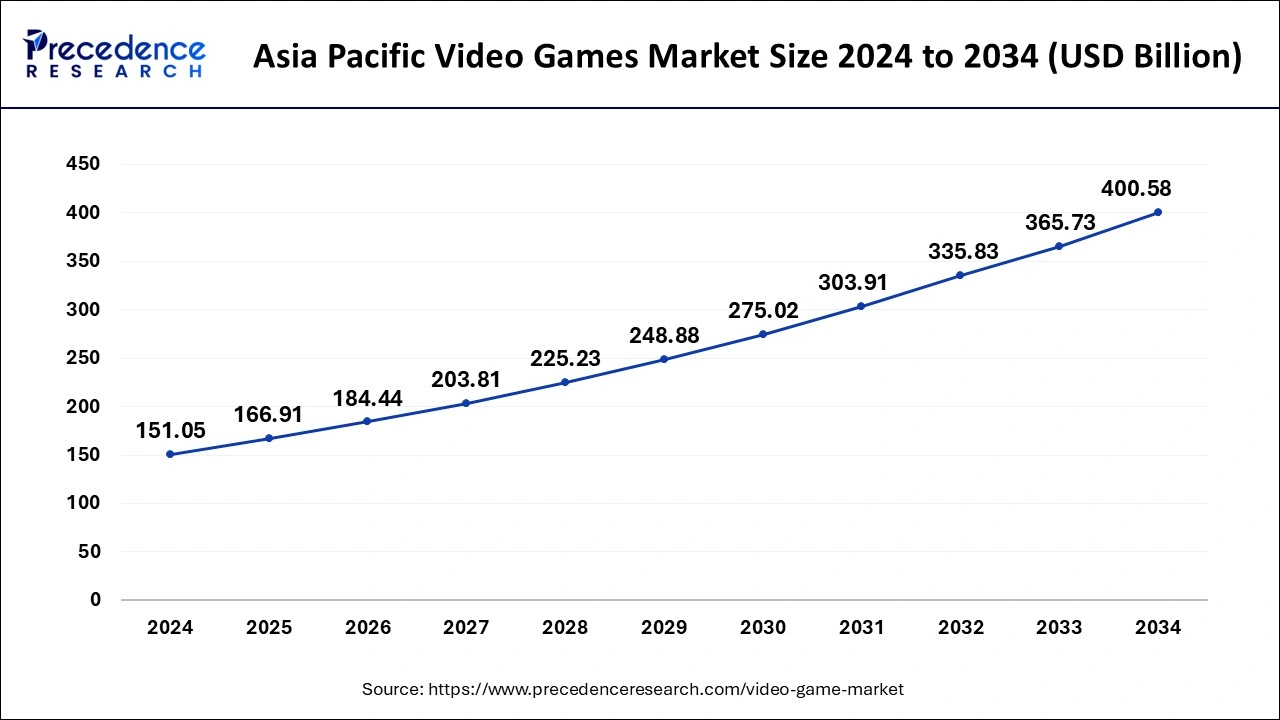
The Asia Pacific video game market was valued at USD 166.91 billion in 2025 and is projected to reach approximately USD 432.13 billion by 2035. The market is expected to expand at a compound annual growth rate (CAGR) of 9.98% during the forecast period from 2026 to 2035.
Asia Pacific: The Dominant Region
Asia Pacific dominated the video games market by holding a major share of 55% in 2025 and is expected to expand at the fastest CAGR during the forecast period. This is mainly due to a massive gaming population, increasing smartphone penetration, affordable internet access, and strong adoption of mobile and online gaming platforms. Countries across the region, including China, Japan, South Korea, India, and Southeast Asian countries, are witnessing rising gaming engagement as consumers spend more time on digital entertainment platforms. The region’s strong esports ecosystem, growing gaming communities, and investments in technologies such as AI, virtual reality (VR), and augmented reality (AR) are further accelerating market expansion.
North America: The Second-Largest Market
North America held the second-largest position in the market in 2025 by holding a 22% share, driven by strong demand for premium gaming experiences, advanced gaming hardware, and innovative game development. The region continues to influence global gaming trends through open-world games, multiplayer ecosystems, user-generated content, and high-quality storytelling. The presence of major game developers, publishers, and technology companies supports continuous innovation in graphics, AI integration, and immersive gameplay.
Europe: Emerging as a Significant Growth Region
Europe is expected to witness significant growth in the video games market during the projection period due to increasing gaming adoption, strong developer presence, and rising integration of gaming into mainstream entertainment and culture. The region has a well-established gaming ecosystem with globally recognized studios, publishers, and esports communities contributing to market development. Growth is also supported by increasing adoption of digital distribution, online gaming platforms, and immersive technologies such as VR and AR.
Market Segmentation Analysis
Type Insights
How Did the Offline Segment Dominated the Video Games Market in 2025?
The offline segment held the largest share of the video games market in 2025, driven by strong consumer demand for immersive gameplay, rich storytelling, and uninterrupted gaming experiences. Offline games offer deeper player engagement through character progression, complex narratives, and expansive virtual worlds that do not rely on internet connectivity.
The segment’s growth is further supported by the ability to play without concerns related to network latency, server outages, connectivity issues, or online service interruptions. Many players continue to prefer offline gaming for its reliability, enhanced focus on single-player experiences, and access to premium content without requiring a constant internet connection. These advantages have helped maintain the offline segment’s leading position within the global video games market.
What Made Mobile the Leading Segment in the Video Games Market in 2025?
The mobile gaming segment accounted for the largest share of the video games market in 2025, driven by the widespread adoption of smartphones, increasing access to affordable internet services, and the convenience of playing games anytime and anywhere. Mobile devices have made gaming more accessible to a broader audience, contributing significantly to market expansion.
The popularity of free-to-play (F2P) business models, supported by in-app purchases, subscriptions, and microtransactions, has enabled game developers to attract large user bases while generating recurring revenue. Additionally, the availability of diverse gaming genres, regular content updates, and user-friendly app distribution platforms has further strengthened the appeal of mobile gaming. These factors have established mobile gaming as one of the most widely adopted and fastest-growing segments of the global video games market.
Video Games Market Companies
Tencent Holdings Limited: Tencent is one of the world’s largest gaming companies, with major stakes in leading game developers and publishers across the globe. Its gaming portfolio includes popular titles such as Honor of Kings and PUBG Mobile, serving millions of players worldwide.
Nintendo of America Inc.: Nintendo of America is the North American subsidiary of Nintendo and is known for iconic gaming franchises such as Mario, The Legend of Zelda, and Pokémon. The company plays a key role in marketing and distributing Nintendo products across the region.
Activision Blizzard, Inc.: Activision Blizzard is a major video game publisher recognized for blockbuster franchises including Call of Duty, World of Warcraft, and Diablo. The company has a strong presence in console, PC, and online gaming markets.
Electronic Arts Inc.: Electronic Arts (EA) is a leading game developer and publisher known for sports, action, and simulation games. Its popular franchises include EA Sports FC, Madden NFL, and The Sims.
Microsoft Corporation: Microsoft is a global technology company that operates the Xbox gaming ecosystem, including consoles, cloud gaming services, and game studios. Its acquisition strategy has strengthened its position in the global gaming industry.
Sony Corporation: Sony is a leading player in the gaming market through its PlayStation brand, one of the most successful gaming platforms worldwide. The company also develops exclusive games and advanced gaming hardware technologies.
Take-Two Interactive Software, Inc.: Take-Two Interactive is a prominent video game publisher known for successful franchises such as Grand Theft Auto (GTA), Red Dead Redemption, and NBA 2K. The company focuses on creating high-quality, immersive gaming experiences across multiple platforms.
Check this report to: ICU ECG Patient Market
Get this report to explore global market size, share, CAGR, and trends, featuring detailed segmental analysis and an insightful competitive landscape overview: https://www.precedenceresearch.com/sample/3218
📩You can place an order or ask any questions. Please feel free to contact us at sales@precedenceresearch.com |+1 804 441 9344
