
 by
by The U.S. vehicle-to-grid technology market is undergoing rapid transformation as electric vehicles evolve from simple transportation assets into intelligent energy resources capable of supporting the nation’s power infrastructure. The market size is estimated at USD 1.85 billion in 2025 and is projected to grow from USD 2.45 billion in 2026 to approximately USD 30.84 billion by 2035, expanding at a remarkable CAGR of 32.49% during the forecast period.
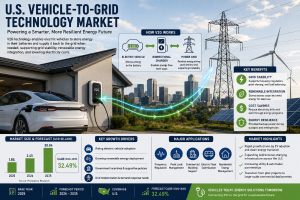
The market is primarily driven by the accelerating adoption of electric vehicles (EVs), increasing investments in renewable energy integration, and the growing need for smarter and more resilient electricity grids. Vehicle-to-grid technology enables electric vehicles equipped with bidirectional charging systems to return stored electricity back to the power grid during periods of peak demand, creating new opportunities for energy optimization, grid balancing, and revenue generation for EV owners. As renewable energy sources such as solar and wind become a larger part of the U.S. electricity mix, maintaining grid stability has become increasingly challenging due to their intermittent nature. V2G technology addresses this challenge by allowing electric vehicles to function as distributed energy storage systems that absorb surplus renewable energy and supply electricity back to the grid when needed. This capability supports grid reliability while maximizing the utilization of clean energy resources.
U.S. Vehicle-to-Grid Technology Market Overview
Vehicle-to-grid (V2G) technology represents one of the most significant innovations in the modern energy sector by enabling electric vehicles to interact intelligently with the electrical grid through bidirectional charging systems. Unlike traditional charging methods, where electricity flows only from the grid to the vehicle, V2G allows electricity to flow in both directions. This enables electric vehicles to store electricity when demand is low and supply excess power back to the grid during periods of peak consumption. The technology transforms electric vehicles into distributed energy storage assets that contribute to grid stability, renewable energy integration, emergency backup power, and demand-response programs. By utilizing thousands of connected EV batteries, utilities can better manage fluctuations in electricity demand while reducing dependence on fossil-fuel-powered peaking plants.
The rapid growth of electric vehicle ownership across the United States is significantly expanding the addressable market for V2G technology. As battery capacities increase and charging infrastructure becomes more sophisticated, EVs are evolving into critical components of the nation’s future energy ecosystem. Another major factor supporting market expansion is the modernization of the U.S. power grid. Utilities are increasingly investing in smart grid technologies capable of communicating with connected vehicles, charging stations, renewable energy systems, and distributed energy resources in real time. These digital energy networks improve electricity distribution efficiency while enhancing resilience against power outages and extreme weather events.
U.S. Vehicle-to-Grid Technology Market Scope
| Report Coverage | Details |
|---|---|
| U.S. Market Size in 2025 | USD 1.85 Billion |
| U.S. Market Size in 2026 | USD 2.45 Billion |
| U.S. Market Size by 2035 | USD 30.84 Billion |
| Growth Rate (2026–2035) | CAGR of 32.49% |
| Base Year | 2025 |
| Forecast Period | 2026 to 2035 |
| Segments Covered | Component Type, State |
| States Covered | California, Texas, New York, Rest of U.S. |
Download Sample: https://www.precedenceresearch.com/sample/3738
U.S. Vehicle-to-Grid Technology Market Growth Factors
Rising Electric Vehicle Adoption Across the United States
- The growing popularity of electric vehicles is creating a strong foundation for the expansion of vehicle-to-grid technology. As EV ownership continues to rise among individual consumers, commercial fleets, public transportation systems, and government agencies, the number of batteries connected to the electricity grid is increasing rapidly. Every connected electric vehicle represents a potential mobile energy storage unit capable of supporting grid operations. The expanding EV fleet is therefore significantly increasing the demand for bidirectional charging infrastructure and intelligent energy management solutions.
Growing Need for Grid Stability and Energy Resilience
- The rapid integration of renewable energy sources such as solar and wind has introduced new challenges for electricity grid operators due to fluctuations in power generation. Vehicle-to-grid technology provides an effective solution by allowing electric vehicles to absorb excess renewable electricity during periods of high production and discharge energy back into the grid when demand increases. This capability improves grid flexibility, enhances energy resilience, and reduces the need for expensive backup power generation.
Government Incentives and Supportive Energy Policies
- Federal and state governments continue to introduce policies that encourage transportation electrification and grid modernization. Funding programs under the Infrastructure Investment and Jobs Act, Inflation Reduction Act, and Department of Energy initiatives are accelerating the deployment of EV charging infrastructure and V2G pilot projects. Utility rebate programs, tax incentives, and clean energy regulations are also encouraging businesses and consumers to invest in vehicle-grid integration technologies.
Advancements in Bidirectional Charging Technologies
- Technological innovation is making V2G systems more efficient, reliable, and commercially viable. New generations of bidirectional chargers offer improved energy conversion efficiency, enhanced cybersecurity, better communication protocols, and seamless interoperability between vehicles, charging stations, and utility systems. These advancements are reducing installation costs while improving overall system performance and user experience.
Increasing Investments in Smart Grid Infrastructure
- Utilities across the United States are investing heavily in digital grid modernization projects that incorporate advanced metering infrastructure, IoT connectivity, cloud computing, and automated energy management systems. These smart grids provide the digital foundation required for large-scale vehicle-to-grid deployment by enabling real-time communication between EVs and electricity networks.
Expansion of Commercial and Fleet Electrification
- Businesses operating delivery fleets, logistics vehicles, transit buses, municipal vehicles, and school buses are increasingly adopting electric transportation. Fleet operators recognize V2G technology as an opportunity to generate additional revenue by selling stored electricity back to the grid during peak demand periods while lowering fleet operating costs. This growing commercialization is expected to become one of the strongest drivers of market expansion over the next decade.
Why the U.S. Vehicle-to-Grid Technology Market is Growing
The U.S. vehicle-to-grid technology market is experiencing exceptional growth due to the convergence of transportation electrification, renewable energy expansion, and nationwide grid modernization efforts. As the number of electric vehicles continues to increase, utilities are recognizing the enormous potential of EV batteries to function as distributed energy storage assets capable of improving electricity reliability and supporting renewable energy integration.
Growing concerns about climate change, rising electricity demand, aging grid infrastructure, and the need to reduce dependence on fossil fuels are encouraging governments and utilities to accelerate investments in V2G ecosystems. The ability of vehicle-to-grid technology to improve energy efficiency, lower electricity costs, and generate additional income for EV owners makes it an attractive solution for consumers, businesses, and utility providers alike.
At the same time, continuous innovation in bidirectional charging hardware, artificial intelligence, cloud computing, battery management systems, and digital energy platforms is making vehicle-grid integration increasingly scalable and commercially viable. As interoperability standards improve and pilot projects transition into full-scale commercial deployments, V2G technology is expected to play a central role in the future of the U.S. clean energy economy.
Latest Trends in the U.S. Vehicle-to-Grid Technology Market
Rapid Expansion of Bidirectional Charging Infrastructure
- One of the most significant trends shaping the U.S. vehicle-to-grid (V2G) technology market is the rapid deployment of bidirectional charging infrastructure. Unlike conventional EV chargers that only deliver electricity to vehicles, bidirectional chargers enable two-way energy transfer, allowing EV batteries to both charge from and discharge electricity back to the grid. Utilities, charging network operators, and private infrastructure providers are investing heavily in advanced charging stations that support residential, commercial, and public charging applications.
- As charging infrastructure expands nationwide, bidirectional charging is becoming a critical component of smart energy ecosystems. The growing availability of compatible charging equipment is expected to accelerate commercial adoption and improve the practicality of V2G services across homes, businesses, fleet depots, and public transportation networks.
Integration with Renewable Energy Systems
- The growing deployment of renewable energy sources, particularly solar and wind power, is creating new opportunities for vehicle-to-grid technology. Renewable energy generation is naturally variable, producing excess electricity during favorable weather conditions while generating less power during periods of low sunlight or weak wind.
- Vehicle-to-grid technology addresses this challenge by transforming electric vehicles into flexible energy storage systems. EV batteries can store surplus renewable electricity during periods of high generation and supply it back to the grid when renewable production declines or electricity demand peaks. This capability improves renewable energy utilization, reduces energy waste, and enhances overall grid reliability while supporting national clean energy goals.
Increasing Utility and Automaker Partnerships
- Collaboration between utilities, automakers, charging equipment manufacturers, and software developers has become a defining trend in the V2G market. Companies are working together to develop standardized communication protocols, improve system interoperability, and create integrated energy management platforms that simplify participation in vehicle-to-grid programs.
- Major automakers are increasingly designing electric vehicles with factory-installed bidirectional charging capabilities, while utility companies are launching pilot programs that reward EV owners for participating in demand-response and grid-balancing initiatives. These partnerships are helping accelerate commercialization and build consumer confidence in V2G technology.
Commercialization of Fleet-Based V2G Solutions
- Commercial fleet operators are emerging as one of the largest adopters of vehicle-to-grid technology. Electric school buses, delivery vehicles, municipal fleets, transit buses, and corporate transportation fleets often remain parked for predictable periods, making them ideal participants in grid-support programs.
- Fleet operators can generate additional revenue by supplying stored electricity back to the grid during periods of high demand while reducing electricity costs through intelligent charging schedules. As more commercial fleets transition to electric vehicles, fleet-based V2G deployments are expected to become a major source of market growth.
Smart Grid Modernization and Digital Energy Management
- Utilities across the United States are rapidly modernizing power grids through investments in smart meters, digital substations, IoT-enabled monitoring systems, cloud computing, and advanced communication networks. These smart grid technologies enable real-time coordination between electric vehicles, charging stations, renewable energy sources, and electricity distribution systems.
- Digital energy management platforms optimize charging schedules, forecast electricity demand, monitor battery performance, and automatically respond to fluctuations in grid conditions. This integration significantly improves operational efficiency while enhancing grid stability and energy security.
Growing Consumer Participation in Energy Markets
- Vehicle-to-grid technology is creating new economic opportunities for electric vehicle owners by allowing them to participate directly in electricity markets. Through utility incentive programs and virtual power plant (VPP) platforms, EV owners can earn financial rewards for providing electricity during periods of peak demand or participating in demand-response events.
- As electricity pricing becomes increasingly dynamic, consumers are recognizing the financial benefits of intelligent charging and energy trading. This trend is expected to encourage broader adoption of V2G-compatible vehicles and charging infrastructure over the coming years.
What is the Role of Artificial Intelligence in the U.S. Vehicle-to-Grid Technology Market?
- Artificial Intelligence (AI) is becoming one of the most transformative technologies driving the evolution of vehicle-to-grid systems. As millions of electric vehicles become connected to increasingly complex power grids, managing energy flows manually becomes impractical. AI enables automated, intelligent decision-making that improves efficiency, reliability, and economic value across the entire V2G ecosystem.
- AI-powered energy management platforms continuously analyze vast amounts of real-time data, including electricity demand, renewable energy generation, charging behavior, battery conditions, weather forecasts, and grid performance. Based on these insights, AI algorithms determine the optimal times for charging or discharging vehicle batteries, maximizing financial returns while supporting overall grid stability.
- Machine learning models also play an important role in predicting electricity consumption patterns and renewable energy availability. By forecasting periods of high electricity demand or excess renewable generation, AI systems can automatically coordinate thousands of connected electric vehicles to balance the grid efficiently without disrupting vehicle availability for owners.
- Battery health management is another major application of artificial intelligence within V2G technology. Frequent charging and discharging cycles can impact battery lifespan if not properly managed. AI continuously monitors battery temperature, state of charge, degradation rates, and usage history to optimize charging strategies that extend battery life while maximizing grid participation.
- Artificial intelligence also enhances cybersecurity by identifying abnormal communication patterns, detecting potential cyber threats, and protecting sensitive energy infrastructure from unauthorized access. As vehicle-grid connectivity expands, AI-driven security systems will become increasingly important for maintaining safe and reliable energy networks.
- Furthermore, AI supports virtual power plants (VPPs) by coordinating thousands of distributed energy resources—including electric vehicles, home batteries, and renewable energy systems—as a single intelligent energy asset. This enables utilities to improve grid reliability while reducing dependence on traditional power plants.
- As artificial intelligence continues to evolve alongside cloud computing, Internet of Things (IoT) connectivity, and advanced analytics, it is expected to become one of the most significant competitive differentiators in the U.S. vehicle-to-grid technology market.
Five Key Forces Driving U.S. Vehicle-to-Grid Technology Market Growth
1. Rapid Growth in Electric Vehicle Adoption
- The rapid expansion of electric vehicle ownership is the single most important factor driving the growth of the U.S. vehicle-to-grid technology market. Consumers, businesses, and government agencies are increasingly transitioning to electric mobility due to environmental concerns, favorable government incentives, lower operating costs, and continuous improvements in battery technology.
- Every newly deployed electric vehicle adds valuable battery storage capacity that can potentially support electricity grid operations. As millions of EVs enter the market over the next decade, utilities will gain access to a vast network of distributed energy resources capable of improving grid reliability and reducing electricity shortages.
- In addition to passenger vehicles, electric school buses, delivery vans, public transportation fleets, and commercial vehicles are becoming important contributors to large-scale V2G deployment. This growing electrification of transportation is expected to create enormous long-term opportunities for bidirectional charging technologies.
2. Increasing Integration of Renewable Energy Sources
- The continued expansion of renewable energy generation is significantly increasing the need for flexible energy storage solutions capable of balancing intermittent electricity production. Solar panels and wind farms frequently generate excess electricity during favorable weather conditions while producing less power during periods of high demand.
- Vehicle-to-grid technology enables electric vehicles to store surplus renewable energy and discharge electricity back into the grid when renewable generation declines. This flexibility improves renewable energy utilization, reduces electricity curtailment, and decreases dependence on fossil-fuel-based backup generation.
- As federal and state governments continue investing in renewable energy infrastructure, the demand for V2G-enabled energy storage solutions is expected to rise substantially.
3. Government Support and Favorable Energy Policies
- Government initiatives continue to play a vital role in accelerating the commercialization of vehicle-to-grid technology across the United States. Federal funding programs, tax credits, utility incentives, clean transportation policies, and investments in charging infrastructure are creating favorable conditions for market expansion.
- Programs supported by the Department of Energy, Infrastructure Investment and Jobs Act (IIJA), Inflation Reduction Act (IRA), and state-level clean energy initiatives are encouraging utilities, businesses, and consumers to adopt bidirectional charging technologies. These supportive policies reduce investment risks while accelerating infrastructure deployment and technological innovation.
4. Continuous Advancements in Smart Charging and Battery Technologies
- Technological innovation continues to improve the efficiency, affordability, and reliability of vehicle-to-grid systems. Modern bidirectional chargers offer faster charging speeds, higher energy conversion efficiency, improved communication capabilities, and greater compatibility with multiple electric vehicle models.
- At the same time, battery technology is advancing rapidly through improvements in energy density, charging performance, thermal management, and battery management systems. These developments reduce concerns regarding battery degradation while improving the long-term economic benefits of V2G participation for vehicle owners.
- As technology costs continue to decline, V2G systems are becoming increasingly accessible across residential, commercial, and industrial applications.
5. Growing Demand for Grid Reliability and Energy Resilience
- The U.S. electricity grid is facing increasing pressure from rising electricity demand, aging infrastructure, extreme weather events, and the growing share of renewable energy generation. Utilities are seeking innovative solutions that improve grid flexibility while minimizing infrastructure expansion costs.
- Vehicle-to-grid technology offers a highly scalable approach by leveraging existing electric vehicle batteries as distributed energy storage assets. During periods of peak demand, connected vehicles can supply electricity back to the grid, helping utilities maintain stable operations, reduce peak load stress, and prevent power outages.
- As concerns over energy resilience continue to grow, V2G technology is expected to become an increasingly important component of future smart grid strategies across the United States.
U.S. Vehicle-to-Grid Technology Market Opportunities
Expansion of Virtual Power Plants (VPPs)
- The growing adoption of virtual power plants presents a significant opportunity for the U.S. vehicle-to-grid (V2G) technology market. Virtual power plants aggregate distributed energy resources such as electric vehicles, battery storage systems, rooftop solar installations, and smart appliances into a unified energy network that can be managed as a single power plant. As utilities seek cost-effective ways to improve grid reliability, V2G-enabled electric vehicles are becoming an essential component of VPP ecosystems. This trend is expected to create new revenue opportunities for EV owners while helping utilities optimize electricity distribution and reduce infrastructure costs.
Growth of Commercial Fleet Electrification
- Commercial fleet electrification is opening substantial growth opportunities for V2G technology providers. Logistics companies, public transportation agencies, school districts, municipalities, and delivery service operators are rapidly replacing conventional vehicles with electric alternatives. Since fleet vehicles typically follow predictable schedules and remain parked for extended periods, they are well suited for participating in grid-support programs. Fleet operators can generate additional revenue through energy trading while reducing electricity costs, creating a compelling business case for large-scale V2G adoption.
AI-Enabled Smart Energy Management
- Artificial intelligence is creating new opportunities to optimize vehicle-grid interactions through intelligent energy management platforms. AI-driven software can forecast electricity demand, optimize charging schedules, monitor battery health, and automate participation in electricity markets. These advanced capabilities improve operational efficiency while maximizing financial returns for utilities and EV owners. As AI technologies become increasingly sophisticated, they are expected to enhance the scalability and commercial viability of V2G solutions across residential, commercial, and industrial applications.
Increasing Renewable Energy Integration
- The continued expansion of renewable energy generation is expected to create sustained demand for advanced energy storage technologies. Vehicle-to-grid systems enable electric vehicles to absorb excess electricity generated by solar and wind farms and return stored energy to the grid during periods of peak demand. This capability improves renewable energy utilization while reducing curtailment and strengthening overall grid resilience. As the United States continues its transition toward a cleaner energy mix, V2G technology is expected to become an increasingly valuable asset within the renewable energy ecosystem.
Utility Modernization and Smart Grid Investments
- Utilities across the United States are investing heavily in digital grid modernization, advanced metering infrastructure, cloud-based energy management platforms, and smart distribution networks. These investments create an ideal environment for widespread deployment of vehicle-to-grid technologies. Enhanced communication capabilities, real-time monitoring systems, and automated grid management platforms enable seamless coordination between electric vehicles and electricity networks, supporting large-scale commercialization of V2G solutions.
Why the Future Looks Promising
The long-term outlook for the U.S. vehicle-to-grid technology market remains exceptionally strong as the country accelerates its transition toward sustainable transportation and intelligent energy infrastructure. Rising electric vehicle adoption, expanding renewable energy capacity, continuous technological innovation, and supportive government policies are collectively creating favorable conditions for sustained market growth throughout the forecast period.
Future developments are expected to include faster bidirectional charging systems, improved battery technologies, AI-powered energy optimization platforms, cloud-based grid management solutions, and greater interoperability between electric vehicles and utility networks. These advancements will make V2G technology increasingly efficient, reliable, and economically attractive for consumers, businesses, and utility providers.
The commercialization of virtual power plants, fleet electrification programs, and decentralized energy systems is expected to further expand market opportunities over the coming decade. Companies investing in advanced charging infrastructure, software platforms, artificial intelligence, and strategic utility partnerships are likely to strengthen their competitive positions while contributing to a more resilient and sustainable U.S. energy ecosystem.
Recent Developments in the U.S. Vehicle-to-Grid Technology Market
- March 2026: Xos announced plans to begin production of new electric vehicles equipped with built-in vehicle-to-grid capability. The rollout will initially focus on a major North American electric school bus platform, supporting grid balancing and emergency backup power applications.
- February 2026: Tesla introduced its Powershare Grid Support Program, enabling Cybertruck owners in selected Texas markets to export electricity back to the grid during peak demand periods. The initiative allows customers served by CenterPoint Energy and Oncor to earn electricity bill credits while improving grid reliability.
- August 2025: Eaton and ChargePoint jointly introduced the ChargePoint Express Grid, a high-power DC vehicle-to-everything (V2X) charging solution supporting up to 600 kW for passenger vehicles and megawatt-scale charging for heavy-duty commercial fleets.
- January 2025: Nuvve Holding Corp. expanded its portfolio by launching a new generation of bidirectional and unidirectional chargers ranging from 20 kW to 360 kW, targeting fleet operators, public charging infrastructure, commercial facilities, and microgrid applications.
Read More: Non-Invasive Prenatal Testing Market
U.S. Vehicle-to-Grid Technology Market Companies
Major companies operating in the market include:
- ABB Ltd.
- AC Propulsion, Inc.
- Edison International
- EV Grid, Inc.
- Fermata Energy
- Hitachi, Ltd.
- Honda Motor Co., Ltd.
- NRG Energy, Inc.
- Nuvve Holding Corp.
- Wallbox Inc.
- Tesla, Inc.
- ChargePoint Holdings, Inc.
- Eaton Corporation
- Siemens AG
- Ford Motor Company
- General Motors
- Pacific Gas & Electric (PG&E)
- Southern California Edison (SCE)
- Duke Energy
- Enel X
Segments Covered in the Report
By Component Type
Hardware
- Bidirectional Chargers (AC)
- Bidirectional Chargers (DC)
- Vehicle-side Bidirectional Electronics
- Grid Integration Hardware
Software
- Smart Charging Platforms
- Energy Management Systems
- Aggregator & Virtual Power Plant (VPP) Platforms
- Connectivity & Cloud Services
- AI-Based Grid Optimization Software
Services
- Installation & Commissioning
- Operations & Maintenance
- Grid Integration Consulting
- Energy Trading Services
- Technical Support & Managed Services
Future Outlook
The future of the U.S. vehicle-to-grid technology market is exceptionally promising as transportation electrification, renewable energy expansion, and smart grid modernization continue to reshape the nation’s energy landscape. Over the next decade, electric vehicles are expected to evolve from transportation assets into intelligent distributed energy resources capable of supporting electricity generation, storage, and grid management.
Advancements in bidirectional charging technology, artificial intelligence, battery management systems, cloud computing, and Internet of Things (IoT) connectivity will significantly improve the efficiency and scalability of V2G solutions. These innovations will enable utilities to better balance electricity demand, integrate renewable energy sources, reduce operational costs, and improve overall grid resilience.
Government investments in charging infrastructure, clean transportation, and grid modernization are expected to accelerate commercialization across residential, commercial, industrial, and public-sector applications. Fleet electrification, virtual power plants, demand response programs, and decentralized energy systems will create additional opportunities for technology providers and utility companies.
You can place an order or ask any questions. Please feel free to contact us at sales@precedenceresearch.com | +1 804 441 9344
