
 by
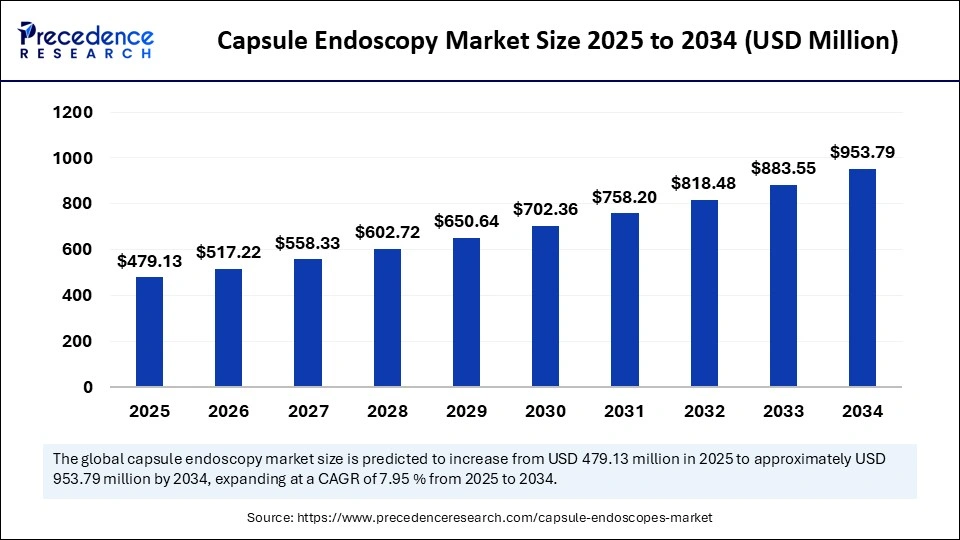
by The global capsule endoscopy market is primed for transformation, expected to surge from USD 443.84 million in 2024 to USD 953.79 million by 2034, propelled by a solid CAGR of 7.95% between 2025 and 2034.
Technological leaps in capsule design, battery life, and imaging power continue to anchor the market’s expansion, enabling healthcare systems to shift decisively toward non-invasive gastrointestinal diagnostics.
Capsule Endoscopy Market Key Insights
-
The market reached USD 443.84 million in 2024 and will climb to USD 479.13 million in 2025, doubling by 2034.
-
North America is the dominant region (40% share in 2024), underpinned by advanced health infrastructure and high adoption rates for minimally invasive diagnostics.
-
Asia Pacific holds the fastest growth rate, driven by healthcare investments, rising disease burden, and expanding medical tourism.
-
Small bowel capsules represent 45% of product share and remain the backbone of diagnostic practice.
-
Hospitals are top end-users (52% share), but ambulatory surgery centers and clinics are growing fastest due to convenience and lower costs.
-
Hardware (capsules, sensors) maintains a 55% component share, while software/AI analytics offer the steepest growth curve.
-
The U.S. capsule endoscopy market alone will reach USD 272.33 million by 2034 (8.16% CAGR).
Revenue Table: Global Capsule Endoscopy Market
| Year | Market Size (USD Million) |
|---|---|
| 2024 | 443.84 |
| 2025 | 479.13 |
| 2034 | 953.79 |
Artificial intelligence is radically enhancing capsule endoscopy by automating image analysis and narrowing diagnostic times. With advanced machine learning, AI detects abnormalities such as bleeding, polyps, and ulcers from thousands of images, alleviating clinician workload and boosting diagnostic accuracy. AI integration has enabled real-time alerts for capsule retention and improved lesion characterization between benign and malignant findings. The synergy between AI, cloud platforms, and capsule imaging is set to improve diagnostic consistency and expand access to remote and underserved communities worldwide.
As capsule endoscopy technology advances, AI adoption is poised to accelerate growth by increasing the utility of capsules and reducing the risk of human error. Through partnerships between device manufacturers and AI specialists, solutions such as instant image transmission and automated reporting are on the rise, making diagnostics more robust and affordable in emerging markets.
Get this report to explore global market size, share, CAGR, and trends, featuring detailed segmental analysis and an insightful competitive landscape overview @ https://www.precedenceresearch.com/sample/6889
What’s Driving Capsule Endoscopy Market Growth?
The key growth drivers are:
-
Rising prevalence of GI disorders—linked to poor dietary habits, aging populations, and higher cancer rates—fuels demand for early, comfortable diagnostics.
-
Technological innovation in capsules (HD imaging, miniaturized sensors, longer battery life) improves both efficacy and patient acceptance.
-
Healthcare systems are prioritizing outpatient solutions, and capsule endoscopy fits seamlessly into this approach.
-
Favorable reimbursement policies in advanced economies make capsule procedures financially accessible to wider populations.
What Opportunities and Trends Will Shape Market Evolution?
How Will Expanding Applications Beyond GI Drive Market Opportunity?
Significant growth is expected from capsules adapted for colon and esophageal screening, broadening patient pools and fueling adoption in colorectal cancer programs. Innovations like targeted drug delivery and physiological monitoring open new frontiers for personalized medicine, while cloud connectivity and remote diagnostics link hospitals and rural clinics, increasing the reach of capsule endoscopy.
Is AI Integration the Key Growth Trend?
Cloud storage, automated image analysis, and tele-diagnostics powered by AI are trends unlocking real-time reporting and remote access for facilities worldwide. These technologies lower interpretation times and raise accuracy, particularly in regions facing shortages of gastroenterologists.
Regional and Segmentation Analysis
-
North America leads (40% share), benefiting from high healthcare expenditure, clinical validation, and widespread use of AI imaging.
-
Asia Pacific posts the fastest growth, backed by expanding healthcare infrastructure, greater disease awareness, and urban hospital pilot programs—especially in India, China, and South Korea.
-
Segmentation breakdown:
-
Product Type: Small bowel capsules remain dominant (45% share), colon capsules are the fastest growth segment for colorectal cancer screening, specialized capsules rise for motility and esophageal studies.
-
Application: GI bleeding diagnosis claims 38% share, followed by Crohn’s disease and polyp detection—fastest growing due to the need for preventive care and advanced imaging accuracy.
-
End-User: Hospitals dominate (52%), but clinics/diagnostic centers are reshaping the market in outpatient settings.
-
Component: Hardware is essential for modality (capsule, sensors), but software and analytics will be the future’s main growth factor.
-
Capsule Endoscopy Market Companies
- Medtronic plc
- Olympus Corporation
- IntroMedic Co., Ltd.
- CapsoVision, Inc.
- Given Imaging
- Chongqing Jinshan Science & Technology
- RF Co., Ltd.
- SmartPill
- Yoqneam Ltd.
- Ankon Technologies Co., Ltd.
- Intromedic USA, Inc.
- Medivators
- Check-Cap Ltd.
- EndoChoice, Inc.
- Preventice Solutions, Inc.
- Shenzhen Jinshan Science & Technology
- i-SCAN
Challenges and Cost Pressures
-
High device and procedural cost is a leading barrier, especially in low- and middle-income countries lacking strong reimbursement programs.
-
Capsule retention risks in patients with strictures and technical limitations in smaller facilities (lack of AI platforms) slow broader adoption.
-
The level of awareness among patients and clinicians remains low in emerging regions, threatening market penetration if not addressed.
Case Study Spotlight
One notable application expansion: hospitals in urban India are piloting capsule endoscopy driven by falling device costs and remote AI diagnostics, improving early detection in rural populations. These pilots showcase the potential for broader adoption in high-growth settings, with lessons for providers in Latin America and Africa.
Read Also: Lymphoma Treatment Market
You can place an order or ask any questions. Please feel free to contact us at sales@precedenceresearch.com |+1 804 441 9344
