
 by
by What is the Cosmetic chemicals market Size in 2026?
The global cosmetic chemicals market is witnessing steady expansion, fueled by increasing consumer awareness regarding personal grooming, rapid product innovation, and the growing preference for organic and sustainable beauty products. According to recent analysis, the market is projected to grow at a CAGR of 5.8% from 2025 to 2034, reaching an estimated value of USD 48.92 billion by 2034, up from USD 27.68 billion in 2024.
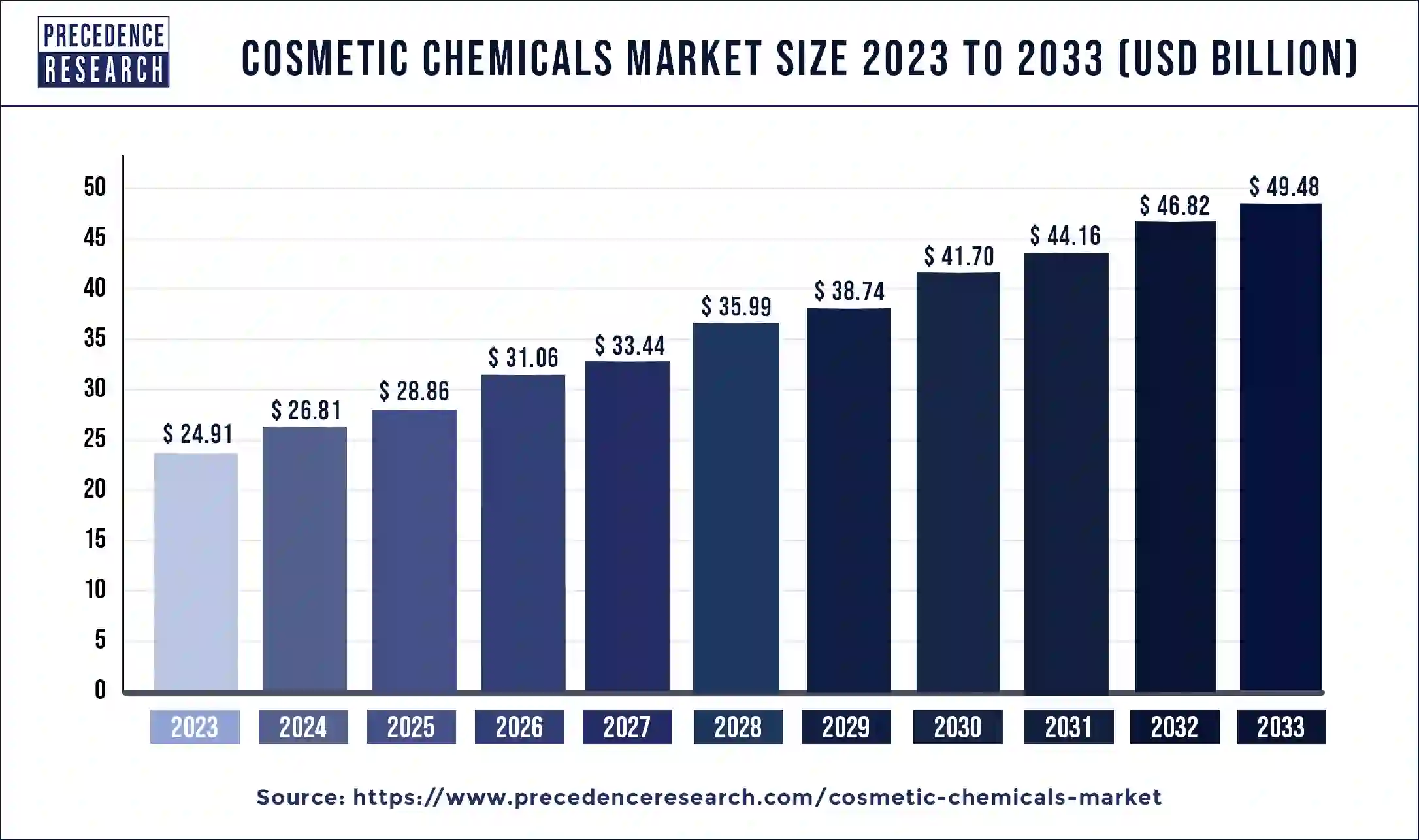
The surge in demand for skincare, haircare, and color cosmetics—particularly among younger demographics—along with the rapid penetration of e-commerce platforms, is significantly contributing to market growth. Additionally, regulatory support for safer ingredients and the shift toward eco-friendly formulations are reshaping the competitive landscape.
What’s Driving the Cosmetic Chemicals Market?
The global cosmetic chemicals market was valued at USD 27.68 billion in 2024 and is expected to reach USD 48.92 billion by 2034, growing at a CAGR of 5.8%.
Asia Pacific dominated the market in 2024 due to high consumption and expanding manufacturing hubs.
Emollients emerged as the leading product segment owing to their extensive use in skincare formulations.
Skincare applications accounted for the largest revenue share due to increasing consumer focus on skin health.
Leading players such as BASF SE, Dow Inc., Evonik Industries AG, and Croda International Plc are driving innovation in sustainable cosmetic ingredients.
How is AI Transforming the Cosmetic Chemicals Market?
Artificial Intelligence is playing a transformative role in the cosmetic chemicals industry by accelerating product development cycles and enhancing formulation precision. AI-driven platforms are enabling manufacturers to analyze vast datasets related to skin types, environmental conditions, and ingredient interactions, leading to more personalized and effective cosmetic solutions.
Furthermore, AI is optimizing supply chain management and demand forecasting, allowing companies to reduce waste and improve operational efficiency. Predictive analytics tools are also helping brands identify emerging consumer preferences, ensuring faster time-to-market for innovative cosmetic products.
What Are the Key Growth Drivers Shaping the Market?
The cosmetic chemicals market is expanding due to several strong growth drivers. Increasing disposable income and urbanization are encouraging consumers to spend more on premium personal care products. Additionally, the rising influence of social media and beauty trends is significantly boosting product demand.
The shift toward natural and organic cosmetics is another major factor. Consumers are increasingly avoiding synthetic ingredients, prompting manufacturers to invest in plant-based and biodegradable alternatives. Regulatory bodies across regions are also encouraging safer formulations, further supporting market growth.
Report Scope
| Report Coverage | Details |
| Market Size in 2025 | USD 26.81 Billion |
| Market Size in 2026 | USD 28.86 Billion |
| Market Size by 2035 | USD 52.14 Billion |
| Growth Rate from 2025 to 2034 | CAGR of 6.88% |
| Dominating Region | North America |
| Fastest Growing Region | Asia Pacific |
| Base Year | 2025 |
| Forecast Period | 2026 to 2035 |
| Segments Covered | Product Type, Application, Geography |
| Regions Covered | North America, Europe, Asia-Pacific, Latin America, and Middle East & Africa |
What Opportunities and Trends Are Emerging in the Market?
Is Sustainability the Future of Cosmetic Chemicals?
Yes, sustainability is becoming a defining trend in the market. Companies are focusing on biodegradable ingredients, eco-friendly packaging, and ethical sourcing practices to meet evolving consumer expectations.
Are Natural Ingredients Gaining Momentum?
Absolutely. There is a growing demand for herbal and plant-derived ingredients, particularly in skincare and haircare segments. This trend is pushing companies to innovate with clean-label products.
How is Digitalization Influencing the Market?
Digital platforms are enabling direct-to-consumer sales and personalized product recommendations, creating new growth avenues for cosmetic chemical manufacturers.
Cosmetic Chemicals Market Insights
Product Type Insights
In 2025, emollients and moisturizers dominated the cosmetic chemicals market. Their widespread use in skincare products reflects the growing consumer focus on hydration, anti-aging, and overall skin health.
A notable example came in February 2025, when Olay launched its Super Cream with SPF 30 in a premium glass jar. The product combines multiple benefits—hydration, firming, brightening, smoothing, and sun protection—highlighting the trend toward multifunctional skincare.
Meanwhile, the preservatives segment is expected to grow at the fastest pace between 2026 and 2035. This growth is driven by the increasing demand for safe, long-lasting products, even as brands explore natural alternatives. For instance, in May 2023, TARAMAR introduced preservative-free skincare made from organic, handpicked Icelandic ingredients, emphasizing clean and non-toxic formulations.
Overall, all product categories—such as surfactants, film-formers, and emulsifying agents—have shown steady growth from 2022 to 2024, with moisturizers leading in value.
Application Insights
The skincare segment showed strong performance in 2025, reflecting rising awareness of skin health and wellness. In April 2025, Croda Beauty Actives introduced Zenakine, a biotech-based ingredient designed to connect skin quality with overall well-being—illustrating how innovation is shaping the industry.
Looking ahead, the haircare segment is expected to gain significant market share between 2026 and 2035. Supporting this trend, Suave Brands Company launched 34 new products across hair, body, and men’s care in March 2025.
Across applications, skincare remains the largest segment, followed by haircare, makeup, oral care, and fragrances—all showing consistent growth.
Regional Insights
North America (U.S.)
North America, particularly the United States, holds the largest share of the cosmetic chemicals market. The U.S. market was valued at USD 7.83 billion in 2025 and is projected to reach around USD 15.57 billion by 2035, growing at a CAGR of 7.12%.
This growth is driven by:
High consumer spending on personal care
Rising demand for organic, vegan, and dermatologically tested products
Rapid growth of indie beauty brands and e-commerce
Increasing investment in R&D and biotechnology integration
Consumers in the U.S. are also highly engaged, with women using an average of 12 personal care products daily and men using about six. Skincare is increasingly seen as an investment in overall well-being.
Asia-Pacific
Asia-Pacific is expected to be the fastest-growing region. Rising disposable incomes in countries like China and India, along with evolving beauty trends, are driving demand.
China leads the region due to its large consumer base and strong demand for skincare products such as whitening, anti-aging, and anti-pollution solutions.
Growth is also supported by digital beauty platforms, domestic brand expansion, and a focus on product safety and performance.
Southeast Asian countries—including Thailand, Indonesia, Vietnam, and Malaysia—are also experiencing rapid growth.
A key development includes Symrise opening a cosmetic ingredient facility in Chennai, India, in September 2024 to strengthen its presence in the region.
Europe
Europe is expected to grow steadily at a CAGR of 5.28% from 2026 to 2035. Growth is supported by:
Strong focus on sustainability and transparency
Demand for natural and bio-based ingredients
Continued R&D investments
Germany leads the region due to its advanced chemical manufacturing capabilities and emphasis on innovation. Demand for organic and dermatologically tested products continues to rise.
Latin America
Latin America is emerging as a fast-growing market due to:
Increasing beauty awareness
Rising urban population
Demand for affordable personal care products
Brazil dominates the region, driven by strong beauty culture and high demand for haircare, skincare, and sun protection products. Local brands are increasingly using natural and functional ingredients, creating opportunities for suppliers.
Middle East & Africa
This region is seeing notable growth due to:
Rising disposable income
Influence of global beauty trends
Demand for products suited to harsh climates
UAE stands out as the fastest-growing market, with strong demand for luxury, halal, and high-performance beauty products. Its position as a regional beauty hub further boosts growth.
Value Chain Analysis
The cosmetic chemicals market operates through three key stages:
Raw Material Sourcing
Companies source high-quality ingredients such as oils, pigments, and active compounds. Ensuring safety, consistency, and regulatory compliance is critical.
Key players: BASF, Evonik, Lonza
Manufacturing
Ingredients are blended under controlled conditions to maintain quality and prevent contamination.
Key players: Croda, Ashland, Clariant
Distribution
Finished products are packaged and delivered to retailers or directly to consumers, connecting supply with demand.
Key players: Brenntag, Unilever, Univar Solutions
Key Market Developments
In January 2020, BASF introduced new skincare actives such as Hydagen Aquaporin, Hydrasensyl Glucan, and Inolixir. These ingredients are designed to improve skin hydration, promote healthy skin, and provide soothing effects—demonstrating the industry’s ongoing focus on innovation.
Market Companies
- SOLVAY SA
- Croda International PLC
- Evonik Industries AG
- Stepan Company
- Symrise
- Ashland Inc
- Dow
- Givaudan
- Eastman Chemical Company
- Lonza Group
- Lanxess
- The Dow Chemical Company
- BASF SE
- P&G Chemicals
- Bayer AG.
- Cargill Incorporated
Segments Covered in the Report
By Product type
- Surfactants
- Emollients & Moisturizers
- Film-Formers
- Colorants & Pigments
- Preservatives
- Emulsifying & Thickening Agents
- Single-Use Additives
- Others
By Application
- Skin Care
- Hair Care
- Makeup
- Oral Care
- Fragrances
- Others
By Region
- North America
- Europe
- Asia-Pacific
- Latin America
- Middle East & Africa
Get Sample : https://www.precedenceresearch.com/sample/2000
Also Read :https://www.expresswebwire.com/active-pharmaceutical-ingredient-market/
