
 by
by 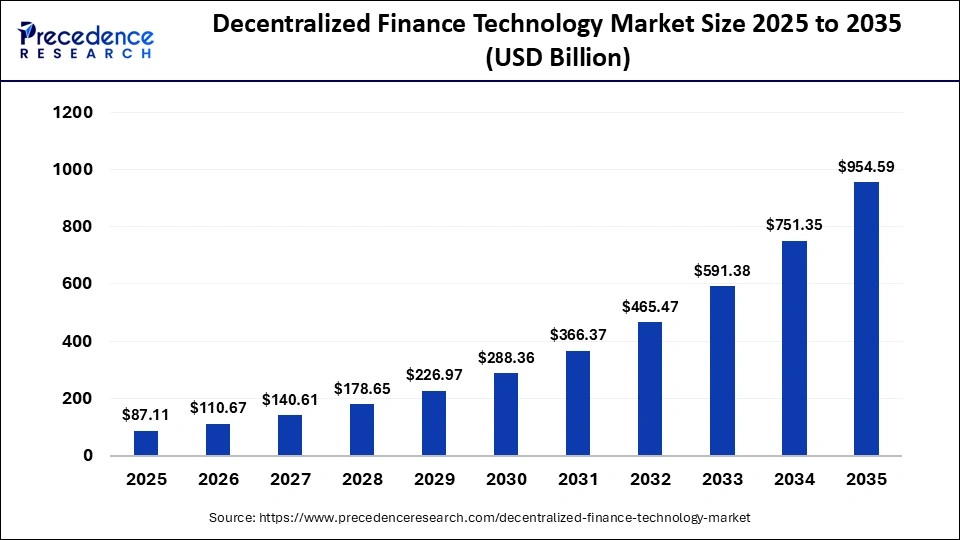
Market Highlights
- North America accounted for the largest market share of 55.40% in 2025.
- Asia Pacific is expected to witness the fastest growth between 2026 and 2035.
- By component, the decentralized applications (dApps) segment held a major market share in 2025.
- By component, the smart contracts segment is expected to grow at a significant CAGR from 2026 to 2035.
- By application, the asset management segment led the market with the largest share in 2025.
- By application, the gaming segment is growing at a significant CAGR between 2026 and 2035.
- By industry, the BFSI segment led the market with a largest market share of 48% in 2025.
- By industry, the automotive segment is expected to grow at the fastest CAGR between 2026 and 2035.
What Is Decentralized Finance (DeFi) Technology?
Decentralized finance (DeFi) technology refers to a blockchain-based financial ecosystem that uses cryptocurrencies and smart contracts to deliver open, peer-to-peer financial services without relying on traditional intermediaries such as banks or clearinghouses. Built primarily on public blockchains, DeFi enables users to access services such as lending, borrowing, trading, payments, and asset management in a transparent, programmable, and permissionless manner.
The DeFi market is projected to experience strong growth, driven by rising adoption of digital assets, demand for lower transaction costs, faster settlement times, and greater user control over financial assets. Increasing enterprise interest in emerging ecosystems including tokenized real-world assets, decentralized autonomous organizations (DAOs), and blockchain-based capital markets is further expanding DeFi’s use cases. Additionally, advancements in Layer-2 scaling solutions and cross-chain interoperability are improving network efficiency and usability, supporting DeFi’s transition toward broader mainstream adoption.
How Is AI Influencing the Decentralized Finance (DeFi) Technology Market?
Artificial intelligence is playing an increasingly influential role in the decentralized finance technology market by enhancing data intelligence, risk management, security, and automation across DeFi platforms. AI-powered algorithms analyze vast volumes of on-chain and off-chain data to support advanced trading strategies, enabling automated bots to execute complex algorithmic trades and dynamically rebalance portfolios based on real-time market conditions and user-defined risk profiles.
In risk and security management, AI models continuously monitor blockchain transactions to detect abnormal patterns, identify potential exploits, and flag fraudulent or malicious activities in real time. This capability is particularly critical for DeFi platforms, where smart contract vulnerabilities and rapid transaction speeds can amplify financial risk. AI also strengthens credit scoring and risk assessment in decentralized lending protocols by evaluating wallet behavior, transaction history, and liquidity exposure.
Additionally, AI-driven chatbots and virtual assistants are improving user experience by providing real-time support, personalized financial insights, and tailored investment recommendations. By automating decision-making and enhancing security and usability, AI is accelerating the maturation of the DeFi ecosystem and supporting its scalability, trust, and broader adoption.
Growth Factors of the Decentralized Finance (DeFi) Technology Market
- Rising Adoption of Digital Assets and Cryptocurrencies: Increasing global acceptance of cryptocurrencies is driving demand for decentralized lending, trading, and payment solutions.
- Demand for Financial Transparency and User Control: DeFi platforms eliminate intermediaries, offering users full control over assets, transparent transactions, and programmable financial services.
- Growth of Tokenization and Web3 Ecosystems: Expanding use of tokenized real-world assets, NFTs, and decentralized autonomous organizations (DAOs) is broadening DeFi applications beyond crypto-native use cases.
- Advancements in Layer-2 Scaling and Interoperability: Development of Layer-2 solutions and cross-chain protocols is improving transaction speed, reducing costs, and supporting mainstream adoption.
- Integration of AI for Risk Management and Automation: AI-driven analytics, fraud detection, and algorithmic trading enhance platform efficiency, security, and user experience.
- Institutional and Enterprise Interest: Financial institutions, fintech firms, and enterprises are exploring DeFi infrastructure for settlement, liquidity management, and programmable finance.
- Limited Access to Traditional Banking: In emerging economies, DeFi provides alternative financial access to underbanked populations, accelerating adoption.
Regional Insights of the Decentralized Finance Technology Market
North America leads the DeFi technology market, driven by strong blockchain innovation, high venture capital activity, and early adoption of digital assets. The United States and Canada are key hubs for DeFi protocol development, AI integration, and institutional participation, supported by a robust fintech ecosystem and growing regulatory engagement.
Europe represents a rapidly evolving market, with strong adoption of DeFi across countries such as Germany, Switzerland, the UK, and France. Regulatory frameworks focused on digital assets and crypto markets are encouraging responsible innovation, while growing interest in tokenization and decentralized payments is expanding regional adoption.
Asia Pacific is one of the fastest-growing regions, supported by high cryptocurrency adoption rates, tech-savvy populations, and active blockchain communities. Countries including China (via Web3 initiatives), Japan, South Korea, Singapore, and India are seeing strong growth in DeFi usage, driven by remittances, digital payments, and decentralized trading platforms.
Latin America is emerging as a significant growth region, fueled by economic volatility, currency inflation, and limited access to traditional banking. Countries such as Brazil, Argentina, and Mexico are increasingly adopting DeFi solutions for savings, lending, and cross-border transactions.
The Middle East & Africa region is gaining traction as governments and enterprises invest in blockchain innovation. The UAE and Saudi Arabia are positioning themselves as regional crypto and Web3 hubs, while parts of Africa are adopting DeFi to improve financial inclusion and cross-border payment efficiency.
Recent Developments
- In March 2024, zkLink launched zkLink Nova, the first aggregated Layer 3 zkEVM rollup network based on zkSync’s ZK Stack. This platform unifies liquidity and assets from Ethereum and Layer 2 rollups, offering an EVM-compatible dApp deployment environment. Founder Vince Yang highlighted that zkLink Nova addresses key challenges in Ethereum’s fragmented ecosystem, enhancing interoperability and fostering innovation.
- In June 2025, JP Morgan’s Kinexys announced plans to issue JPMD, a deposit token on Coinbase’s Base blockchain. The permissioned token aims to provide a secure, stable coin alternative for institutional clients, enabling 24/7 transactions at a low cost. The bank emphasized its role in enhancing the global digital payments ecosystem through trusted financial infrastructure.
Segments Covered in the Report
By Component
- Decentralized Applications
- Smart Contracts
By Application
- Asset Management
- Compliance and KYT
- Data Analytics
- Payments
- Gaming
By Industry
- BFSI
- Retail & E-commerce
- Media & Entertainment
- Automotive
- Others
By Region
- North America
- Europe
- Asia-Pacific
- Latin America
- Middle East and Africa
Get Sample Link : https://www.precedenceresearch.com/sample/7238
