
 by
by 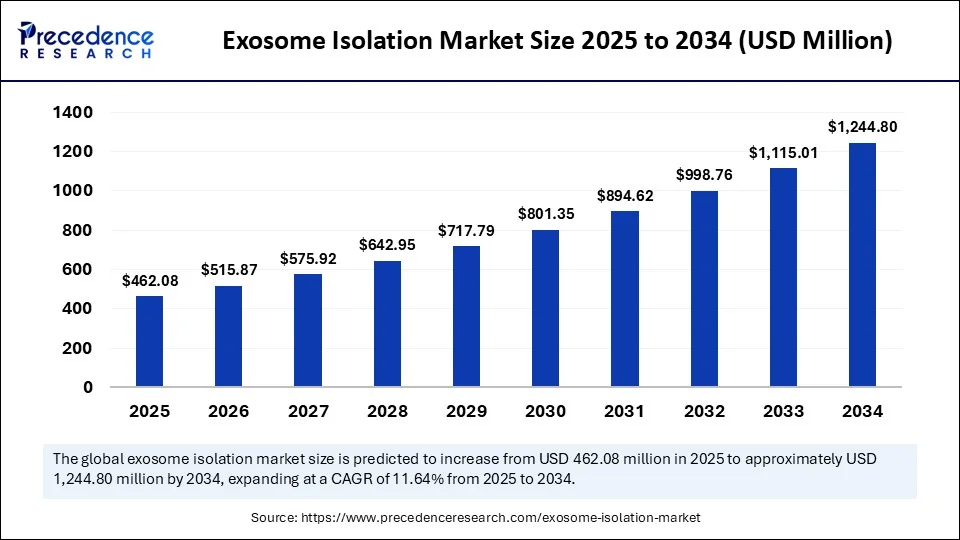
Exosome Isolation Market Key Takeaways
- In terms of revenue, the global exosome isolation market was valued at USD 413.91 million in 2024.
- It is projected to reach USD 1,244.80 million by 2034.
- The market is expected to grow at a CAGR of 11.64% from 2025 to 2034.
- North America dominated the exosome isolation market in 2024.
- By region, Asia Pacific is expected to expand at the fastest CAGR between 2025 and 2034.
- By product & service, the kits and reagents segment held the largest share of 47-58% in 2024.
- By product & service, the services and software segment is expected to grow at a remarkable CAGR of 40% between 2025 and 2034.
- By workflow stage, the isolation methods segment captured the biggest share of 55% in 2024.
- By workflow stage, the downstream analysis segment is expected to grow at a remarkable CAGR of 39% between 2025 and 2034.
- By application, the diagnostics/biomarker discovery segment led the market in 2024.
- By application, therapeutics / drug delivery / regenerative medicine segment is expected to grow at the fastest CAGR between 2025 and 2034.
- By indication, the cancer segment contributed the highest market share in 2024.
- By indication, the neurodegenerative disorders segment is expected to grow at a significant CAGR between 2025 and 2034.
- By end-user, the pharmaceutical and biotechnology companies segment held the largest market share in 2024.
- By end-user, the academic and research institutes segment is expected to grow at a remarkable CAGR between 2025 and 2034.
How AI Is Transforming the Exosome Isolation Market
Artificial intelligence (AI) is rapidly advancing the exosome isolation market by improving the speed, accuracy, and scalability of current techniques. AI-powered platforms are streamlining sample processing and optimizing isolation protocols, significantly reducing human error and labor-intensive procedures.
Machine learning algorithms are playing a key role in enhancing the precision of exosome detection and classification, paving the way for more accurate and earlier disease diagnostics. Furthermore, the integration of AI with microfluidic systems has enabled real-time analysis, enhancing workflow efficiency in both clinical and research environments.
AI is also accelerating the discovery of novel biomarkers by analyzing vast datasets and identifying patterns that might otherwise go unnoticed. As AI technologies continue to mature, their influence on innovation, diagnostics, and workflow automation within the exosome isolation field is expected to grow exponentially.
Market Overview
The exosome isolation market focuses on the development and commercialization of tools, kits, reagents, instruments, and services designed to isolate and purify exosomes small extracellular vesicles (30–150 nm) found in biological fluids such as blood, urine, and cell culture media. These technologies include ultracentrifugation, size-exclusion chromatography, immunoaffinity capture, microfluidics, and electrokinetic techniques, supporting a wide range of downstream applications in diagnostics, therapeutics, and biomedical research.
Growing demand for non-invasive diagnostic solutions and personalized medicine is fueling market growth. Advances in isolation methods are enhancing the purity, efficiency, and scalability of exosome separation, making them increasingly viable for clinical and research use. Pharmaceutical and biotechnology companies are ramping up investments in exosome-based drug delivery systems, recognizing their potential in targeted therapies.
Moreover, academic-industry collaborations are accelerating innovation, while increased government funding particularly in oncology and neurodegenerative disease research is expanding the adoption of exosome technologies. As the field of precision medicine continues to evolve, exosome isolation is emerging as a vital enabler of next-generation diagnostic and therapeutic strategies.
Market Trends
- The rapid shift toward microfluidics-based isolation techniques, which offer high throughput and sample purity, is boosting the market’s growth.
- A surge in clinical trials focused on exosome-based biomarkers for oncology and neurology boosts market growth.
- The rising use of exosomes in drug delivery systems, particularly in targeted cancer therapies, drives market growth.
- Increasing collaborations and M&A activity between biotechs, universities, and diagnostics firms further support market growth.
Opportunity
Market and Application Expansion
Emerging economies and untapped applications present major opportunities for market players. Innovations in point-of-care exosome isolation kits are expanding access beyond large laboratories. The rise of wearables could lead to the integration of exosome testing devices in the future. Strategic partnerships and licensing agreements are expected to open new product pipelines. Exosome isolation in veterinary medicine and plant biology also shows untapped promise. Companies investing in AI-enabled platforms and automation will be well-positioned to capture the next wave of demand.
Recent Development
- In January 2025, Bhubaneswar-based biotech startup Exsure has made headlines with the launch of India’s first dual-functional exosome isolation reagent, suitable for both human serum and cell-culture medium. In a milestone moment on republic day, the company also introduced Plantexosure, the first plant-based exosome isolated reagent in the country. These additions join their expanding product range, including leucoSure and dr barriers. Supported by rupees 3 crore in speed funding from Unicorn India Ventures, ExSure is now fast-tracking development of exosome-powered drug delivery platforms and conducting preclinical studies.
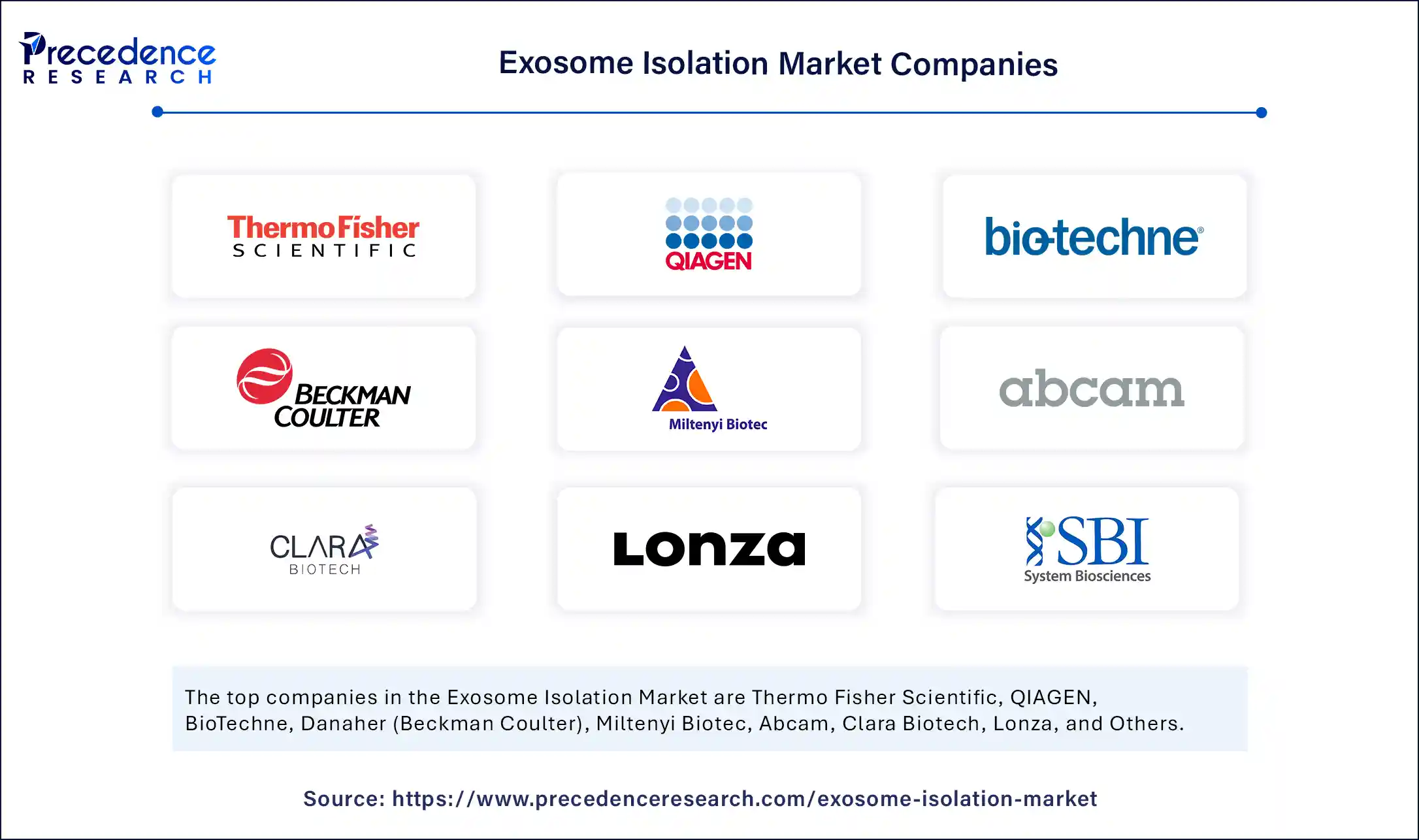
Exosome Isolation Market Companies
-
- Thermo Fisher Scientific
- QIAGEN
- BioTechne
- Danaher (Beckman Coulter)
- Miltenyi Biotec
- Abcam
- Clara Biotech
- Lonza
- System Biosciences (SBI)
- NX Pharmagen
- Exopharm
- RoosterBio
- Creative Medical Technologies
- Diagenode (Hologic)
- Izon Science (qEV SEC platform)
- FUJIFILM (Hitachi Diagnostics)
- Everzom
- Ciloa
- Unchained Labs
- Aethlon Medical
