
 by
by 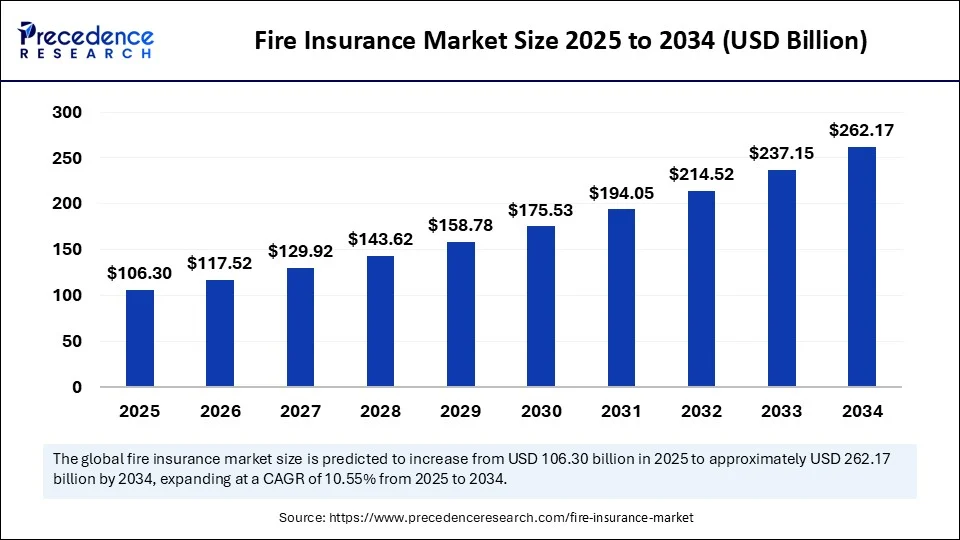
Fire Insurance Market Key Takeaways
- In 2024, the global fire insurance market reached a valuation of USD 96.16 billion.
- The market is expected to rise to USD 262.17 billion by 2034, expanding at a CAGR of 10.55%.
- North America emerged as the largest regional market, accounting for 41% of total revenue in 2024.
- The Asia Pacific region is expected to record the highest CAGR over the forecast years.
- The property fire insurance segment dominated coverage type categories in 2024.
- Business interruption insurance is projected to lead in growth among coverage types.
- Commercial property insurance generated the largest revenue share by property type in 2024.
- The industrial property category is expected to grow at the fastest pace through 2034.
- Annual-term policies held the highest share under policy terms in 2024.
- The multi-year policy segment is anticipated to grow most rapidly between 2025 and 2034.
- High-deductible fire insurance was the leading segment by deductibility in 2024.
- Low-deductible policies are expected to experience the fastest growth rate in the forecast period.
- Among distribution channels, brokers led the market in 2024.
- Captive agents are forecast to grow at the fastest CAGR during the upcoming years.
AI Impact on the Fire Insurance Market
Artificial intelligence is transforming the fire insurance market by enabling more accurate risk assessment at specific locations using historical data. These advanced insights help insurers calculate precise premiums tailored to individual properties. AI-driven tools streamline the entire claims process—from the initial notification to final settlement—enhancing speed, reducing human involvement, and improving accuracy in claim verification. Fraud detection, a persistent challenge in fire insurance, has also improved significantly through AI-powered systems that identify suspicious patterns and anomalies often missed by human investigators. Additionally, AI-enabled data analytics allows insurers to extract valuable insights from large data sets, supporting smarter business strategies, product innovation, and refined risk evaluation. These capabilities further support dynamic pricing models, enabling insurers to remain competitive, respond to customer needs effectively, and develop more personalized and efficient insurance offerings.
Get a Free Sample Copy of the Report@ https://www.precedenceresearch.com/sample/6324
Market Overview
The global fire insurance market is experiencing a robust expansion fueled by increasing urbanization, climate volatility, and technological integration in insurance underwriting. Fire insurance plays a crucial role in risk management strategies for homeowners, businesses, and public entities, offering protection against financial losses resulting from fire-related events. The market is undergoing a digital transformation, characterized by AI-driven risk analysis, automated claims processing, and usage-based policy pricing models.
Drivers
Key market drivers include the rising frequency of wildfires and structural fires, particularly in regions affected by global warming. Government regulations that mandate fire insurance for certain commercial properties and residential zones are also stimulating market growth. Increasing digitization in the insurance sector enables better customer engagement and operational efficiency. The rise of smart infrastructure and connected devices is providing insurers with real-time risk data, which is enhancing risk assessment and loss prevention capabilities. Additionally, as more businesses embrace enterprise risk management frameworks, fire insurance is becoming an integral component of comprehensive protection plans.
Opportunities
Significant growth opportunities lie in underserved and emerging markets where fire insurance is not yet fully adopted. With ongoing urban development and industrial expansion, these regions present a fertile ground for insurers to introduce scalable and affordable products. Technological advances like geospatial mapping, remote sensing, and IoT-based fire detection systems can be used for proactive risk management, allowing insurers to price policies more effectively and reduce claim volumes. Insurance companies also have the opportunity to diversify their offerings by bundling fire insurance with climate disaster packages or business continuity policies. Cross-industry partnerships, particularly with tech providers, construction firms, and municipal agencies, could also unlock new revenue models.
Challenges
One of the foremost challenges in the fire insurance market is managing risk in high-exposure zones. As climate change intensifies, insurers are either raising premiums or withdrawing from areas considered too risky, which can limit access to fire coverage. Regulatory hurdles and fragmented legal frameworks also complicate cross-border operations. Fraudulent and exaggerated claims remain a persistent issue, impacting loss ratios and eroding profitability. There’s also a digital divide in certain regions where lack of infrastructure hampers the adoption of AI-based underwriting and digital claims management. Moreover, customer perception of fire insurance as a non-essential product continues to affect penetration in cost-sensitive markets.
Regional Insights
North America holds a significant portion of the global fire insurance market due to the high incidence of wildfires and widespread awareness of property insurance. The region accounted for 41% of global market revenue in 2024, with the U.S. and Canada being major contributors. In Europe, strict building safety codes and mandatory insurance schemes support strong market penetration. However, the Asia Pacific region is projected to witness the highest CAGR during the forecast period, driven by rapid urbanization, rising construction activity, and supportive government policies. Latin America and the Middle East are emerging markets where fire insurance adoption is rising gradually due to growing awareness and increased infrastructure investment.
Recent Developments
Recent innovations in the fire insurance market are centered around data analytics, automation, and risk modeling. AI-driven tools are enabling faster and more accurate claims processing. In 2025, several insurers introduced blockchain-powered policy management systems to enhance transparency and reduce fraud. There is growing interest in parametric fire insurance products that provide payouts based on pre-defined triggers like temperature spikes or fire outbreaks detected via satellite. Some insurers are also launching microinsurance products tailored for low-income communities, supported by mobile platforms. These developments are reshaping the competitive landscape and opening up the market to a broader customer base.
Fire Insurance Market Companies
- Allstate Insurance Company
- Travelers Companies, Inc.
- Tokio Marine Nichido Fire Insurance Co., Ltd.
- Generali Group
- The Hartford Financial Services Group, Inc.
- Zurich Insurance Group Ltd
- Nationwide Mutual Insurance Company
- State Farm Mutual Automobile Insurance Company
- Ping An Insurance (Group) Company of China, Ltd.
- Munich Reinsurance Company
- Allianz SE
- Farmers Insurance Group of Companies
- Chubb Ltd.
- AXA SA
- Liberty Mutual Insurance Group, Inc.
Segments Covered in the Report
By Coverage Type
- Property Fire Insurance
- Business Interruption Insurance
- Commercial Fire Insurance
- Industrial Fire Insurance
- Residential Fire Insurance
By Property Type
- Commercial Property
- Industrial Property
- Residential Property
By Policy Term
- Annual Policies
- Multi-Year Policies
- Short-Term Policies
By Deductible
- High-Deductible Fire Insurance
- Low-Deductible Fire Insurance
By Distribution Channel
- Brokers
- Captive Agents
- Direct Writers
- Independent Agents
By Region
- North America
- Europe
- Asia Pacific
- Latin America
- Middle East and Africa
Also Read: Perishable Prepared Food Market
Ready for more? Dive into the full experience on our website@ https://www.precedenceresearch.com/
