
 by
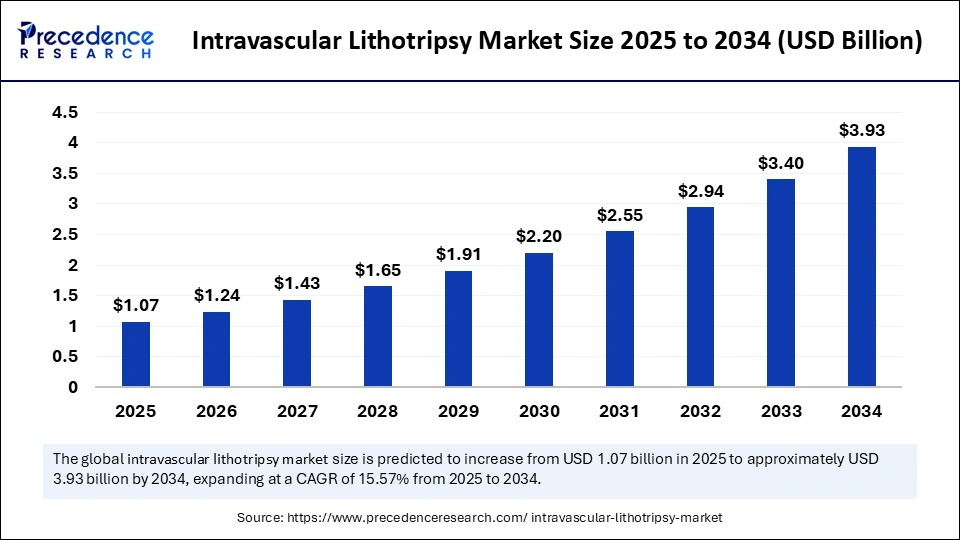
by The global intravascular lithotripsy (IVL) market is set for remarkable expansion, climbing from $1.07 billion in 2025 to an estimated $3.93 billion by 2034, driven by a robust CAGR of 15.57%.
With rising cardiovascular disease prevalence and a worldwide pivot toward safer, minimally invasive solutions for calcified arteries, this sector is at the forefront of interventional cardiology advances.
Intravascular Lithotripsy Market Key Insights
-
The global IVL market was valued at $0.93 billion in 2024 and is forecasted to surge to $3.93 billion by 2034, marking an impressive CAGR of 15.57% between 2025 and 2034.
-
North America remains the dominant region thanks to advanced clinical infrastructure, accelerated regulatory approvals, and robust reimbursement frameworks.
-
Asia Pacific is growing at the fastest pace, powered by rising cardiac disease rates and rapid technology adoption in China, India, and Japan.
-
IVL catheters lead the product segment, while cardiac and cath labs account for 70% of end-user adoption due to their specialized treatment capabilities.
-
Coronary artery disease (CAD) tops the application segment, underscoring IVL’s core role in complex coronary interventions.
-
The U.S. alone is forecasted to reach $1.25 billion by 2034, reflecting high procedure volumes and leading technology uptake.
-
Recent multi-center trials and platform innovations spotlight Shockwave Medical, Abbott, and top academic hospitals as pivotal ecosystem contributors.
Intravascular Lithotripsy Market Revenue Breakdown
| Year | Market Size (USD Billion) |
|---|---|
| 2024 | 0.93 |
| 2025 | 1.07 |
| 2034 | 3.93 |
Artificial intelligence is transforming intravascular lithotripsy by empowering clinicians with faster, more precise imaging analyses and real-time guidance. Deep-learning models now enhance intravascular ultrasound (IVUS) and optical coherence tomography (OCT), improving detection and quantification of calcified plaque—even in complex vessel morphologies. These data-driven advances help practitioners choose the right cases for IVL and optimize every procedure for safety and efficacy.
Across leading research centers, AI is steadily automating calcium scoring, segmentation, and lesion assessment—streamlining workflow and enabling personalized device selection. Industry presentations and academic studies now demonstrate how AI-integrated platforms offer rapid image review and automated procedural support, further anchoring lithotripsy’s reputation for user-friendly intervention and improved patient outcomes.
What Factors Are Fueling Intravascular Lithotripsy Market Growth?
Key growth drivers include the escalating global burden of cardiovascular diseases—now accounting for nearly 18 million deaths annually—and the demand for technologies that surpass limitations of balloon angioplasty or atherectomy. IVL offers minimally invasive, trauma-sparing calcium modification, allowing for optimal stent expansion, better vessel compliance, and reduced procedural risk. Clinical evidence continues to validate IVL’s effectiveness, especially for patients with severely calcified, hard-to-treat atherosclerotic lesions.
What Opportunities and Trends Define the IVL Market’s Future?
How Is the Push Into Complex Lesions Creating New Opportunities?
Expansion into hard-to-treat calcified lesion types, including bifurcations, under-expanded stents, and in-stent restenosis, is a major opportunity. Recent multinational studies found IVL achieves nearly a 99% procedural success rate in “undilatable” lesions, previously considered almost untreatable with conventional methods. This positions IVL as the solution of choice for tomorrow’s most challenging coronary interventions.
Why Are Catheters and Generators Reshaping the IVL Solution Landscape?
IVL catheters continue to dominate due to their versatility in both coronary and peripheral procedures. Meanwhile, IVL generator sales are on the rise as smaller, more efficient designs gain traction in emerging markets and new clinical settings. Platform innovations, often unveiled at international conferences, reinforce the ongoing shift toward smart, integrated treatment systems.
How Is Asia Pacific Blazing the Trail for Rapid IVL Adoption?
Asia Pacific’s rapid ascent is driven by surging cardiovascular cases and aggressive investments in tertiary care—especially across China, India, and Southeast Asia. Localized R&D, streamlined regulatory pathways, and robust hospital partnerships have made advanced IVL solutions broadly accessible, laying the groundwork for significant regional impact.
Intravascular Lithotripsy Market Regional and Segmentation Analysis
-
North America: Premier region by revenue and innovation, owed to top-tier clinical trial activity, FDA approvals, and robust payer coverage.
-
Asia Pacific: Fastest-growing geography, with China and India dominating volume and regional innovation. Local investments in clinical trials, training, and supply infrastructure accelerate penetration.
-
Europe: Anchored by high procedural sophistication and well-established physician networks.
-
Latin America, Middle East & Africa: Emerging opportunities as tertiary care infrastructure and access improve.
Intravascular Lithotripsy Market Segmentation
| Segment | Key Insights |
|---|---|
| Procedure/Application | Coronary artery disease (CAD) leads; renal, carotid, and multi-vessel disease show rapid expansion. |
| Product/Device Type | IVL catheters dominate; generator adoption rising with clinical innovation. |
| End User/Hospital Type | Cardiac and cath labs (≈70% share); outpatient and hybrid O.R.s are fastest-growing. |
- Shockwave Medical
- Boston Scientific
- Medtronic
- Abbott Laboratories
- Philips Healthcare
- Terumo Corporation
- Becton Dickinson (BD)
- Penumbra, Inc.
- Cook Medical
- Cardinal Health
- Teleflex Incorporated
- Asahi Intecc
- Siemens Healthineers
- Abiomed
- OrbusNeich
- Volcano Corporation
- Avinger Inc.
- Spectranetics (Philips)
- Merit Medical Systems
- C.R. Bard (now BD)
Recognizing Challenges: What’s Holding Back Broader Uptake?
Despite tremendous momentum, uptake remains slower for high-risk, complex calcified lesions (e.g., eccentric, nodular, or severely calcified vessels) where IVL’s effectiveness may be lower compared to more established methods. Real-world studies reveal gaps in data for high-risk subgroups and highlight technical limitations—especially in emerging markets lacking advanced imaging or backup tools. Cost pressures and the need for specialized operator training add further complexity to mainstream adoption.
Case Study: AI-Enhanced Imaging for IVL Success
At a leading U.S. hospital, IVL supported by AI-enhanced intravascular imaging helped physicians prepare and treat heavily calcified coronary lesions that had previously failed conventional angioplasty. The platform enabled rapid plaque assessment and risk stratification, ultimately achieving full stent expansion and reducing post-procedure complications—demonstrating the clinical promise of digital enablement in real-world care.
Read Also: High Nucleotide Yeast Extract Market
You can place an order or ask any questions. Please feel free to contact us at sales@precedenceresearch.com |+1 804 441 9344
