
 by
by What is the Machine Automation Controller Market Size in 2026?
The global machine automation controller market size was calculated at USD 45.61 billion in 2025 and is predicted to increase from USD 49.04 billion in 2026 to approximately USD 94.18 billion by 2035, expanding at a CAGR of 7.52% from 2026 to 2035. Increased productivity, improved accuracy, reduced operational costs, and enhanced safety are key drivers of market growth.
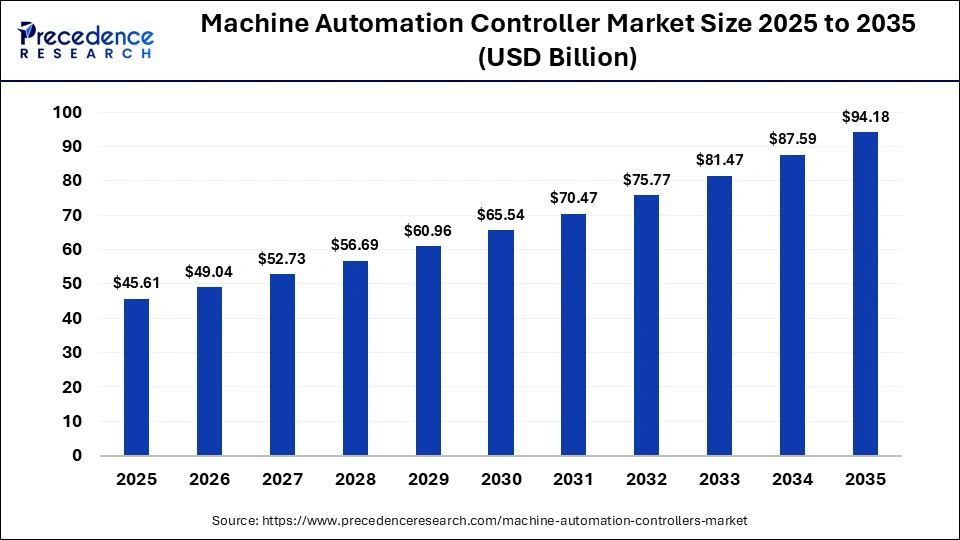
Key Takeaways
- Asia-Pacific contributed the biggest market share of 40% in 2025.
- North America is expected to grow at the fastest CAGR in the market during the forecast period.
- By controller type, the distributed control systems (DCS) segment held a dominant position in the market in 2025.
- By controller type, the programmable automation controllers (PAC) segment is expected to be the fastest-growing segment in the foreseen period.
- By machine operation type, the discrete manufacturing segment led the global market in 2025.
- By machine operation type, the batch process segment is expected to grow with the highest CAGR in the market during the studied years.
- By end-use industry, the oil and gas segment held the largest market share in 2025.
- By end-use industry, the power generation and utilities segment is expected to expand rapidly in the market in the coming years.
Machine Automation Controller Market Overview
Machine automation controllers (MACs) are widely used across manufacturing, automated production lines, industrial machinery, smart buildings, and energy management systems. As an advanced evolution of traditional industrial control technologies, MACs bridge the gap between programmable logic controllers (PLCs) and programmable automation controllers (PACs), offering enhanced performance and flexibility.
These controllers combine high-speed processing capabilities with advanced functionalities while maintaining the reliability, safety, and ease of maintenance required in industrial environments. Their ability to handle complex automation tasks and integrate multiple control functions is driving their increasing adoption across modern industries.
Impact of Artificial Intelligence on Machine Automation Controllers
Artificial intelligence (AI) and machine learning (ML) are transforming machine automation controllers by enabling smarter, more adaptive industrial operations. In advanced manufacturing environments, AI-powered controllers collect high-quality, real-time data directly from machines, which is then stored and analyzed to build predictive and correlation models.
This enables continuous monitoring of machine performance and supports immediate corrective actions, reducing downtime and improving operational efficiency. By embedding AI capabilities directly into control systems, operators can gain real-time insights at the machine level, enhancing decision-making and process optimization.
Furthermore, AI-enabled controllers can quickly detect minor equipment anomalies that might otherwise go unnoticed, preventing potential failures and ensuring consistent product quality. This capability is particularly critical in high-speed production environments, where even small deviations can lead to significant defects. As a result, the integration of AI is playing a crucial role in driving the growth of the machine automation controller market.
Market Scope
| Report Coverage | Details |
| Market Size in 2025 | USD 45.61 Billion |
| Market Size in 2026 | USD 49.04 Billion |
| Market Size by 2035 | USD 94.18 Billion |
| Market Growth Rate from 2026 to 2035 | CAGR of 7.52% |
| Dominating Region | Asia-Pacific |
| Fastest Growing Region | North America |
| Base Year | 2025 |
| Forecast Period | 2026 to 2035 |
| Segments Covered | Controller Type, Machine Operation Type, End Use Industry, and Region |
| Regions Covered | North America, Europe, Asia-Pacific, Latin America, and Middle East & Africa |
Regional Insights
Asia-Pacific is the fastest-growing region in the machine automation controller market, driven by rapid industrialization and the strong presence of manufacturing hubs such as China, Japan, South Korea, and India. The expansion of electronics, automotive, and semiconductor industries is significantly increasing the demand for advanced automation controllers. Government initiatives promoting smart manufacturing and Industry 4.0 adoption are further accelerating growth across the region. Additionally, the rising need for high-speed, flexible, and cost-efficient production systems is boosting controller deployment.
North America is a mature and innovation-driven market, supported by advanced manufacturing infrastructure and early adoption of automation technologies. Industries such as automotive, aerospace, electronics, and renewable energy are actively investing in intelligent automation systems. The integration of AI, Industrial IoT (IIoT), and predictive maintenance solutions is enhancing the demand for high-performance machine automation controllers. Moreover, increasing investments in smart factories and reshoring of manufacturing activities are strengthening regional growth.
Europe represents a well-established market characterized by strong industrial automation adoption and a focus on sustainability and energy efficiency. Countries like Germany, the UK, and France are leading in implementing advanced automation systems, particularly in automotive and industrial manufacturing sectors. The region’s emphasis on Industry 4.0, environmental regulations, and smart factory initiatives is driving the adoption of machine automation controllers.
Latin America is an emerging market for machine automation controllers, supported by increasing industrial development and modernization of manufacturing facilities. Countries such as Brazil and Mexico are investing in automation technologies to improve productivity, reduce operational costs, and enhance efficiency. The growing focus on energy, automotive, and consumer goods industries is expected to create new opportunities for market expansion.
The Middle East & Africa region is gradually adopting machine automation controllers, particularly in oil & gas, energy, and infrastructure sectors. The need to enhance operational efficiency and safety in hazardous industrial environments is driving demand for automation solutions. Additionally, ongoing investments in industrial diversification and smart infrastructure development are expected to support market growth over time.
Machine Automation Controller Market Value Chain Analysis
- Raw Material Sourcing
Entails sourcing precision electronic parts, specialized metals, and sophisticated software layers for advanced controllers.
Key Players: Digicon Automation Pvt. Ltd. and Prima Automation Pvt. Ltd.
- Component Fabrication and Machining
Covers building precise internal electronic architectures and durable external housings to meet demanding industrial requirements.
Key Players: Lubi Electronics, ABB Ltd., and Mitsubishi Electric.
- Testing and Certification
Verifies the controller’s reliability, safeguards human operators, and ensures adherence to relevant international trade regulations.
Key Players: SGS SA, Masibus, Systema, and SMEClabs.
- Installation and Commissioning
Transforms the physical controller into a machine’s operational brain, where mistakes risk damage and safety hazards.
Key Players: Igus India, Messung Industrial Automation, and Probotix.
- Distribution and Sales
Proceed via a mature hybrid channel, balancing direct manufacturer participation with an extensive technical partner network.
Key Players: IPCS Machine Automation, Aeron Automation Solutions, and Unimech Automation.
- Maintenance and After-Sales Service
Concentrates on maximizing uptime and lengthening hardware lifecycles, which generally range from 10 to 20 years.
- Product Lifecycle Management
PLM forms a closed loop, linking R&D and field data to oversee 15 25 year lifecycles.
Machine Automation Controller Market Key Players
- Siemens AG
- ABB Ltd.
- Schneider Electric SE
- Rockwell Automation, Inc.
- Mitsubishi Electric Corporation
- Honeywell International Inc.
- Emerson Electric Co.
- Omron Corporation
- FANUC Corporation
- Yokogawa Electric Corporation
- Beckhoff Automation GmbH
- Robert Bosch (Bosch Rexroth)
- Keyence Corporation
- Delta Electronics, Inc.
- Yaskawa Electric Corporation
Segments Covered in the Report
By Controller Type
- Programmable Logic Controllers (PLC)
- Programmable Automation Controllers (PAC)
- Distributed Control Systems (DCS)
- Industrial PC-Based Controllers (IPC/Soft PLC)
- Dedicated Motion Controllers
- CNC Controllers
By Machine Operation Type
- Discrete Manufacturing
- Batch Process
- Continuous Process
By End Use Industry
- Automotive
- Electronics and Semiconductors
- Food and Beverage Processing
- Chemicals and Petrochemicals
- Oil and Gas
- Pharmaceuticals and Biotechnology
- Power Generation and Utilities
- Metals and Mining
- Packaging
- Water and Wastewater Treatment
- Others
By Region
- North America
- Latin America
- Europe
- Asia-pacific
- Middle and East Africa
Get Sample Link: https://www.precedenceresearch.com/sample/8228
