
 by
by 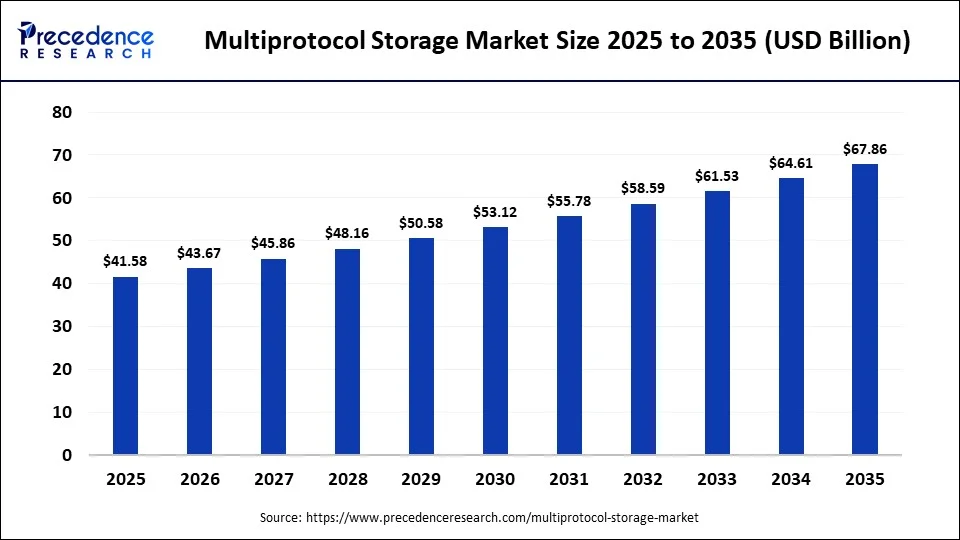
Market Highlights
- North America accounted for the largest market share of 37% in 2025.
- The Asia Pacific is projected to grow at the fastest CAGR from 2026 to 2035.
- By storage, the file storage segment held the largest share in 2025.
- By storage, the object storage segment is grow at the fastest CAGR from 2026 to 2035.
- By protocol type, the NFS (network file system) segment held the largest market share in 2025.
- By protocol type, the NVMe-oF segment is expected to grow at the fastest CAGR from 2026 to 2035.
- By deployment model, the on-premises segment contributed the highest market share in 2025.
- By deployment model, the hybrid segment is projected to grow at the fastest CAGR from 2026 to 2035.
- By architecture, the unified storage systems segment held the major market share in 2025.
- By architecture, the software-defined segment is expanding at a strong CAGR from 2026 to 2035.
- By component, the hardware segment captured the biggest market share in 2025.
- By component, the software segment is projected to grow at the fastest CAGR from 2026 to 2035.
- By application, the data centers segment generated the largest market share in 2025.
- By application, the AI/ machine learning workloads segment is projected to grow at the fastest CAGR from 2026 to 2035.
- By end user, the IT& telecommunications segment held the largest market share in 2025.
- By end user, the healthcare and life sciences segment is projected to grow at the fastest CAGR from 2026 to 2035.
Multiprotocol Storage Market Overview
The global multiprotocol storage market consists of advanced data storage systems designed to support multiple storage access protocols such as file, block, and object storage within a single unified architecture. These platforms enable enterprises to consolidate storage resources, improve capacity utilization, and simplify data management across diverse and complex IT environments.
Multiprotocol storage solutions support a broad range of enterprise workloads, including transactional databases, virtualized infrastructures, cloud-native applications, big data analytics, artificial intelligence and machine learning workloads, as well as backup and disaster recovery operations. By allowing different applications to access the same storage infrastructure through their preferred protocol, organizations can eliminate storage silos, enhance flexibility, and streamline operations.
Market growth is driven by the rapid expansion of enterprise data volumes, increasing adoption of hybrid IT and multi-cloud strategies, and rising demand for scalable, cost-efficient, and flexible storage architectures. Enterprises are increasingly adopting multiprotocol storage to modernize legacy systems, support diverse workload requirements, and reduce the operational complexity and costs associated with managing multiple standalone storage platforms.
How AI Is Transforming Multiprotocol Storage: Self-Optimizing Systems and Workload-Aware Management
Artificial intelligence is fundamentally reshaping the multiprotocol storage market by enabling intelligent automation, self-optimizing operations, and workload-aware resource management. AI-powered analytics platforms deliver real-time visibility into storage performance, capacity utilization, and system health, allowing organizations to proactively detect anomalies, prevent failures, and minimize unplanned downtime. By automating repetitive monitoring and optimization tasks, AI reduces operational burden and allows IT teams to focus on higher-value initiatives.
Modern multiprotocol storage platforms integrate machine learning models that continuously analyze telemetry data including latency, throughput, IOPS, error rates, and access patterns across file, block, and object protocols. These AI-driven systems dynamically rebalance workloads, optimize data placement, and automate tiering between high-performance flash and cost-efficient disk storage based on real-time demand and application priority. Quality-of-service parameters are adjusted automatically to ensure consistent performance for mission-critical workloads.
AI-enabled management layers also enhance predictive maintenance by identifying early signs of hardware degradation and recommending proactive component replacement before failures occur. As enterprises deploy increasingly heterogeneous workloads ranging from databases and virtual machines to containers and AI training pipelines AI-powered multiprotocol storage platforms support automated policy enforcement, ensuring optimal performance, efficiency, and reliability across hybrid data center and cloud environments.
Multiprotocol Storage Market Growth Factors
- Rapid Growth in Enterprise Data Volumes: The exponential increase in structured and unstructured data from applications, IoT, analytics, and AI workloads is driving demand for unified storage platforms that can support file, block, and object data within a single system.
- Expansion of Hybrid IT and Multi-Cloud Architectures: Enterprises are increasingly operating across on-premises, private cloud, and public cloud environments. Multiprotocol storage simplifies data movement and management across these hybrid and multi-cloud infrastructures.
- Rising Adoption of AI, Analytics, and High-Performance Workloads: AI/ML training, big data analytics, and real-time applications require flexible storage architectures capable of handling diverse access protocols while maintaining high performance and low latency.
- Need for Infrastructure Consolidation and Cost Optimization: Organizations are replacing siloed storage systems with multiprotocol platforms to reduce capital expenditure, improve utilization rates, and lower operational complexity.
- Growing Focus on Automation and Intelligent Storage Management: AI-driven storage optimization, predictive maintenance, and automated tiering are accelerating adoption as enterprises seek self-managing, resilient storage environments.
- Modernization of Legacy Storage Systems: Enterprises upgrading aging infrastructure are adopting multiprotocol storage to future-proof their environments and support cloud-native and containerized workloads without redesigning storage architectures.
Regional Insights
North America dominates the multiprotocol storage market due to early adoption of advanced IT infrastructure, strong presence of hyperscale cloud providers, and high investment in AI, analytics, and data center modernization. Enterprises in the United States and Canada are rapidly adopting unified storage solutions to support hybrid cloud deployments and data-intensive workloads.
Europe represents a significant market driven by regulatory compliance requirements, data sovereignty concerns, and increasing digital transformation initiatives across industries such as finance, healthcare, and manufacturing. Enterprises in Western Europe are particularly focused on storage consolidation and secure data management across multi-cloud environments.
Asia-Pacific is the fastest-growing region, supported by rapid enterprise digitization, expanding data center capacity, and growing adoption of cloud and AI technologies in countries such as China, India, Japan, and South Korea. Rising investments in smart infrastructure, e-commerce, and telecom are further accelerating demand for scalable multiprotocol storage platforms.
Latin America and the Middle East & Africa are emerging markets, benefiting from expanding cloud adoption, modernization of enterprise IT systems, and growing investments in telecom and financial services. As regional data centers expand and digital services mature, demand for cost-efficient and flexible storage architectures is expected to increase steadily.
Top Companies in Multiprotocol Storage Market & their Offerings
- Dell Technologies
- Hewlett Packard Enterprise
- NetApp
- IBM Corporation
- Hitachi Vantara
- Pure Storage
- Cisco Systems
- Fujitsu Limited
- Huawei Technologies
- Western Digital Corporation
- Oracle Corporation
- Infinidat
- Quantum Corporation
- DataDirect Networks (DDN)
- Nutanix
- Tintri
- Qumulo
- Panasas
- Synology
- Lenovo Group Limited
Recent Developments
- In February 2025, the AI data platform company, VAST Data, revealed two significant advancements for its multiprotocol storage platform, including block storage functionality for VAST DataStore and the new VAST Event Broker. These additions are aimed at accommodating the complex data processing needs of analytics and AI while maintaining a universal, multiprotocol storage platform.
- In May 2025, NetApp announced an update to its AIPod solution that integrates the NVIDIA AI Data Platform, creating a reference architecture aimed at simplifying large-scale deployment of agentic AI. This development addresses growing enterprise demand for a unified and well-governed data infrastructure as organizations increase investment in AI-driven workloads. The collaboration focuses on retrieval-augmented generation and inference, which are critical to enabling generative and agentic AI systems to operate reliably on enterprise-owned data.
Segments Covered in the Report
By Storage Type
- File Storage
- Block Storage
- Object Storage
By Protocol Type
- NFS (Network File System)
- SMB/CIFS
- iSCSI
- Fibre Channel (FC)
- NVMe-oF
- S3-Compatible Object Protocol
By Deployment Model
- On-Premises
- Cloud-Based
- Hybrid
By Architecture
- Unified Storage Systems
- Hyper-Converged Infrastructure (HCI)
- Software-Defined Storage (SDS)
By Component
- Hardware (Storage Arrays, Controllers)
- Software (Storage OS, Management Software)
- Services (Deployment, Support, Managed Services)
By Application
- Data Centers
- Virtualization & Cloud Workloads
- Big Data & Analytics
- AI / Machine Learning Workloads
- Backup & Disaster Recovery
- Media & Content Storage
By End-User Industry
- IT & Telecommunications
- BFSI
- Healthcare & Life Sciences
- Government & Defense
- Media & Entertainment
- Manufacturing
- Retail & E-Commerce
By Region
- North America
- Europe
- Asia-Pacific
- Latin America
- Middle East and Africa
Get Sample Link : https://www.precedenceresearch.com/sample/7256
