
 by
by 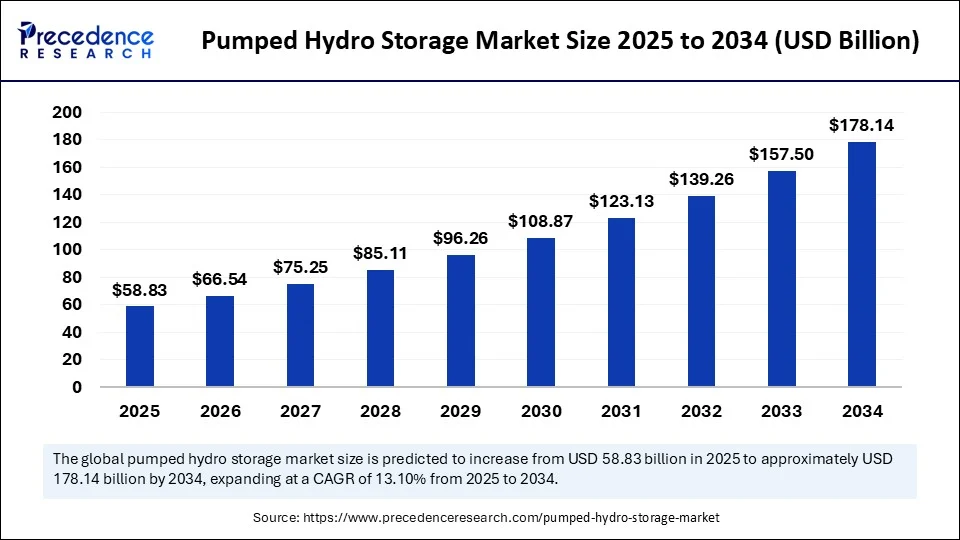
Pumped Hydro Storage Market Key Takeaways
- In 2024, the global pumped hydro storage market reached a valuation of USD 52.01 billion.
- The market is forecasted to grow to USD 178.14 billion by 2034.
- It is projected to expand at a CAGR of 13.10% from 2025 to 2034.
- Europe led the market in 2024 with the largest share of 59%.
- The Asia Pacific region is expected to grow at the fastest CAGR between 2025 and 2034.
- North America continues to be a significant contributor to the global pumped hydro storage market.
- By type, open-loop systems captured the largest market share in 2024.
- By type, closed-loop systems are projected to record the fastest CAGR during the forecast period.
- By capacity, the above 1000 MW segment held the dominant market share in 2024.
- By capacity, the 500–1000 MW segment is expected to experience the fastest CAGR in the coming years.
How is Artificial Intelligence Transforming the Operations of Pumped Hydro Storage Systems?
Artificial Intelligence is revolutionizing the operations of pumped hydro storage systems by enabling smarter, more efficient, and predictive energy management. Through advanced algorithms and machine learning models, AI optimizes water flow, turbine speed, and energy dispatch based on real-time grid demand and weather forecasts. AI also enhances predictive maintenance by analyzing sensor data to detect early signs of wear and tear, reducing downtime and extending equipment life. In addition, AI-powered digital twins allow operators to simulate and optimize different operational scenarios without affecting real systems. By integrating AI, PHS facilities are becoming more responsive, cost-efficient, and reliable, especially as they increasingly support intermittent renewable energy sources like solar and wind.
Market Overview
The pumped hydro storage market is experiencing a significant resurgence as global energy systems shift toward renewable energy integration and sustainable power solutions. Recognized as the most mature and reliable form of large-scale energy storage, pumped hydro systems play a vital role in grid stability by storing excess energy and delivering it during periods of peak demand. The pumped hydro storage market is benefiting from increased investment in renewable power, as these storage systems offer a proven method for balancing intermittent energy sources such as wind and solar. With long lifespans, high efficiency, and large-scale capacity, pumped hydro continues to dominate the energy storage landscape worldwide.
Drivers
The primary driver fueling the growth of the pumped hydro storage market is the global transition to cleaner energy sources. As countries move away from fossil fuels and invest in renewable energy infrastructure, there is a growing need for grid-scale storage that can mitigate the variability of wind and solar generation. Government policies supporting clean energy, combined with decarbonization goals and climate action targets, are accelerating the deployment of pumped hydro facilities. Additionally, advancements in turbine technology and system optimization have enhanced operational efficiency, further strengthening the position of the pumped hydro storage market.
Opportunities
The pumped hydro storage market presents numerous growth opportunities, especially in developing regions with untapped hydroelectric potential. Expanding electrification initiatives and rural energy access programs create demand for stable energy storage systems, which pumped hydro can effectively fulfill. Moreover, the repurposing of existing dam and reservoir infrastructure for closed-loop or hybrid pumped hydro systems offers a cost-effective pathway for expanding capacity. Technological innovations enabling underground and modular installations are opening new avenues, making the pumped hydro storage market more adaptable to modern energy infrastructure needs.
Challenges
Despite its advantages, the pumped hydro storage market faces several challenges. Environmental concerns regarding land use, ecosystem disruption, and water resource management can delay or prevent project approvals. High upfront capital costs and long development timelines pose financial and planning hurdles, particularly in regions with complex regulatory frameworks. Furthermore, geographical limitations restrict the feasibility of pumped hydro in flat or arid regions, requiring alternative storage solutions. These challenges must be addressed to ensure long-term growth in the pumped hydro storage market.
Regional Insights
In 2024, Europe led the global pumped hydro storage market, accounting for 59% of the total revenue share. This dominance is attributed to the region’s aggressive renewable energy targets and existing hydroelectric infrastructure. The Asia Pacific region is expected to grow at the fastest CAGR between 2025 and 2034, driven by expanding energy demands, government support for clean energy, and large-scale hydropower development in countries like China and India. North America remains a notable region in the pumped hydro storage market, with ongoing upgrades to aging infrastructure and increased focus on grid reliability amid rising renewable integration.
Pumped Hydro Storage Market Companies
- ANDRITZ AG (Austria)
- Siemens AG (Germany)
- Enel SpA (Italy)
- Duke Energy Co. (U.S.)
- Voith GmbH & Co. KGaA (Germany)
- GE Vernova (U.S.)
- Power Construction Corporation of China (China)
- Torrent Power (India)
- ITC Holdings (U.S.)
- NextEra Energy, Inc. (U.S.)
- China Energy Engineering Corporation (China)
Recent Developments
- In May 2025, AGL acquired 100% ownership of two pumped hydro energy storage projects held by Upper Hunter Hydro Top Trust and its trustee (UHH). The two early-stage projects are located in the Hunter region, NSW. The projects at Glenbawn and Glennies Creek aim to provide 770 MW 10-hour and 623 MW 10-hour pumped hydro energy storage capacity respectively with the future opportunity for integrated wind farms.
- In April 2025, the Scottish Government approved UK’s pumped storage hydro project at Loch Earba. This will be the largest pumped hydro storage project, which will have 1800 MW installed energy production capacity and 40,000 MWh storage capacity, surpassing the currently existing storage capacity.
- In March 2025, the Madhya Pradesh, India, government launched a scheme for the development and implementation of pump hydro storage projects in the state in an attempt to tackle the surplus energy available in the state.
- In March 2025, SSE and Gilkes Energy submitted a Section 36 planning consent application to Scottish Government for a proposed joint venture Fearna pumped storage hydro (PSH) project in Scotland’s Highlands. The 50:50 development joint venture project is located at the western end of Glengarry, around 25km west of Invergarry and adjoins SSE Renewables’ existing Loch Quoich reservoir in the Great Glen hydro scheme. Under the terms of the joint venture agreement, Gilkes Energy will lead the project’s development under a developer services agreement with SSE Renewables.
- In January 2025, the provincial government of Ontario, Canada, commenced the pre-development work on a pumped hydro energy storage project, which have a storage capacity of 1G/11GW. Ontario will invest up to CA$285 million (US$198 million) to advance the Ontario Pumped Storage Project, proposed for construction in Meaford, a coastal municipality about 180km from Toronto.
Segments Covered in the Report
By Type
- Open Loop
- Closed Loop
- By Capacity
By Capacity
- Below 500 MW
- 500-1000 MW
- Above 1000 MW
By Region
- North America
- Europe
- Asia Pacific
- Latin America
- Middle East & Africa
Get Report Sample Link @ https://www.precedenceresearch.com/sample/6295
