
 by
by 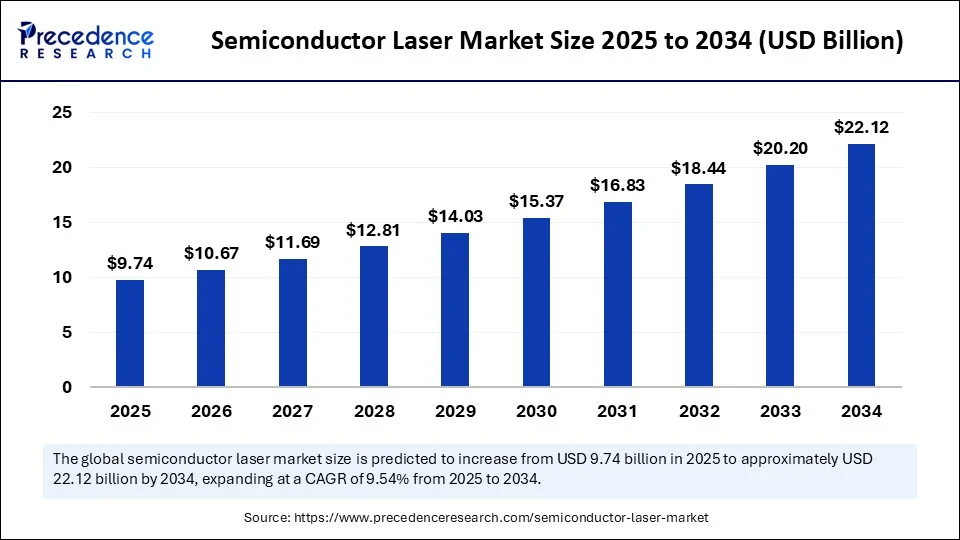
Semiconductor Laser Market Key Takeaways
- In terms of revenue, the global semiconductor laser market was valued at USD 8.89 billion in 2024.
- It is projected to reach USD 22.12 billion by 2034.
- The market is expected to grow at a CAGR of 9.54% from 2025 to 2034.
- Asia Pacific dominated the semiconductor laser market with the largest share of 50% in 2024.
- North America is expected to grow at the fastest CAGR in the upcoming period.
- By type of semiconductor material, the gallium arsenide (GaAs) segment captured the biggest market share of 45% in 2024.
- By type of semiconductor material, the gallium nitride (GaN) segment is expected to grow at the fastest CAGR during the forecast period.
- By application, the telecommunications segment contributed the highest share of 40% in 2024.
- By application, the medical devices segment is expected to grow at the fastest CAGR in the semiconductor laser market.
- By output power, the low power (less than 100 mW) segment held the largest market share of 55% in 2024.
- By output power, the medium power (100 mW-1 W) segment is emerging as the fastest-growing.
- By packaging type, the TO-can packaging segment generated the major market share of 50% in 2024.
- By packaging type, the surface mount technology (SMT) segment is expected to grow at the fastest rate during the forecast period.
- By wavelength range, the infrared segment accounted for the significant market share of 60% in 2024.
- By wavelength range, the UV (ultraviolet) segment is observed to grow at the fastest CAGR during the forecast period.
How is AI transforming the development and performance of semiconductor lasers?
Artificial Intelligence is reshaping the landscape of semiconductor laser development by introducing unprecedented levels of precision, efficiency, and innovation. Through advanced machine learning algorithms, researchers can now model laser behavior across a wide range of conditions, dramatically reducing the need for extensive physical prototyping. These AI models analyze large datasets to uncover critical insights into material properties, thermal performance, and optical output, paving the way for the creation of more sophisticated and efficient laser designs. Additionally, AI-powered design platforms are enabling the development of highly customized laser systems for emerging technologies such as LiDAR-based 3D sensing, autonomous vehicles, and high-speed optical communications.
Market Overview
The semiconductor laser a compact, efficient light source based on electroluminescence in semiconductor materials—is at the core of numerous modern technologies. Also known as laser diodes, these devices offer small size, low power consumption, and seamless integration into electronic systems. They are extensively deployed in fields such as telecommunications, optical data storage, medical diagnostics, industrial sensing, and consumer electronics.
What Makes Semiconductor Lasers Essential in Today’s Tech Landscape?
Semiconductor lasers are critical enablers of today’s digital world. Their high modulation speeds, wavelength versatility, and precise beam control make them ideal for advanced applications like LiDAR in autonomous vehicles, 3D facial recognition in smartphones, and non-invasive medical treatments. As industries shift toward miniaturization, real-time data processing, and connectivity, the demand for compact, energy-efficient, and high-performance photonics has surged—solidifying semiconductor lasers as indispensable tools in the evolution of smart manufacturing, healthcare technologies, and next-gen communication systems.
Semiconductor Laser Market Growth Factors
- Rising demand for energy-efficient solutions across the electronics and telecom industries.
- Increased use in defense and aerospace for targeting and sensing.
- Growing adoption in printing and barcoding for retail and logistics.
- Surge in wearable technology integrating compact laser components.
- Supportive government initiatives for photonics and laser R&D.
- Growing data consumption is driving optical fiber communication demand.
- Emergence of smart cities is accelerating the need for sensing and surveillance.
- Expanding healthcare infrastructure, boosting laser-based diagnostics.
- Evolving manufacturing standards require precision laser tools.
Opportunity
Expansion of 5G and optical communication networks
Massive prospects for semiconductor lasers are being created by the introduction of 5G and next-generation optical networks, especially in fiber optics and signal transmission. Telecom companies are modernizing their infrastructure to accommodate faster higher higher-capacity systems in response to the surge in data demand. Optical transceivers require semiconductor lasers, particularly distributed feedback lasers. New players and collaborations are becoming possible as a result of emerging markets’ significant investments in digital connectivity. Over the ensuing ten years, this trend is anticipated to continue.
Recent Developments
- On 25 July 2025, xLight (USA) announced USD 40 million to develop a semiconductor laser for EUV lithography tools, targeting a prototype by 2028 to compete with the currently dominant supplier. The funding round was led by Playground Global and Boardman Bay Capital Management.
- On 2 July 2025, the University of California research team launched a novel method to directly integrate quantum dot lasers onto silicon chips, enabling O-band single-mode lasing with thermal operation up to 105 degrees and a lifespan of 6.2 years. This innovation promises scalable photonic integrated circuits in standard semiconductor fabs.
- On 22 March 2025, the Chinese Academy of Sciences announced a solid-state deep ultraviolet laser at a 193 nm wavelength for semiconductor photolithography. Although it currently outputs 70nW at 6kHz, far below commercial excimer lasers, it represents a breakthrough in migrating from gas lasers toward solid-state sources.
Semiconductor Laser Market Key Players
- Coherent, Inc.
- TRUMPF GmbH + Co. KG
- Laser Diode Inc.
- Osram Opto Semiconductors GmbH
- Nichia Corporation
- Sharp Corporation
- Lumentum Operations LLC
- Honeywell International Inc.
- Panasonic Corporation
- Qualcomm Technologies, Inc.
- Samsung Electronics Co., Ltd.
- Philips Electronics
- Broadcom Inc.
- II-VI Incorporated
- Kyocera Corporation
- Jenoptik AG
- Everlight Electronics Co., Ltd.
- STMicroelectronics
- Fujitsu Limited
- Applied Materials, Inc.
Segments Covered in the Report
By Type of Semiconductor Material
- Gallium Arsenide (GaAs)
- Indium Phosphide (InP)
- Gallium Nitride (GaN)
- Aluminum Gallium Arsenide (AlGaAs)
- Others
By Application
- Telecommunications
- Consumer Electronics
- Medical Devices
- Military & Defense
- Industrial Manufacturing
- Aerospace & Automotive
- Others
By Output Power
- Low Power (Less than 100 mW)
- Medium Power (100 mW – 1 W)
- High Power (Above 1 W)
By Packaging Type
- Bare Die
- TO-can Packaging
- Surface Mount Technology (SMT)
- Others
By Wavelength Range
- UV (Ultraviolet)
- Visible
- Infrared
By Region
- North America
- Europe
- Asia-Pacific
- Rest of the World
