
 by
by What is the Surface Roughness Measurement Market Size in 2026?
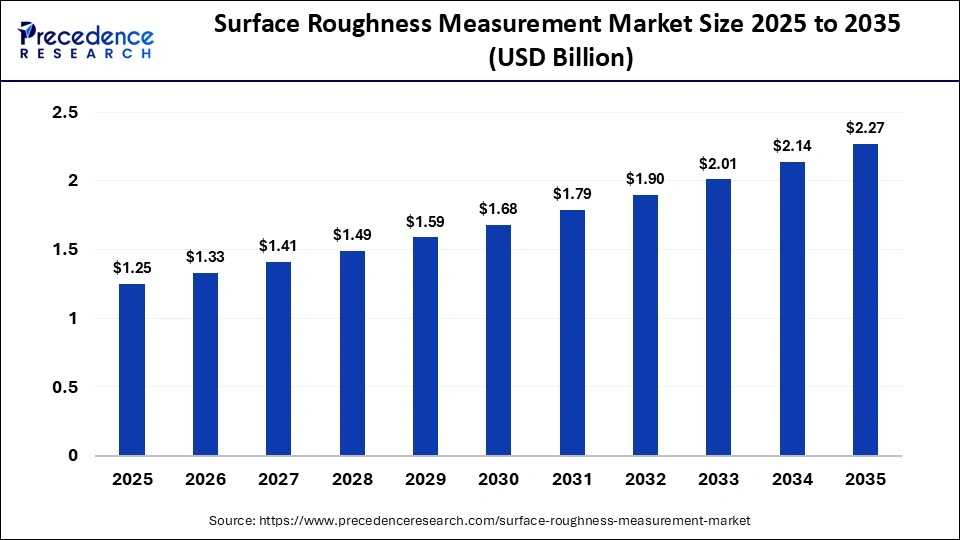
The global surface roughness measurement market size was calculated at USD 1.25 billion in 2025 and is predicted to increase from USD 1.33 billion in 2026 to approximately USD 2.27 billion by 2035, expanding at a CAGR of 6.13% from 2026 to 2035. The market growth is driven by the growing use of non-contact measurement technologies, improved semiconductor manufacturability, tougher international quality standards, and the use of surface metrology systems in production automation.
Key Takeaways
- North America dominated the market with the largest market share of 32% in 2025.
- Asia-Pacific is expected to grow at the fastest CAGR in the market during the forecast period.
- By component, the probes segment accounted for a considerable revenue share in the market in 2025.
- By component, the software segment is expected to grow at the fastest CAGR in the market between 2026 and 2035.
- By surface type, the 3D segment accounted for the highest revenue share in the market in 2025.
- By surface type, the 2D segment is expected to grow steadily in the market between 2026 and 2035.
- By technique, the contact technique segment held the largest revenue share in the market in 2025.
- By technique, the noncontact technique segment is expected to expand rapidly in the market in the coming years.
- By vertical, the automotive segment accounted for a considerable revenue share in the market in 2025.
- By vertical, the semiconductor segment is expected to grow at the fastest CAGR in the market between 2026 and 2035.
What is the Surface Roughness Measurement Market?
The surface roughness measurement market plays a critical role in precision engineering and quality control by evaluating the smoothness and texture of material surfaces. It includes advanced technologies such as contact-based stylus profilometers and non-contact optical systems that generate accurate two-dimensional and three-dimensional surface profiles.
Beyond basic texture analysis, surface roughness measurement helps assess key performance factors such as friction, wear resistance, adhesion, and durability. With increasingly strict manufacturing standards across industries like aerospace, semiconductors, and medical devices, this market has evolved into an essential quality checkpoint, where even microscopic surface defects can impact overall product performance and reliability.
Impact of AI on the Surface Roughness Measurement Market
Artificial intelligence (AI) is transforming surface roughness measurement from a traditional inspection process into an intelligent, data-driven solution. AI-powered systems not only capture surface data but also analyze complex patterns to identify irregularities linked to tool wear, process variations, and material inconsistencies.
By converting optical measurement data into real-time insights, AI enables faster and more accurate decision-making on the production floor. In high-speed manufacturing environments, this allows for early defect detection, improved process optimization, and reduced production errors. As AI systems continuously learn from new data, they enhance measurement accuracy and efficiency, driving smarter and more predictive manufacturing operations.
Trends Influencing the Surface Roughness Measurement Market
- Reinventing Optical Techniques: Contact-based stylus systems are increasingly used as the common practice. Not only are optical and laser technologies now increasingly favored due to their speed, but they also allow for precise shaping without directly contacting the surface. It gives you more precision and fewer potential interferences, something that comes in very handy when dealing with fragile or valuable components.
- Rise of Portable Measurement Devices: There is a growing need for portable roughness testers that allow operators to go from the laboratory to the field. These devices are becoming basic components of maintaining, on-the-job applications, testing the application with less than 5 seconds total time on site, and the need to have an adaptable device in the hands of the operator, often superseding accuracy, as this equipment is used widely.
- Advancements in Semiconductor and Electric Vehicle Manufacturing Quality Standards: As semiconductor chip fabrication and electric vehicle assembly progress at a very rapid speed, the bar in respect to surface variation tolerances is rising correspondingly harder. Components also need to have near-perfect finishes today, an incentive pushing measurement technology to take advantage of improved resolution capabilities by scanning faster, achieving greater consistency on a wide range of complex materials.
Market Scope
| Report Coverage | Details |
| Market Size in 2025 | USD 1.25 Billion |
| Market Size in 2026 | USD 1.33 Billion |
| Market Size by 2035 | USD 2.27 Billion |
| Market Growth Rate from 2026 to 2035 | CAGR of 6.13% |
| Dominating Region | North America |
| Fastest Growing Region | Asia-Pacific |
| Base Year | 2025 |
| Forecast Period | 2026 to 2035 |
| Segments Covered | Component, Surface Type, Technique, Vertical, and Region |
| Regions Covered | North America, Europe, Asia-Pacific, Latin America, and Middle East & Africa |
Regional Insights
North America remains a significant market due to the presence of advanced manufacturing industries, particularly in aerospace, automotive, and medical devices. The region benefits from early adoption of automation, AI-integrated inspection systems, and strict quality standards, which continue to drive demand for high-precision surface measurement solutions.
Europe is characterized by its focus on high-quality engineering and regulatory compliance. Countries with strong industrial bases are investing in advanced metrology tools to support automotive innovation, precision machining, and medical device manufacturing. The emphasis on sustainability and product durability is also encouraging the adoption of non-contact and optical measurement technologies.
Asia-Pacific is emerging as a rapidly expanding region due to the growth of large-scale manufacturing sectors such as electronics, semiconductors, and automotive production. Increasing industrialization, along with investments in smart manufacturing and Industry 4.0 initiatives, is driving the demand for efficient and high-speed surface roughness measurement systems.
Latin America is witnessing gradual adoption of surface measurement technologies, supported by the development of automotive and industrial manufacturing sectors. Companies in the region are focusing on improving product quality and operational efficiency, which is boosting the use of precision measurement tools.
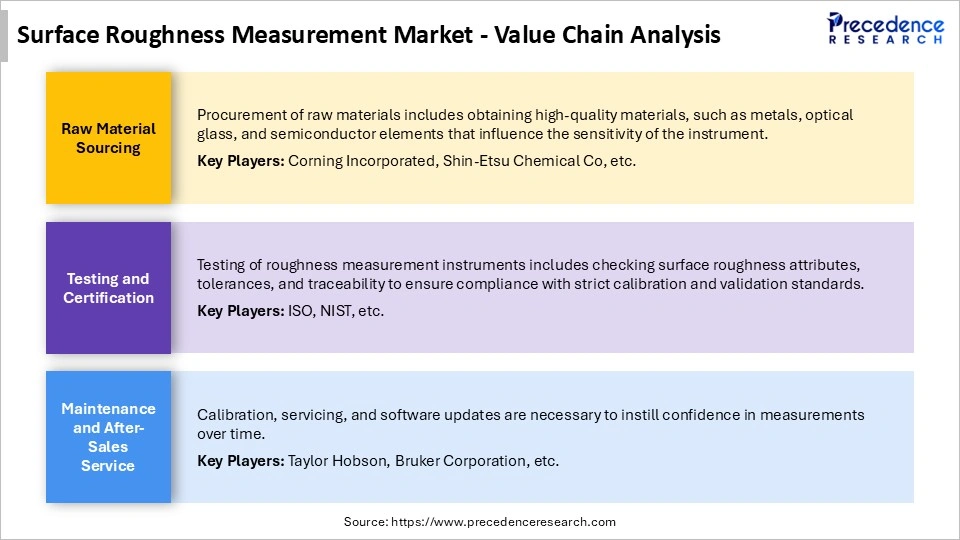
Surface Roughness Measurement Market Value Chain Analysis
Surface Roughness Measurement Market Key Players
- Starrett
- Hexagon AB
- Nikon Corporation
- AMETEK, Inc.
- Taylor Hobson
- Mahr GmbH
- CARL Zeiss AG
- Mitutoyo Corporation
- EXTECH
- Wenzel
- Semper Group
- Alicona Imaging GmbH
- Zygo Corporation
- JENOPTIK AG
- Horiba Ltd
- Fowler
- Faro Technologies
- Mitutoyo Corporation
- ZEISS
- Optimax Imaging Inspection & Measurement Ltd
Recent Developments
- In December 2025, KEYENCE Corporation announced upgrades to its IM-series and LJ-series platforms. These enhancements combine multisensory measurement with an AI automation capability to automatically capture thousands of dimensions in a matter of seconds, and subtly transform speed standards in surface and dimensional metrology.
- In November 2025, Carl Zeiss AG introduced a new update for its ZEISS INSPECT and PiWeb software, scheduled for 2026. It enhances digital inspection by integrating surface measurement data into integrated intelligent quality systems within automotive, aerospace, and medical manufacturing sectors.
Segments Covered in the Report
By Component
- Probes
- Software
- Frame Grabbers
- Lighting Equipment
- Camera
- Others
By Surface Type
- 3D
- 2D
By Technique
- Contact Technique
- Noncontact Technique
By Vertical
- Automotive
- Semiconductor
- Aerospace and Defence
- Optics and Metal Bearing
- Medical and Pharmaceuticals
- Energy and Power
- Other Verticals
By Region
- North America
- Latin America
- Europe
- Asia-pacific
- Middle and East Africa
Get Sample Link: https://www.precedenceresearch.com/sample/8232
