
 by
by 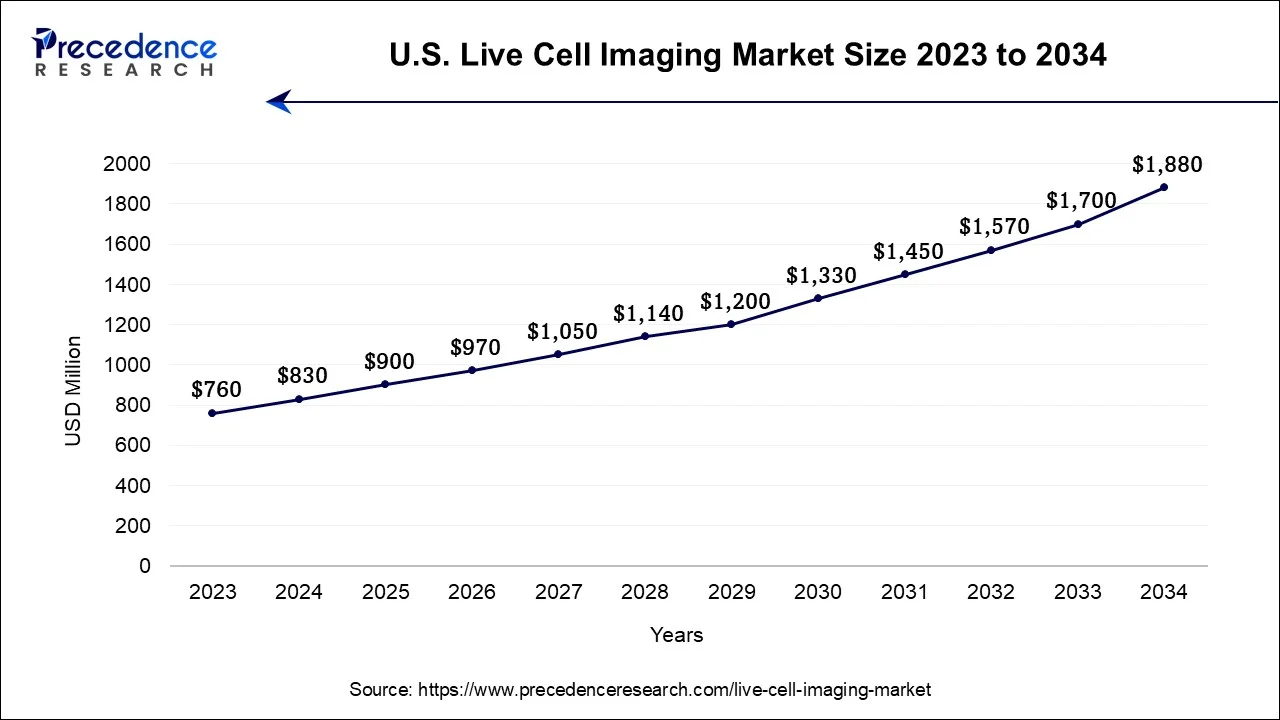
Market Key Takeaways
- By product, the equipment segment held the largest market share in 2025.
- By product, the software segment is expected to grow at a remarkable CAGR between 2026 and 2035.
- By application, the cell biology segment contributed the major market share in 2025.
- By application, the developmental biology segment is expanding at a remarkable CAGR between 2026 and 2035.
- By technology, the fluorescence resonance energy transfer (FRET) segment held the largest share in 2025.
- By technology, the high content screening (HCS) segment is set to grow at a notable CAGR between 2026 and 2035.
U.S. Live Cell Imaging Market Overview
The U.S. live cell imaging market is supported by a strong ecosystem of federally funded biomedical research institutions, leading academic medical centers, and major pharmaceutical and biotechnology hubs. Live cell imaging allows researchers to monitor living cells over extended periods under physiologically relevant conditions, enabling real-time observation of key cellular processes such as division, migration, differentiation, and programmed cell death. This dynamic approach aligns with the growing emphasis in U.S. research on time-resolved, functional insights rather than static endpoint measurements.
Live cell imaging is a critical tool in U.S. oncology research, particularly within National Cancer Institute (NCI)-designated cancer centers. It is widely applied to study tumor heterogeneity, metastatic behavior, immune–tumor interactions, and cellular responses to therapeutic interventions. These capabilities are essential for understanding drug resistance mechanisms and adaptive signaling pathways that are difficult to capture using fixed-cell imaging or bulk molecular techniques.
The technology also plays a central role in neuroscience research across the United States, supported by large-scale federal initiatives such as the BRAIN Initiative. Live cell imaging enables real-time visualization of neuronal activity, synaptic signaling, axonal transport, and network formation, advancing research into neurodevelopmental disorders, neurodegenerative diseases, and brain plasticity. Continued public and private investment in life sciences research is expected to sustain strong demand for advanced live cell imaging solutions across the U.S. market.
How AI-Driven Innovations Are Reshaping the U.S. Live Cell Imaging Market
Artificial intelligence (AI) and machine learning are rapidly transforming the U.S. live cell imaging market by significantly enhancing data interpretation, automation, and research productivity. AI-powered image analysis tools enable automated detection, classification, and tracking of cellular structures and behaviors in real time, allowing researchers to extract meaningful insights from complex, high-content imaging datasets. This capability is particularly valuable for predicting cellular responses, identifying subtle phenotypic changes, and accelerating drug screening and toxicity studies in preclinical research.
AI integration supports high-throughput live cell analysis by reducing reliance on manual image annotation, minimizing human error, and dramatically shortening analysis timelines. Pharmaceutical and biotechnology companies increasingly rely on AI-driven platforms to process large volumes of time-lapse imaging data, enabling faster decision-making in target validation, compound screening, and mechanism-of-action studies. In clinical research, AI enhances diagnostic accuracy and early disease detection by recognizing complex patterns and anomalies in live-cell images that may be overlooked using traditional analysis methods, ultimately contributing to improved patient outcomes.
Recent industry innovations highlight this momentum. In January 2025, Revvity, Inc. introduced Phenologic.AI, a deep learning–powered software designed to enhance cellular imaging workflows within its Harmony and Signals Image Artist platforms. By leveraging pre-trained models to analyze brightfield images, Phenologic.AI adds a new multiplexing dimension to live cell imaging and streamlines analytical workflows. Such advancements underscore how AI is expanding the analytical depth, speed, and scalability of live cell imaging across U.S. research and pharmaceutical environments.
U.S. Live Cell Imaging Industry Outlook
- Industry Growth Overview: Between 2026 and 2035, the industry is expected to grow at an accelerated pace. The growth of the U.S. live cell imaging market is driven by rapid advancements in microscopy technologies, increasing investment in R&D activities, the rising burden of chronic diseases, and a strong emphasis on personalized medicine. Additionally, rising funding for biomedical research and rapid technological advancements, such as Artificial Intelligence in High Content Screening (HCS) for faster drug discovery, are expected to propel growth in the U.S. live cell imaging sector.
- Geographical Expansion: Several leading players in the U.S. live cell imaging industry are expanding their global reach through various strategic initiatives. Their strategies involve significant investments, R&D focused on AI integration and automation, and forming partnerships to strengthen their product portfolios and geographical presence, especially in the fast-growing market.
- Major Investors: Several major strategic investors and key players are actively engaged in the U.S. live cell imaging market. These entities increasingly invest in R&D, strategic acquisitions, and product innovation (AI integration, automation) to drive market growth in the coming years. For instance, in January 2025, Molecular Devices, LLC., launched the ImageXpress HCS.ai High-Content Screening System. This fifth-generation high-content imager is distinguished by its ability to quickly capture crystal-clear images of complex cell models, acquire detailed data with intuitive software, and offer deep insights leveraging AI-driven analysis.
Top Players in the U.S. Live Cell Imaging Market
- Danaher Corporation
- PerkinElmer, Inc.
- Thermo Fisher Scientific Inc.
- Revvity
- GE Healthcare
- BD (Becton, Dickinson and Company)
- Agilent Technologies, Inc.
Recent Developments
- In June 2025, Ramona announced the launch of a live-cell imaging system that significantly improves speed and throughput for analyzing cells. The Vireo system uses miniaturized video microscopes and real-time image processing through artificial intelligence. Ramona said in a news release that Vireo can help give scientists better, faster insights into drug discovery.
- In May 2025, Leica Microsystems expanded its research microscope lineup with the addition of the Viventis LS2 Live light-sheet microscope, designed to provide high-quality imaging for studying complex biological systems down to the cellular level, thereby enhancing research into health, disease, and biology. The new Viventis LS2 Live light-sheet fluorescence microscope provides a unique, multi-view, multi-position light-sheet imaging approach to illuminate life in its entirety.
Segments Covered in the Report
By Product
- Equipment
- Consumable
- Software
By Application
- Cell Biology
- Developmental Biology
- Stem Cell & Drug Discovery
- Others
By Technology
- Time-lapse Microscopy
- Fluorescence recovery after photobleaching (FRAP)
- Fluorescence resonance energy transfer (FRET)
- High content screening (HCS)
- Others
Get Sample Link : https://www.precedenceresearch.com/sample/7255
