
 by
by 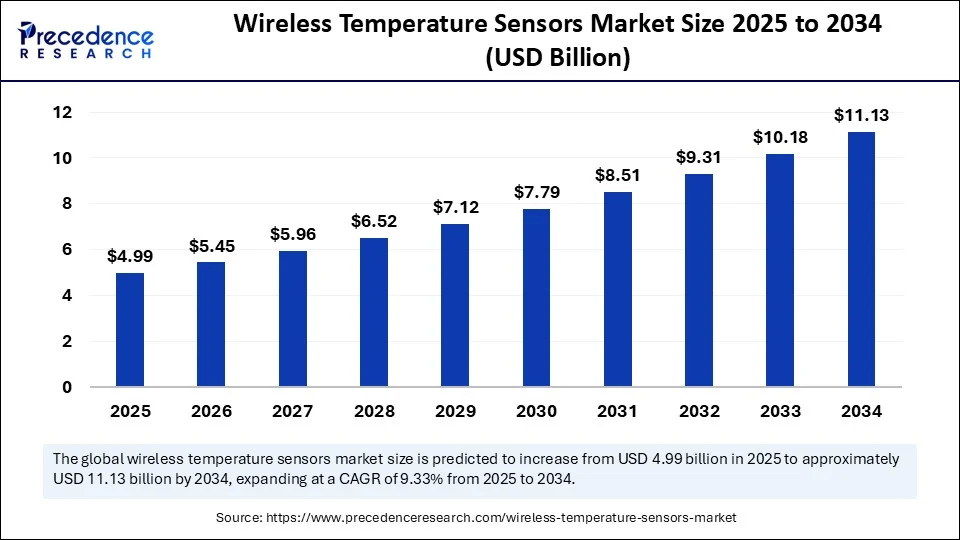
Wireless Temperature Sensors Market Key Takeaways
- In terms of revenue, the global wireless temperature sensors market was valued at USD 4.56 billion in 2024.
- It is projected to reach USD 11.13 billion by 2034
- The market is expected to grow at a CAGR of 9.33% from 2025 to 2034.
- North America dominated the wireless temperature sensors market with the largest market share of 37% in 2024.
- Asia Pacific is expected to grow at the fastest CAGR during the forecast period.
- By product/sensor type, the semiconductor (IC) temperature sensors segment held the biggest market share of 35% in 2024.
- By product/sensor type, the RTD (resistance temperature detector) wireless sensors segment is expected to grow at the fastest CAGR during the forecast period.
- By communication protocol, short-range wireless: Wi-Fi (2.4/5 HGz) segment captured the highest market share of 30% in 2024.
- By communication protocol, the LPWAN/long range low power: LoRaWAN/LoRa and Sigfox segment is projected to grow at the fastest CAGR during the forecast period.
- By solution type/Offering, the integrated offering combining hardware with a cloud-based SaaS platform segment held the largest share of 45% in 2024.
- By solution type/offering, the managed services/end-to-end monitoring segment is the fastest-growing during the study period.
- By range & deployment class, the short-range wireless sensors (up to 100m) segment generated the major market share of 50% in 2024.
- By range & deployment class, the long range (LPWAN, km scale) segment is emerging as the fastest growing during the forecast period.
- By industry vertical, on cold chain & logistics vertical segment accounted for the significant market share of 28% in 2024.
- By industry vertical, the healthcare & pharma segment is expected to grow at the fastest CAGR during the forecast period.
- By sales distribution channel, the system integrators & channel partners segment held the biggest market share of 40% in 2024.
- By sales distribution channel, the direct sales segment is expected to grow at the fastest CAGR during the forecast period.
How AI is Enhancing the Efficiency of the Wireless Temperature Sensors Market
Artificial Intelligence (AI) is revolutionizing the wireless temperature sensors market by driving smarter data analysis, predictive insights, and real-time decision-making across various industries. By integrating AI with sensor networks, businesses can go beyond basic temperature tracking to enable predictive maintenance, anomaly detection, and energy optimization. In healthcare, AI-powered sensor data supports remote patient monitoring, precise vaccine storage, and enhanced safety in medical facilities. In manufacturing and logistics, it streamlines cold chain management and boosts automation. Additionally, AI algorithms improve sensor calibration, reduce errors, and extend device lifespan, making wireless temperature sensors more reliable and cost-effective. These advancements are accelerating adoption in smart homes, industrial automation, and environmental monitoring applications.
Market Overview
Wireless temperature sensors are advanced sensing devices designed to measure temperature and transmit the data wirelessly to a gateway, cloud platform, or local receiver. These devices integrate a sensing element (such as thermistors, RTDs, thermocouples, or semiconductor sensors) with communication modules and power management systems (battery, energy harvesting, or mains). A typical setup includes a sensor node, optional local gateway, and software platform for alerting, logging, analytics, and API integration. The wireless temperature sensors market delivers these solutions for diverse applications, including environmental monitoring, cold-chain and logistics, industrial process control, building automation, pharmaceutical and healthcare storage, data-center management, and smart agriculture.
How Is the Wireless Temperature Sensor Market Evolving in Today’s Technology-Driven Landscape?
The wireless temperature sensor market is undergoing rapid transformation as industries embrace IoT, smart devices, and automation to improve real-time monitoring and operational efficiency. These sensors offer accurate temperature tracking without the limitations of wired systems, making them increasingly vital in sectors such as healthcare, automotive manufacturing, smart homes, and logistics. Growing emphasis on safety compliance, energy efficiency, and predictive maintenance is accelerating adoption. At the same time, innovations in low-power wireless communication, seamless cloud integration, and AI-powered analytics are enhancing scalability and performance. As digital transformation progresses, wireless temperature sensors are emerging as a cornerstone of connected and intelligent ecosystems.
Wireless Temperature Sensors Market Growth Factors
- Rising Adoption of IoT and Smart Devices: The growing integration of IoT-enabled systems and connected infrastructure is significantly driving demand for wireless temperature sensors. These devices enable real-time monitoring, automation, and seamless data sharing across industries, making them a key component of digital transformation.
- Expansion in Healthcare Applications: The healthcare sector is witnessing increased adoption of wireless sensors for applications such as patient monitoring, safe vaccine storage, and ensuring the performance of medical equipment. Their ability to provide accurate, remote temperature data enhances patient safety and operational efficiency in hospitals and laboratories.
- Industrial Automation and Predictive Maintenance: Manufacturing and industrial facilities are leveraging wireless temperature sensors to optimize operations, improve workplace safety, and enable predictive maintenance. By detecting anomalies early, these sensors help reduce downtime and improve productivity.
- Smart Homes and Building Automation: The rise of smart homes and energy-efficient building initiatives is fueling the adoption of wireless temperature sensors in HVAC systems, appliance monitoring, and indoor environmental control. Their role in maintaining comfort while reducing energy consumption is making them increasingly popular among consumers.
- Rising Food Safety and Cold Chain Monitoring Needs: The food and beverage industry relies on wireless temperature sensors to maintain strict safety standards and preserve product quality during storage and transportation. With increasing regulatory requirements, these sensors play a critical role in ensuring compliance and improving supply chain transparency.
Drivers
Growing Demand for Real-Time Data
The increasing need for real-time data across industries such as manufacturing, logistics, and healthcare is a major growth driver for the wireless temperature sensors market. These sensors enable continuous monitoring without the limitations of wired systems, improving decision-making accuracy, enhancing safety, and minimizing downtime. Their adoption is further boosted by the rise of Industry 4.0, where smart factories and automated warehouses rely heavily on connected sensor networks.
Expansion in Healthcare and Pharmaceutical Applications
Healthcare and pharmaceuticals represent one of the strongest growth segments. Wireless temperature sensors are widely used for patient monitoring, vaccine and drug cold chain management, and maintaining hospital environments. The surge in digital health adoption, along with increasing investments in telemedicine and remote patient care, is accelerating demand. In addition, the pharmaceutical industry’s focus on precision in transportation and storage further supports wider deployment of these solutions.
Restraints
High Initial Installation and Integration Costs
Despite their long-term benefits, the high upfront cost of wireless temperature sensors, along with expenses tied to IoT platform integration, can be a barrier—particularly for small and medium-sized enterprises. Budget limitations and the costs associated with upgrading legacy infrastructure often discourage adoption in developing regions.
Data Security and Privacy Concerns
Since wireless temperature sensors rely on IoT networks and cloud connectivity, they are vulnerable to cyberattacks, unauthorized access, and data breaches. These risks are especially critical in industries like healthcare and pharmaceuticals, where sensitive information is involved. Compliance with stringent cybersecurity standards, HIPAA regulations, and GDPR adds complexity and cost, creating further challenges for market growth.
Opportunities
Rising Adoption in Smart Homes and Building Automation
The growing popularity of smart homes and intelligent building management systems presents a significant opportunity for market expansion. Wireless temperature sensors play a key role in enhancing energy efficiency, optimizing HVAC systems, and improving occupant comfort. As urbanization and green building initiatives accelerate, demand for these solutions is set to grow. Integration with voice assistants and smart appliances further enhances their value proposition.
Expansion of Cold Chain Logistics and Food Safety Monitoring
With global trade in perishable goods on the rise, demand for reliable cold chain monitoring solutions is increasing. Wireless temperature sensors are critical in ensuring product quality, regulatory compliance, and safety during storage and transportation. The growing e-commerce grocery sector and rising consumption of fresh and frozen products create additional growth avenues. Moreover, investments in smart logistics hubs and automated warehouses are expected to further fuel adoption.
Recent Developments
- On 24 March 2025, Johnson Controls launched the NSW8000 Series wireless network sensor, a multisensory offering real-time temperature and relative humidity monitoring, occupancy detection, and optional CO2 sensing, fully integrated with Metasys building automation systems.
- In May 2025, Enless Wireless announced the upcoming release of a new LoRaWN temperature sensor with a black bulb probe, designed to measure resultant temperature key for optimizing occupant comfort and energy performance in building management systems.
Wireless Temperature Sensors Market Key Players
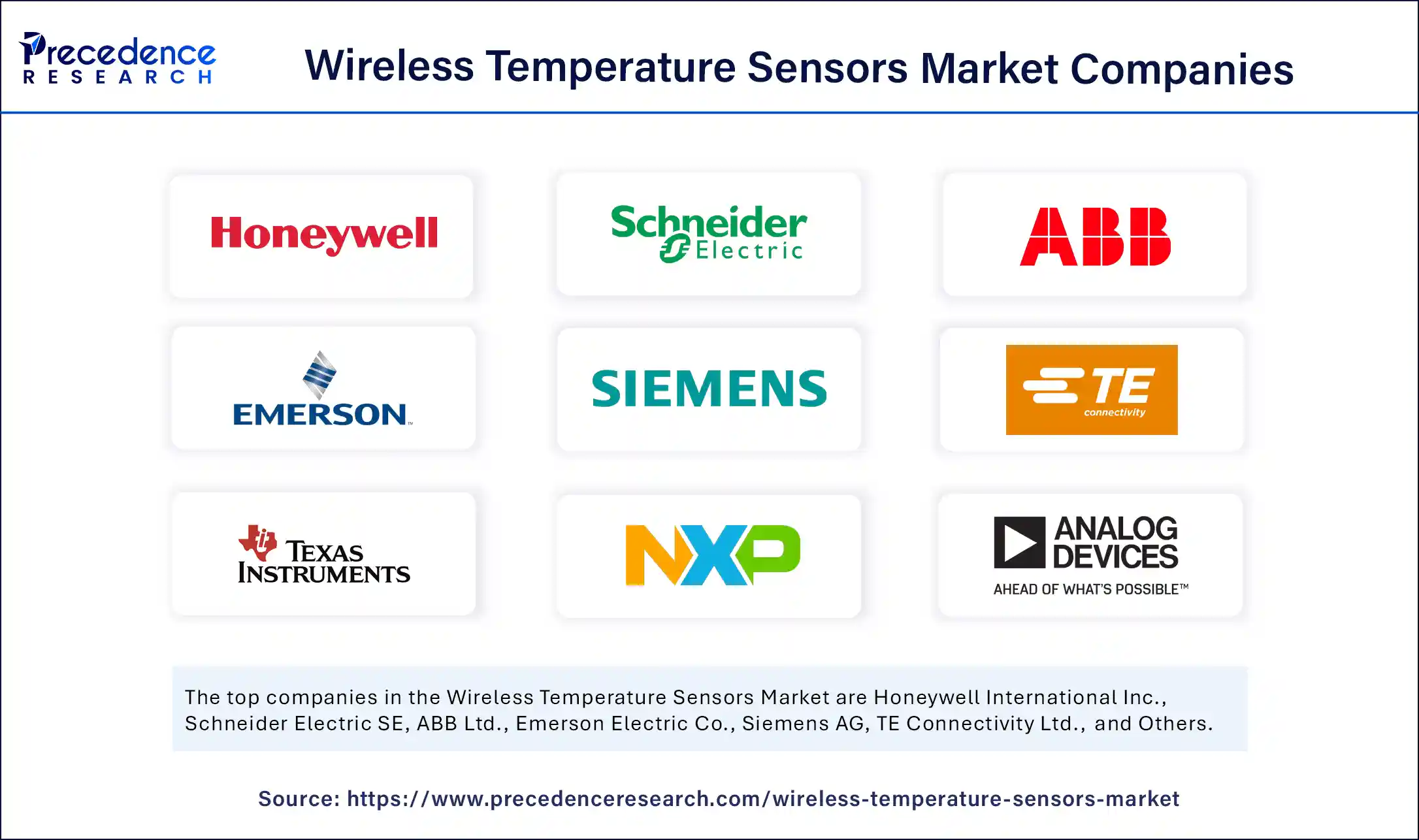
- Honeywell International Inc.
- Schneider Electric SE
- ABB Ltd.
- Emerson Electric Co.
- Siemens AG
- TE Connectivity Ltd.
- Texas Instruments Incorporated
- NXP Semiconductors N.V.
- Analog Devices, Inc.
- Monnit Corporation
- OMEGA Engineering, Inc.
- Vaisala Oyj
- Sensaphone (Sensaphone Corporation)
- Dwyer Instruments, Inc.
- Swift Sensors (Swift Sensors, Inc.)
- UbiBot (UbiBot, Inc.)
- Yokogawa Electric Corporation
- Microchip Technology Inc.
- JUMO GmbH & Co. KG
- Axzon, Inc.
