 by
by 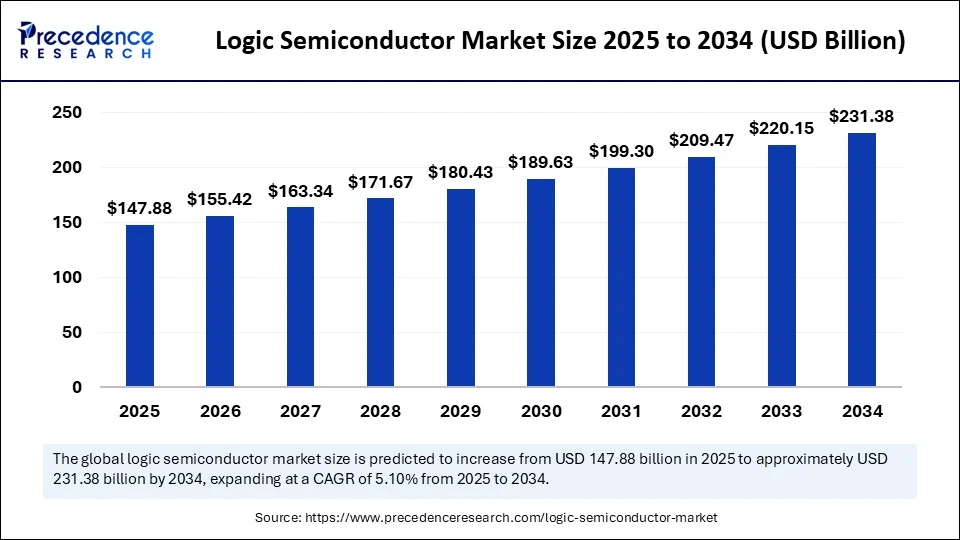
Logic Semiconductor Market Key Takeaways
- In terms of revenue, the global logic semiconductor market was valued at USD 140.7 billion in 2024.
- It is projected to reach USD 231.38 billion by 2034.
- The market is expected to grow at a CAGR of 5.1% from 2025 to 2034.
- North America dominated the global logic semiconductor market with the largest share of 48% in 2024.
- Asia Pacific is expected to grow at a notable CAGR from 2025 to 2034.
- By product type, the microcontrollers (MCUs) segment held the major market share in 2024.
- By product type, the microprocessors (uPs) segment is projected to grow at a CAGR between 2025 and 2034.
- By process node, the mature node segment contributed the biggest market share in 2024.
- By process node, the advanced nodes segment is expected to expand at a significant CAGR between 2025 and 2034.
- By end-user industry, the consumer electronics segment led the market in 2024.
- By end-user industry, the automotive segment is expected to grow at a significant CAGR over the projected period.
- By design type, standard cell/SoC platforms generated the major market share in 2024.
- By design type, the FPGA/SoP segment is expected to grow at a notable CAGR from 2025 to 2034.
Impact of Artificial Intelligence on the Logic Semiconductor Market
Artificial Intelligence (AI) is significantly driving innovation and demand in the logic semiconductor market. To meet the growing performance requirements of AI-driven applications, semiconductor companies are increasingly developing specialized AI accelerators and reconfigurable logic platforms such as Field-Programmable Gate Arrays (FPGAs) and custom Application-Specific Integrated Circuits (ASICs). Beyond product development, AI is also being utilized internally by chipmakers to streamline and enhance chip design processes. This includes improving the precision of layout masks, optimizing circuit architectures, and predicting potential failure points in the manufacturing process. As AI continues to evolve, its integration across both product and production workflows is set to redefine efficiency and capabilities within the logic semiconductor industry.
Market Overview
The logic semiconductor market comprises integrated circuits (ICs) that perform logical operations and control data flow in electronic systems. These semiconductors are the foundational components of modern computing, powering a range of devices including Central Processing Units (CPUs), Graphics Processing Units (GPUs), Field-Programmable Gate Arrays (FPGAs), Application-Specific Integrated Circuits (ASICs), and Systems on Chips (SoCs). They are critical to the functionality of smartphones, personal computers, automotive electronic control units (ECUs), AI accelerators, and Internet of Things (IoT) devices.
Market growth is being driven by the rising demand for edge AI, autonomous technologies, and real-time data processing across industries such as automotive, consumer electronics, and industrial automation. Logic chips serve as the “brains” of intelligent systems, executing instructions, processing digital signals, and enabling seamless communication between connected sensors and devices. According to the IEEE, logic ICs embedded with AI capabilities are essential for scaling edge computing and robotics, particularly in applications requiring low latency and high performance. As digital infrastructure continues to evolve, the need for high-efficiency logic semiconductors whether embedded in vehicles, smartphones, or cloud infrastructure is expected to increase significantly.
Logic Semiconductor Market – Growth Factors
- Rising Demand for AI and Edge Computing: The growing adoption of artificial intelligence, machine learning, and edge computing in applications like autonomous vehicles, robotics, and smart devices is significantly increasing the demand for high-performance logic semiconductors.
- Proliferation of Consumer Electronics: Smartphones, tablets, smart TVs, and wearables rely heavily on logic ICs for processing and connectivity. With the rapid rollout of 5G and increasing consumer tech penetration, demand for advanced logic chips continues to grow.
- Automotive Electrification and Automation: As vehicles become increasingly software-defined—with features like ADAS, infotainment, and electric powertrains—automotive manufacturers are integrating more logic semiconductors to support real-time data processing and autonomous decision-making.
- Expansion of Data Centers and Cloud Infrastructure: The surge in cloud computing, big data, and AI workloads is driving the need for powerful, energy-efficient logic chips in servers and data centers to handle massive computational demands.
- Growth in IoT and Industrial Automation: Industrial automation and smart manufacturing depend on logic ICs for real-time control, signal processing, and connectivity. The increasing deployment of IoT devices across sectors further fuels market expansion.
Opportunity: How the Complexity of Consumer Electronics Is Reshaping the Logic Semiconductor Market
The increasing complexity of consumer electronics such as gaming consoles, AR/VR headsets, smart TVs, and multifunctional smartphones is creating significant growth opportunities for the logic semiconductor market. These devices are now equipped with numerous sensors, high-performance graphics, and fast connectivity features, all of which rely heavily on robust and efficient logic processing units. To meet these evolving demands, manufacturers are developing customized logic architectures optimized for size, power efficiency, performance, and cost.
The rapid product cycles and seasonal demand peaks in consumer electronics are further accelerating innovation in logic chip design. Logic semiconductors are now central to differentiating products in a highly competitive market.
According to the Japan Electronics and Information Technology Industries Association (JEITA), logic components held the largest share of integrated circuits in high-end consumer electronics in 2024, driven by the rise of embedded AI and graphics-intensive applications. Companies like Apple and Samsung Electronics have introduced chipsets with specialized logic cores designed for multitasking, machine learning, and immersive media experiences. Today, logic semiconductors handle a substantial portion of real-time processing in smartphones and wearable devices, underscoring their critical role and continued market expansion in the consumer tech sector.
Recent Development
- In April 2025, Taiwan Semiconductor Manufacturing Company (TSMC) (TWSE: 2330, NYSE: TSM) introduced its latest advanced logic technology, A14, during the North America Technology Symposium. Marking a significant leap beyond its industry-leading N2 process, A14 is designed to enable faster, more energy-efficient computing, particularly in AI workloads. TSMC anticipates A14 to significantly elevate smartphone performance by strengthening on-device AI features. Although mass production is targeted for 2028, TSMC confirmed that A14’s development is already ahead of schedule in yield performance.
- In January 2025, according to SEMI’s World Fab Forecast, the global semiconductor industry is set to witness the launch of 18 new fab construction projects 2025. These include 15 new 300mm and three new 200mm facilities. The Americas and Japan lead with four projects each, followed by China and Europe & the Middle East with three each. Taiwan, Korea, and Southeast Asia are also part of this expansion, with at least one project each expected to break ground during the year.
- In May 2025, in a boost to its domestic chip manufacturing ambitions, India approved its sixth semiconductor facility, a collaboration between HCL and Foxconn, under the India Semiconductor Mission. According to official government sources, five additional units are already under advanced stages of construction. The government continues to seek international investments to develop a robust ecosystem that includes fabs, ATMP units, and design infrastructure.
- In April 2025, TSMC reconfirmed its commitment to AI-focused innovation at its North America symposium by emphasizing the importance of the new A14 logic platform. While building on the capabilities of its N2 process set to begin volume production in late 2025 the A14 platform is engineered to optimize power efficiency and computing speed. TSMC’s momentum reflects its growing market dominance, backed by robust ~11% YoY revenue growth and a market cap nearing $42 billion.
Logic Semiconductor Market Top Companies