
 by
by The US DNA synthesis market is experiencing strong growth, fueled by advances in synthetic biology, gene editing technologies, personalized medicine, and increasing investments in genomic research. Artificial intelligence and automation are transforming DNA design and manufacturing, accelerating innovation across biotechnology, pharmaceuticals, diagnostics, and agriculture.
US DNA Synthesis Market Size and Forecast
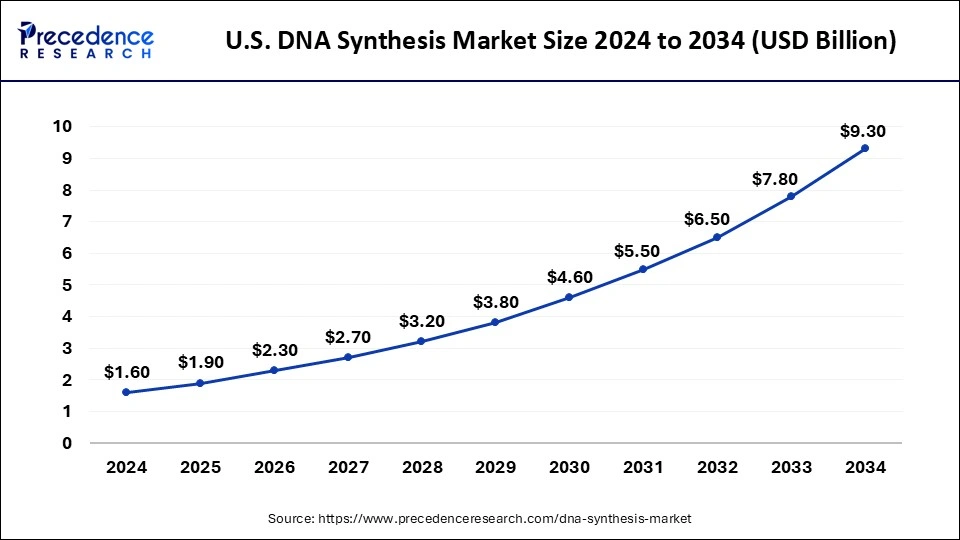
The US DNA synthesis market size was calculated at USD 1.90 billion in 2025 and is predicted to increase from USD 2.30 billion in 2026 to approximately USD 10.66 billion by 2035, expanding at a CAGR of 18.82% from 2026 to 2035. The growing investments in the biotechnology industry and technological advancements in the genetic engineering sector have accelerated the market expansion.
Market Highlights
- Based on service type, the oligonucleotide synthesis segment accounted for the largest share of the market in 2025, driven by its extensive use in molecular biology, diagnostics, and drug discovery applications.
- The gene synthesis segment is projected to witness significant growth during the forecast period, supported by increasing demand for synthetic genes in genetic engineering, personalized medicine, and advanced therapeutic development.
- By application, the research and development segment dominated the market in 2025, owing to rising investments in genomics research and the growing focus on innovative biotechnology solutions.
- The therapeutics segment is expected to register the highest growth rate over the forecast period, fueled by the expanding pipeline of nucleic acid-based therapies and increasing adoption of precision medicine approaches.
- In terms of end users, biopharmaceutical companies held the largest market share in 2025, reflecting their strong investments in drug discovery, biologics development, and next-generation therapeutics.
- Academic and research institutes are anticipated to experience the fastest growth during the forecast period, driven by increasing government funding, expanding genomic research activities, and growing collaborations between research organizations and industry players.
What is Driving the Growth of the U.S. DNA Synthesis Market?
The US DNA synthesis market encompasses technologies and services used to produce synthetic DNA sequences for research, diagnostics, therapeutics, vaccine development, and industrial biotechnology applications. DNA synthesis has become a cornerstone of modern life sciences, enabling innovations in genomics, precision medicine, and synthetic biology.
The market is expanding due to rising investments in biotechnology research, increasing adoption of gene therapies, and growing demand for synthetic genes and oligonucleotides. Furthermore, advancements in CRISPR technology, mRNA therapeutics, and next-generation sequencing are creating new growth opportunities for DNA synthesis providers.
Government support for genomic research and the presence of leading biotechnology companies further strengthen the United States’ position as a global leader in DNA synthesis technologies.
How is Artificial Intelligence Transforming the U.S. DNA Synthesis Market?
Artificial Intelligence (AI) is revolutionizing DNA synthesis by improving sequence design, reducing errors, and accelerating research workflows.
AI-powered algorithms enable researchers to optimize gene sequences, predict biological functions, and design synthetic constructs with greater precision. Machine learning models are also supporting automated quality control and reducing manufacturing costs.
Generative AI and computational biology platforms are helping scientists accelerate drug discovery, protein engineering, and vaccine development. These technologies are expected to significantly shorten research timelines and improve the efficiency of synthetic biology applications.
What are the Major Trends Influencing the U.S. DNA Synthesis Market?
- Increasing Adoption of Synthetic Biology: Synthetic biology is becoming a key driver of market growth as researchers develop engineered microorganisms, novel therapeutics, and sustainable bio-based products.
- Rising Demand for Gene and Cell Therapies: The expansion of gene-editing technologies and cell therapies is increasing the need for custom DNA constructs and synthetic genes.
- Growth of mRNA and Vaccine Development: The success of mRNA-based vaccines has accelerated investments in nucleic acid technologies, boosting demand for DNA synthesis solutions.
- Advancements in Automation: Automated DNA synthesis platforms are improving throughput, reducing production costs, and enabling large-scale manufacturing.
- Expanding Applications in Agriculture and Industrial Biotechnology: DNA synthesis technologies are increasingly being used to develop proved crops, biofuels, and environmentally sustainable products.
Market Scope
| Report Coverage | Details |
| Market Size in 2025 | USD 1.90 Billion |
| Market Size in 2026 | USD 2.30 Billion |
| Market Size by 2035 | USD 10.66 Billion |
| Growth Rate from 2026 to 2035 | CAGR of 18.82% |
| Base Year | 2025 |
| Forecast Period | 2026 to 2035 |
| Segments Covered | Service, Application, and End-User |
What are the Segment Insights of the U.S. DNA Synthesis Market?
By Product Type
The oligonucleotides segment accounted for the largest market share due to their widespread use in PCR, sequencing, diagnostics, and therapeutic applications. Meanwhile, the synthetic genes segment is expected to witness rapid growth because of increasing applications in synthetic biology and gene therapy.
By Method
The solid-phase synthesis segment dominated the market owing to its high accuracy and scalability. Enzymatic DNA synthesis technologies are anticipated to experience significant growth due to their potential to improve efficiency and reduce costs.
By Application
The research and development segment held the largest market share, driven by increasing investments in genomics and biotechnology research. However, the therapeutics segment is projected to expand at the fastest rate due to rising demand for gene therapies and personalized medicine.
By End User
Biotechnology and pharmaceutical companies represented the leading end-user segment because of their extensive use of DNA synthesis technologies in drug development and synthetic biology applications. Academic and research institutes are also expected to contribute significantly to market growth.
What Does the Future Hold for the U.S. DNA Synthesis Market?
The future of the U.S. DNA synthesis market will be shaped by synthetic biology, AI-driven molecular design, personalized medicine, and gene-editing technologies. Emerging innovations such as enzymatic DNA synthesis, digital biology, and automated laboratories are expected to transform the industry.
Growing investments in mRNA therapeutics, precision medicine, and industrial biotechnology are likely to create significant opportunities over the coming decade.
Why is the U.S. DNA Synthesis Market Expected to Witness Strong Growth?
The market is benefiting from increasing demand for synthetic biology solutions, advances in gene therapies, and expanding applications across healthcare, agriculture, and industrial biotechnology.
As artificial intelligence, automation, and genomics continue to redefine biological research and therapeutic development, the U.S. DNA synthesis market is expected to witness sustained growth and remain at the forefront of life sciences innovation.
Who are the Key Players Operating in the U.S. DNA Synthesis Market?
Major companies operating in the market include:
- Twist Bioscience Corporation
- Thermo Fisher Scientific Inc.
- Integrated DNA Technologies (IDT)
- GenScript Biotech Corporation
- Eurofins Scientific
- Danaher Corporation
- Agilent Technologies, Inc.
- Merck KGaA
- Bio-Rad Laboratories, Inc.
- Bioneer Corporation
- OriGene Technologies, Inc.
- ATUM
- Synbio Technologies
- Azenta Life Sciences
- Codex DNA, Inc.
These companies are focusing on automation, AI-enabled design platforms, strategic collaborations, and expanding manufacturing capabilities to strengthen their competitive positions.
Market Competitive Landscape: Leading Companies and Strategies
The U.S. DNA synthesis market is highly competitive due to the presence of several leading companies and numerous startups operating in this field. Top companies dealing in this sector include LGC Biosearch Technologies, Bioneer Corporation, Thermo Fisher Scientific, Inc., Eton Bioscience, and Quintara Biosciences. These companies are engaged in the research and development of DNA-based solutions for the end-users. Also, they are adopting several strategies, such as collaborations and product launches, to uphold their position in this industry.
- In February 2026, Thermo Fisher Scientific launched the Thermo Scientific Sequential Protein/DNA/RNA Extraction Kit. This extraction kit was designed to enable the sequential extraction of DNA, protein, and RNA from a single sample.
The rising cost of extraction equipment and strict biosecurity regulations have created problems among the market players. The growing adoption of DNA data storage systems by the research centers, along with the technological advancements in DRT3 solutions, will create a suitable landscape for the market’s future.
Recent Developments
- In May 2026, 4basebio launched the enzymatic ssDNA platform. This platform was designed to accelerate the development of safer, more precise genetic therapies by enabling targeted gene editing, advanced cell engineering, and innovative nucleic acid-based medicines.
- In April 2026, Ansa Biotechnologies announced the presentation of its direct, sequence-perfect clonal DNA products that deliver unmatched quality, ultra-fast turnaround times at affordable costs. The products enable researchers to design and assemble longer, more complex constructs for next-generation cell and gene therapies, genome engineering, bioproduction, vaccine research, and agrigenomics applications.
- In April 2026, Covaris announced the launch of its truCOLLECT solution, a novel integrated system for remote whole blood collection, stabilization, and downstream processing. It is designed to address pre-analytical variability and logistical constraints associated with venipuncture-based collection, particularly in decentralized and geographically distributed studies.
Get Sample Link : https://www.precedenceresearch.com/sample/8467
Segments Covered in the Report
By Service
- Oligonucleotide Synthesis
- Custom Oligonucleotide Synthesis
- Pre-designed Oligonucleotide Synthesis
- Gene Synthesis
By Application
- Research and Development
- Therapeutics
- Diagnostic
By End-User
- Biopharmaceutical Companies
- Academic and Research Institutes
- Contract Research Organizations
Also Read Our Latest Article : Cesium Market
