
 by
by 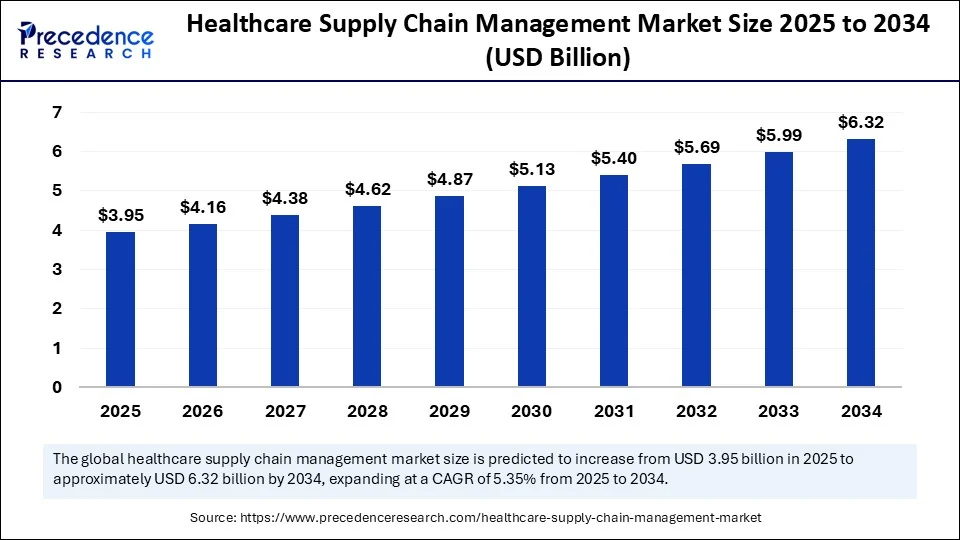
Healthcare Supply Chain Management Market Key Takeaways
- In terms of revenue, the global healthcare supply chain management market was valued at USD 3.75 billion in 2024.
- It is projected to reach USD 6.32 billion by 2034.
- The market is expected to grow at a CAGR of 5.35% from 2025 to 2034.
- North America dominated the healthcare supply chain management market with the largest market share of 39.8% in 2024.
- Asia Pacific is expected to expand at the fastest CAGR between 2025 and 2034.
- By component, the software segment dominated the market, under which the inventory management sub-segment held the maximum market share in 2024.
- By component, the analytics and reporting sub-segment is expected to expand at a notable CAGR over the projection period.
- By delivery mode, the cloud-Based segment captured the biggest market share of 51.3% in 2024.
- By end user, the healthcare providers segment contributed the highest market share of 34.7% in 2024.
- By end user, the healthcare manufacturers segment is expected to expand at the highest CAGR over the forecast period.
- By function, the inventory management segment held the largest market share of 22.1% in 2024.
- By function, the compliance and risk management segment is expected to expand at the fastest CAGR over the projected period.
- By technology, the RFID segment generated the major market share of 26.4% in 2024.
- By technology, the AI & machine learning segment is expected to expand at a notable CAGR over the projected period.
- By deployment size, the large enterprises segment accounted for the significant market share of 41.9% in 2024.
- By deployment size, the mid-sized organizations segment is expected to expand at a notable CAGR over the projected period.
Market Overview
The healthcare supply chain management market encompasses the systems, technologies, and services aimed at optimizing the movement of pharmaceuticals, medical devices, hospital supplies, and healthcare services from manufacturers to end users such as hospitals, pharmacies, and patients. This includes processes such as logistics, procurement, inventory control, and data management across the healthcare continuum.
The primary objectives of healthcare supply chain management are to increase operational efficiency, reduce costs, ensure compliance with regulatory standards, and maintain the quality and availability of medical products. By streamlining supply chain operations, healthcare organizations can improve patient outcomes and better respond to demand fluctuations while safeguarding product integrity.
Healthcare Supply Chain Management Market Growth Factors
- Cost Efficiency Demands: Healthcare providers are increasingly focused on reducing operational expenses. Supply chain management (SCM) systems play a key role by minimizing inventory waste, streamlining procurement processes, and enhancing financial planning. These efficiencies support more sustainable and cost-effective operations.
- Adoption of AI and IoT Technologies: The integration of artificial intelligence (AI), the Internet of Things (IoT), and predictive analytics is transforming healthcare logistics. These technologies improve demand forecasting accuracy, enable real-time inventory monitoring, and help prevent supply chain disruptions, ultimately reducing shortages and excess stock.
- Rise of Cloud-Based Solutions: Cloud-based platforms offer centralized and scalable solutions for managing sourcing, logistics, and inventory. Their flexibility simplifies deployment, enhances data accessibility, and lowers infrastructure expenses, making them well-suited for large, complex healthcare networks.
- Emphasis on Compliance and Product Traceability: Regulatory demands for traceability, serialization, and anti-counterfeiting measures are pushing healthcare organizations to adopt advanced SCM tools. These solutions enhance transparency, ensure adherence to compliance standards, and support patient safety by maintaining control over product movement throughout the supply chain.
Drivers
Global regulations regarding pharmaceutical traceability are a major factor driving growth in the healthcare supply chain management market. International regulatory frameworks are increasingly focused on enforcing serialization, product verification, and secure data sharing to combat counterfeit drugs and improve supply chain transparency. For instance, the European Union’s Falsified Medicines Directive requires serialized tracking and a centralized verification system, while the United States mandates electronic traceability of prescription drugs through the Drug Supply Chain Security Act.
In countries like India, China, and Brazil, national regulations have introduced barcode and QR code-based systems for both domestic and export pharmaceutical tracking. Additionally, global health initiatives now incorporate real-time logistics tools to monitor procurement and delivery during public health emergencies. These evolving regulatory demands push healthcare providers, pharmaceutical manufacturers, and logistics partners to adopt digital supply chain solutions, boosting demand for efficient and compliant platforms.
Restraint
One of the main factors limiting market expansion is the ongoing disruption in supply chains and the increasing frequency of drug shortages. Hospitals are reporting delays in patient care and cancelled procedures due to the unavailability of critical medications and supplies. Recent figures show a significant rise in active drug shortages, reflecting the vulnerability of global healthcare supply chains.
Events such as natural disasters, manufacturing shutdowns, or geopolitical tensions have disrupted the production and delivery of key products. For example, the temporary closure of a major intravenous fluid manufacturing site in the United States led to widespread shortages. These disruptions not only impact patient outcomes but also reduce confidence in digital solutions when real-world logistics face such unpredictability. Additionally, the complexity of coordinating between multiple stakeholders and regulatory frameworks remains a challenge for full-scale adoption of supply chain management systems.
Opportunity
A key opportunity in the healthcare supply chain management market is the growing adoption of cloud-based platforms. These technologies are transforming how healthcare organizations manage sourcing, inventory, and logistics. Cloud platforms provide centralized control, real-time data visibility, and remote accessibility across networks of hospitals, clinics, and suppliers.
By automating tasks and streamlining data sharing, cloud systems help reduce operational errors, improve decision-making, and lower infrastructure costs. As governments and institutions promote digital transformation and resilience in healthcare systems, cloud-based SCM solutions are gaining traction. This shift presents a significant growth opportunity for technology vendors offering scalable and customizable cloud platforms tailored to the healthcare industry’s complex requirements.
Recent Developments
- On July 22, 2025, COSMOS Pharmaceutical partnered with RELEX Solutions to integrate AI-powered supply chain optimization into its operations. Using machine learning and analytics, the platform will improve demand forecasting, automate replenishment, and increase inventory accuracy to support scalable, data-driven growth in pharmaceutical distribution.
- In July 2025, Compass Group Equity Partners, a St. Louis-based private equity firm, partnered with The Illuminate Group to launch a next-generation cold chain platform. The solution combines tracking, predictive analytics, and real-time monitoring to improve temperature-sensitive pharmaceutical logistics and reduce spoilage risks in global supply networks.
- In May 2025, Tjoapack introduced a new customer dashboard to improve visibility in pharmaceutical packaging. The tool provides real-time supply chain tracking, production updates, and performance metrics to enhance communication, forecasting accuracy, and decision-making for drug manufacturers and distributors.
- In February 2025, Cencora expanded its Drug Shortages Mitigation Program to tackle critical supply gaps in the pharmaceutical sector. The initiative includes strategic inventory planning, better supplier engagement, and data-driven risk assessment to strengthen supply chain resilience in the U.S. healthcare system.
Healthcare Supply Chain Management Market Key Players
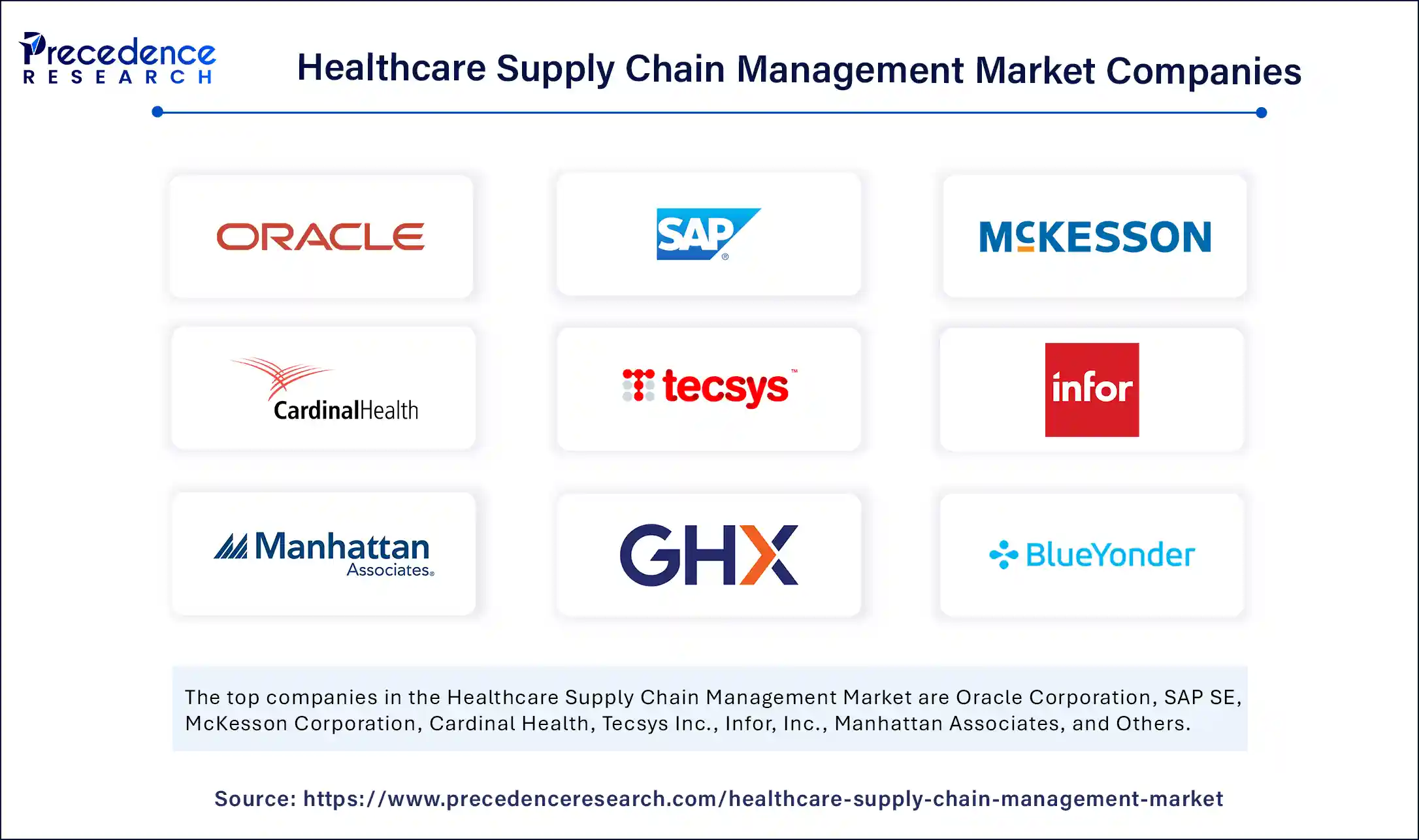
- Oracle Corporation
- SAP SE
- McKesson Corporation
- Cardinal Health
- Tecsys Inc.
- Infor, Inc.
- Manhattan Associates
- Global Healthcare Exchange (GHX)
- JDA Software (Blue Yonder)
- Smith & Nephew
- Jump Technologies
- LogiTag Systems
- Syft (a GHX company)
- Hybrent, Inc.
- Premier, Inc.
- IBM Corporation
- Kinaxis Inc.
- Oracle Cerner
- Zebra Technologies
- Medtronic Supply Chain Solutions
