 by
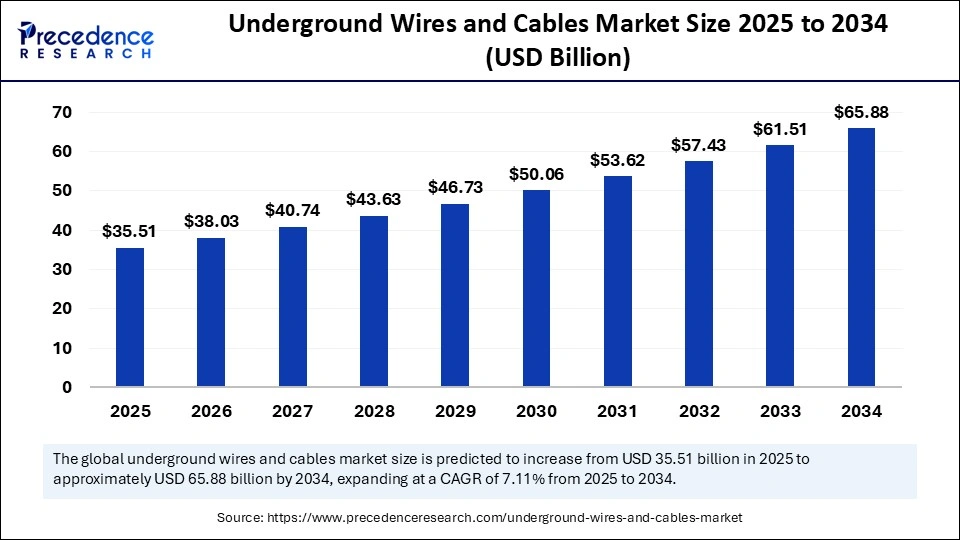
by The global underground wires and cables market is set to expand significantly, with projected growth from USD 35.51 billion in 2025 to approximately USD 65.88 billion by 2034, registering a CAGR of 7.11%. This growth is propelled by rising investments in reliable power infrastructure and advancements in underground cabling technologies aimed at boosting efficiency, safety, and sustainability.
What is Powering the Growth in the Underground Wires and Cables Market?
The surge in underground cables’ adoption is closely linked to the increasing global demand for dependable power transmission systems. As urbanization accelerates and industrial sectors expand, utility companies are investing heavily in underground cabling to deliver stable energy supplies while mitigating weather-related outages. Technological innovations in cable materials and designs further drive market growth by improving durability and transmission efficiency.
Underground Wires and Cables Market Key Insights
-
The North America region dominated the market in 2024 with a 41% share, led by substantial grid modernization efforts.
-
Asia Pacific is forecasted to be the fastest-growing region, expanding at a CAGR of 8.5% driven by urbanization and renewable energy projects.
-
Power cables accounted for 45% of the market share in 2024, representing the largest segment by product type.
-
Communication cables are the fastest-growing segment, expected to grow at a CAGR of 7.5% through 2034, fueled by 5G and smart city initiatives.
-
Direct burial installation constitutes the largest installation type segment with a 42% share in 2024.
-
Metallic conductors (copper and aluminum) made up 48% of the market by material in 2024.
-
Up to 1 kV (low voltage) cables held the largest voltage rating segment at 38%.
-
Power transmission and distribution applications made up 40% of demand in 2024.
-
Utility companies dominated as end users with a 43% share in 2024.
How Much is AI Enhancing the Underground Wires and Cables Market?
Artificial Intelligence is revolutionizing the underground wires and cables sector by improving overall operational efficiency and safety. Smart analytics powered by AI facilitate real-time load balancing, which reduces transmission losses and augments grid stability. Energy providers increasingly leverage AI-driven predictive maintenance and fault detection technologies to ensure uninterrupted power delivery.
Role of AI in Predicting Equipment Failure and Optimizing Network Performance
AI algorithms analyze vast data from underground cable networks to anticipate potential faults before they occur, minimizing downtime and repair costs. This proactive approach enables grid operators to optimize network performance, allocate resources efficiently, and support the integration of renewable energy sources seamlessly.
What are the Key Growth Factors Driving This Market?
Several factors fuel the expansion of the underground wires and cables market:
-
Adoption of smart grid technologies demanding integrated underground cabling with real-time monitoring.
-
Rapid urban electrification and metro development requiring buried power and communication networks.
-
Growing emphasis on disaster-resilient infrastructure to mitigate outage risks from extreme weather.
-
Industrial automation and rising industrial zones driving demand for high-capacity underground cabling.
Market Scope
| Report Coverage | Details |
| Market Size in 2025 | USD 35.51 Billion |
| Market Size in 2026 | USD 38.03 Billion |
| Market Size by 2034 | USD 65.88 Billion |
| Market Growth Rate from 2025 to 2034 | CAGR of 7.11% |
| Dominating Region | North America |
| Fastest Growing Region | Asia Pacific |
| Base Year | 2024 |
| Forecast Period | 2025 to 2034 |
| Segments Covered | Type, Installation Type, Material, Application, Voltage Rating, End user, Insulation Material, and Region |
| Regions Covered | North America, Europe, Asia-Pacific, Latin America, and Middle East & Africa |
Which Opportunities and Trends are Shaping the Market?
What Role do Infrastructure and Industrial Expansion Trends Play?
Booming investments in urban infrastructure projects, mega-city developments, and large-scale industrial zones generate major demand for underground cables that provide reliable electricity, data, and communication networks. Governments’ focus on smart city and modern transport projects further accelerates cable deployment.
How is the Renewable Energy Transition Impacting Market Prospects?
The increasing integration of renewable energy requires advanced underground and submarine cabling systems to connect distant wind and solar farms to grids efficiently, stimulating demand for specialized cable solutions.
What Emerging Technologies are Influencing the Sector?
Advancements in lightweight composite materials and recyclable cable systems, along with innovations in insulation like XLPE and EPR, are driving product performance enhancements and environmental sustainability.
How Does Regional and Segment Analysis Reflect Market Dynamics?
North America dominates with a 41% market share, spearheaded by extensive federal funding for grid upgrades and the Grid Resilience and Innovation Partnerships (GRIP) program.
The U.S. market alone is projected to grow at a CAGR of 7.17% through 2034.
Asia Pacific is the fastest-growing region at 8.5%, driven by China’s New Infrastructure Plan and urban megaprojects such as metro rail installations. Europe, led by Germany’s Energiewende program, focuses heavily on grid resilience and renewable integration.
Underground Wires and Cables Market Segment-Wise Insights
| Segment Category | Leading Segment | Market Share (2024) | Growth Forecast (CAGR) |
|---|---|---|---|
| Type | Power Cables | 45% | Communication Cables – 7.5% |
| Installation | Direct Burial | 42% | Duct Installation – 7% |
| Material | Metallic Conductors | 48% | Composite Materials – 8% |
| Voltage Rating | Up to 1 kV | 38% | Above 220 kV – 7.2% |
| Application | Power Transmission & Distribution | 40% | Renewable Energy Projects – 7.5% |
| End User | Utility Companies | 43% | Renewable Energy Developers – 7.5% |
| Insulation Material | XLPE | 36% | EPR – 7% |
Latest Industry Breakthroughs from Leading Companies
-
In June 2025, Sumitomo Electric Industries launched a 525kV XLPE HVDC underground cable system for Germany’s Corridor A-Nord energy project.
-
LyondellBasell and Maillefer introduced recyclable polypropylene-based power cable systems offering sustainable alternatives to traditional XLPE insulation.
-
In August 2025, Indian brand Surya Roshni expanded into wires and cables with the Turbo Flex range combining safety and durability for residential and commercial use.
Notable industry leaders in underground wires and cables include Nexans Group, LS Cable and System, NKT Cables, Southwire Company LLC, and Furukawa Electric Co. Ltd.
What Challenges and Cost Pressures Affect Market Expansion?
The primary constraints stem from the high installation and maintenance costs of underground cable systems relative to overhead lines. The requirement for extensive excavation, specialized equipment, and skilled labor leads to elevated project costs, slowing adoption in cost-sensitive regions. Additionally, complex fault detection and repair procedures impose operational challenges.
Is There a Case Study Demonstrating Market Impact?
The World Bank’s 2025 funding initiative aimed at upgrading Turkiye’s power transmission system by increasing underground cables to support 1.7 GW of renewable generation exemplifies how targeted investments can enhance grid reliability and accommodate energy transition goals.
Segments Covered in the Report
By Type (Product Type)
- Power Cables
- Low Voltage (LV) Cables (≤1 kV)
- Medium Voltage (MV) Cables (1–33 kV)
- High Voltage (HV) Cables (33–220 kV)
- Extra High Voltage (EHV) Cables (>220 kV)
- Communication Cables
- Fiber Optic Cables
- Coaxial Cables
- Copper Cables / Twisted Pair Cables
- Control & Instrumentation Cables
- Specialty Cables (Fire-Resistant, Armored, Submarine, etc.)
By Installation Type
- Direct Burial
- Duct Installation
- Trough / Trench Installation
- Submarine / Underwater Installation
- Others (Tunnels, Conduits, etc.)
By Material
- Metallic Conductors
- Copper
- Aluminum
- Non-Metallic Conductors / Composite Materials
- Optical Fiber
- Hybrid Conductors (Optical + Power Transmission)
By Voltage Rating
- Up to 1 kV (Low Voltage)
- 1–33 kV (Medium Voltage)
- 33–220 kV (High Voltage)
- Above 220 kV (Extra High Voltage)
By Application
- Power Transmission & Distribution
- Transmission Networks
- Distribution Networks
- Telecommunications
- Broadband Internet Infrastructure
- 5G & Mobile Communication Networks
- Data Centers & Cloud Connectivity
- Industrial Infrastructure
- Oil & Gas
- Mining
- Manufacturing Plants
- Transportation Infrastructure (Railways, Airports, Ports)
- Commercial & Residential Buildings
- Renewable Energy Projects
- Wind Farms (Onshore & Offshore)
- Solar Power Installations
- Other Clean Energy Infrastructure
By End User
- Utility Companies (Power Transmission & Distribution Utilities)
- Telecommunication Operators
- Industrial Enterprises
- Construction & Real Estate Developers
- Government & Municipal Authorities
- Renewable Energy Developers
By Insulation Material
- Cross-Linked Polyethylene (XLPE)
- Polyvinyl Chloride (PVC)
- Ethylene Propylene Rubber (EPR)
- Polyethylene (PE)
- Others (Silicone Rubber, Halogen-Free Compounds)
By Region
- North America
- Europe
- Asia Pacific
- Latin America
- Middle East
- Africa
Read Also: Steel Utility Poles Market
You can place an order or ask any questions. Please feel free to contact us at [email protected] |+1 804 441 9344
