
 by
by 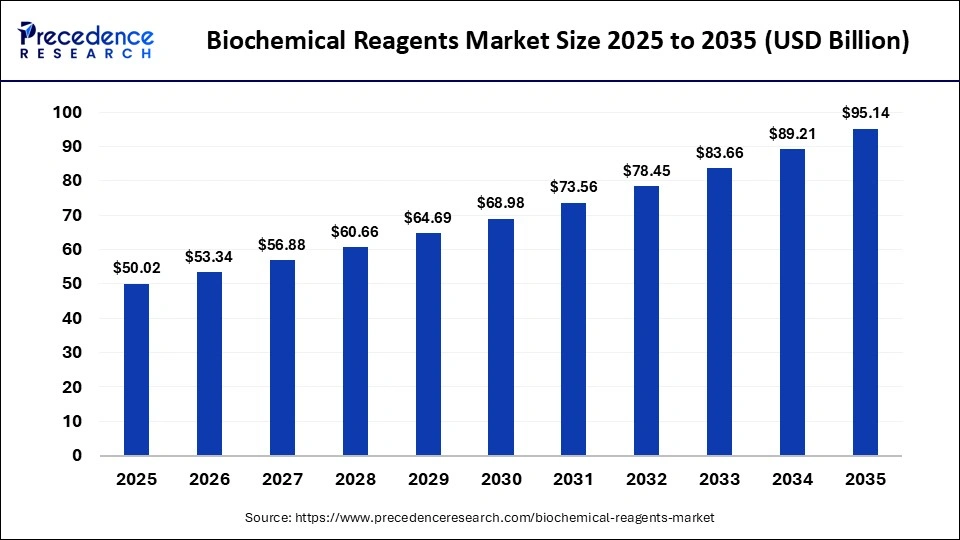
Market Highlights
- North America led the biochemical reagents market with 41.40% share in 2025.
- The Asia Pacific is expected to grow the fastest CAGR of 8.5% between 2026 and 2035.
- By product type, the kits and assay reagents segment contributed the highest market share of 26.80% in 2025.
- By product type, the nucleic acids & oligonucleotides segment is growing at a strong CAGR of 9.1% between 2026 and 2035.
- By application, the research and development segment held the major market share of 34.50% in 2025.
- By application, the drug discovery and development segment is expected to expand at the fastest CAGR of 8.6% from 2026 to 2035.
- By technique, the PCR & qPCR segment captured the highest market share of 28.90 in 2025.
- By technique, the flow cytometry segment is expected to grow at a healthy CAGR of 8.4% between 2026 and 2035.
- By end user, the pharmaceutical and biotechnology companies segment dominated the biochemical reagents market with 38.20% market share in 2025.
- By end user, the contract research organizations (CRO) segment is poised to grow at the fastest CAGR between 2026 and 2035.
- By distribution channel, the direct sales segment dominated with 46.70% market share in 2025.
- By distribution channel, the online sales platform segment is expected to expand at the highest CAGR of 9.3% between 2026 and 2035.
What Is Driving Life Science Development through Biochemical Research?
Biochemical reagents are specialized chemical compounds used to initiate, measure, or analyze biological processes. They are essential tools across life science applications, including molecular biology, genomics, proteomics, clinical diagnostics, and biotechnology, enabling researchers to generate accurate, quantitative insights into complex biological systems.
The growing demand for biochemical reagents is being fueled by the rapid expansion of life science research, rising volumes of diagnostic testing, and the continued development of biopharmaceuticals. As precision medicine becomes more widely adopted, laboratories require reagents that deliver high specificity, reproducibility, and reliability to support sensitive analytical workflows. Increased funding for academic research, the expanding role of contract research organizations (CROs), and the adoption of laboratory automation are further accelerating market growth.
In parallel, the biochemical reagents market is evolving toward higher sensitivity, consistent batch-to-batch performance, and seamless compatibility with advanced analytical instruments. Stricter regulatory expectations around quality control, validation, and traceability are also influencing purchasing decisions, favoring suppliers with robust manufacturing standards and compliance capabilities. As a result, established companies with strong expertise in biochemical research materials are well positioned to benefit from this shift and support the next phase of life science innovation.
How Is Artificial Intelligence Transforming the Biochemical Reagents Market?
Artificial intelligence is rapidly reshaping the biochemical reagents landscape by automating complex laboratory workflows, accelerating innovation, and improving data reliability across research and diagnostic applications. AI is increasingly used to design high-throughput assays, optimize reagent formulations, and streamline quality control (QC) processes, significantly reducing development timelines and manual effort. Advanced AI models can analyze experimental outcomes across thousands of variables, enabling faster iteration and more consistent reagent performance from bench to bench.
Leading life science companies are now integrating agentic AI and pipeline-driven AI systems to support experiment planning, validation, and execution. These technologies help automate decision-making throughout the experimental lifecycle, while digital laboratory platforms standardize metadata and ensure reagent datasets are AI-ready. This standardization is critical for improving reproducibility and enabling large-scale data analytics across multiple laboratories and research programs.
Despite these advances, the industry remains cautious about a growing “scientific content crisis,” where inconsistent, poorly annotated, or low-quality data can undermine the accuracy of AI-generated insights. As a result, major market players are investing heavily in AI-enabled platforms that emphasize traceability, regulatory compliance, and robust data governance. By minimizing human error, enhancing auditability, and ensuring data integrity, AI is becoming a central driver in accelerating biochemical reagent development while maintaining scientific rigor and regulatory confidence.
Biochemical Reagents Market Outlook
- Market Overview: Biological assays or biochemical reagents have become essential testing tools to detect or measure biological samples from patients. In addition, these reagents support global health systems and help monitor diseases.
- Expansion of Global Markets: As research facilities and diagnostic services continue to grow throughout the world, the number of assays and reagents used for research in genomics, proteomics, and within the field of clinical laboratory medicine is increasing.
- Increase in Healthcare Demand Globally: With the burden of both chronic and infectious diseases increasing globally, there is a growing demand for the use of biochemical tests. Therefore, reagents are crucial to provide reliable and accurate diagnostic results and for public health monitoring.
- Technological Advances: Emerging technologies such as automated assays, improved sensitivity of platforms, and increased shelf life of reagents will increase laboratory efficiency and spur adoption due to the complexity associated with the workflows involved in many laboratories.
- Regulatory and Quality Pressures: Stringent regulatory requirements and quality control measures have put pressure on biochemical reagent manufacturers to comply with these requirements, resulting in increased costs of manufacturing and approval by the FDA for their products.
- R&D Investments: Government and academic institutions are providing increased funding for research and development of new drug therapies and scientific innovations. This provides manufacturers with long-term stability and continued demand for their products across the industry.
Regional Insights
North America holds a leading position in the biochemical reagents market due to strong investments in life science research, advanced laboratory infrastructure, and the presence of major biotechnology and pharmaceutical companies. High adoption of AI-enabled laboratory automation, extensive academic funding, and a mature network of contract research organizations (CROs) further support market growth. Stringent regulatory standards for research quality and diagnostics also drive demand for highly standardized, reproducible biochemical reagents in the region.
Europe represents a significant share of the market, supported by robust public funding for biomedical research, expanding genomics and proteomics initiatives, and strong regulatory oversight focused on quality and traceability. Countries such as Germany, the UK, and France are actively investing in precision medicine and translational research, which is increasing the need for high-performance reagents compatible with advanced analytical platforms. Collaboration between academic institutions, research consortia, and biotech firms continues to strengthen regional demand.
Asia–Pacific is expected to witness the fastest growth, driven by expanding biotechnology sectors in China, India, Japan, and South Korea. Rising government support for life science research, growing pharmaceutical manufacturing, and increasing adoption of laboratory automation and AI-driven research tools are fueling reagent demand. The region is also benefiting from the rapid expansion of CROs and diagnostic laboratories, particularly as healthcare infrastructure and R&D capabilities continue to improve.
Latin America is experiencing steady growth as investments in healthcare research, clinical diagnostics, and academic science increase. Countries such as Brazil and Mexico are gradually expanding their biotechnology ecosystems, creating new opportunities for biochemical reagent suppliers, particularly in diagnostics and applied research.
The Middle East & Africa region remains at an emerging stage but shows growing potential due to rising investments in healthcare infrastructure, academic research centers, and public health laboratories. Government-led initiatives aimed at strengthening biomedical research and diagnostics are expected to gradually increase demand for biochemical reagents, especially in urban and research-focused hubs.
Biochemical Reagents Market Companies
- Thermo Fisher Scientific
- QIAGEN
- New England Biolabs
- Illumina, Inc.
- Agilent Technologies, Inc.
- Bio-Rad Laboratories F.
- Hoffmann-La Roche Ltd.
- Merck KGaA
- Promega Corp.
- Takara Bio, Inc.
- LGC Ltd.
- Toyobo Co. Ltd.
Recent Developments
- In December 2025, Veritiv launched TempSafe PalletShield, the industry’s first curbside-recyclable, fibre-based cold chain pallet shipper designed for biopharma logistics, offering over five days of validated thermal performance and enhanced sustainability.
- In December 2025, FUJIFILM India expanded its in-vitro diagnostics portfolio with the FW500 Clinical Chemistry Analyzer, combining precision and speed to support mid-sized labs with up to 200 tests/hour and advanced reagent integration.
- In December 2025, Sino Biological received the 2025 Supplier Performance Recognition Award from Scientist.com for excellence in responsiveness, marketplace activity, and customer satisfaction, highlighting its contribution to global drug discovery research services.
Segments Covered in the Report
By Product Type
- Enzymes
- Antibodies
- Proteins & Peptides
- Nucleic Acids & Oligonucleotides
- Buffers, Salts & Solutions
- Dyes & Stains
- Kits & Assay Reagents
By Application
- Research & Development
- Clinical Diagnostics
- Drug Discovery & Development
- Biotechnology Production
- Academic & Government Research
By Technique
- PCR & qPCR
- ELISA
- Chromatography
- Flow Cytometry
- Immunoassays
- Cell Culture
By End-user
- Pharmaceutical & Biotechnology Companies
- Clinical & Diagnostic Laboratories
- Academic & Research Institutes
- Contract Research Organizations (CROs)
By Distribution Channel
- Direct Sales
- Distributors & Wholesalers
- Online Sales Platforms
By Region
- North America
- Europe
- Asia-Pacific
- Latin America
- Middle East and Africa
Get Sample Link : https://www.precedenceresearch.com/sample/7258
