
 by
by 
Key Takeaways
- North America dominated the automotive LiDAR sensor market with a 40% share in 2025.
- Asia Pacific is expected to grow at the fastest CAGR between 2026 and 2035.
- By technology type, the solid-state LiDAR segment held the biggest market share of 58% in 2025.
- By technology type, the mechanical/scanning LiDAR segment is expected to expand at a significant rate between 2026 and 2035.
- By range, the long-range segment contributed to the highest market share of 51% in 2025.
- By range, the medium range segment is expected to grow at a notable CAGR between 2026 and 2035.
- By vehicle type, the passenger cars segment held a major market share of 72% in 2025.
- By vehicle type, the EV & autonomous shuttles segment is expected to expand at the fastest CAGR of 18.1% from 2026 to 2035.
- By application, the ADAS segment held the biggest market share of 85% in 2025.
- By application, the autonomous driving segment is expected to expand at the fastest CAGR of 18.4% between 2026 and 2035.
- By end user, the OEMs segment held a major market share of 50% in 2025.
- By end user, the aftermarket segment is expected to expand at the fastest CAGR from 2026 to 2035.
Market Overview
The automotive LiDAR sensor market is experiencing rapid growth due to the increasing development of autonomous vehicles and the widespread adoption of advanced driver assistance systems (ADAS). LiDAR technology enhances vehicle safety and navigation by providing highly accurate 3D mapping and real-time object detection, allowing vehicles to better understand their surrounding environment.
Rising government regulations focused on improving road safety are encouraging automakers to integrate advanced sensing technologies into modern vehicles. In addition, continuous technological advancements in sensor miniaturization and performance are making LiDAR systems more efficient and easier to integrate into vehicle designs.
Declining sensor costs and growing investments from major automotive manufacturers and technology companies are further accelerating market commercialization. Moreover, the increasing popularity of connected vehicles and electric mobility is creating strong demand for high-performance sensing solutions, which is expected to drive continued market expansion in the coming years.
Role of Artificial Intelligence in the Automotive LiDAR Sensor Market
Artificial intelligence (AI) is significantly enhancing the functionality and performance of automotive LiDAR systems. AI algorithms enable real-time processing of LiDAR data, allowing vehicles to accurately recognize objects, interpret surroundings, and make predictive driving decisions.
By analyzing complex 3D point-cloud data generated by LiDAR sensors, AI improves the detection of vehicles, pedestrians, and road obstacles. The integration of AI with sensor-fusion technologies combining LiDAR with cameras and radar further strengthens the reliability and accuracy of autonomous driving systems.
This combination reduces false detections, enhances environmental perception, and improves navigation efficiency. As a result, LiDAR technology is evolving from a basic sensing component into an intelligent, data-driven solution that plays a critical role in the development of next-generation mobility and autonomous transportation.
Major Trends Shaping the Automotive LiDAR Sensor Market
- Transition Toward Solid-State LiDAR: Automotive manufacturers are increasingly adopting solid-state LiDAR technology due to its higher durability, lower production costs, and greater scalability compared with traditional mechanical LiDAR systems.
- Growing Integration in ADAS Systems: LiDAR sensors are becoming a key component in advanced driver assistance systems, enabling better object detection, lane monitoring, and collision avoidance across different driving conditions.
- Miniaturization of Sensors: Manufacturers are developing smaller and lighter LiDAR sensors that can be seamlessly integrated into vehicle structures without affecting design aesthetics or aerodynamic performance.
- Declining LiDAR Costs: Technological advancements and large-scale production are steadily reducing the cost of LiDAR sensors, making them more accessible for integration into mainstream passenger vehicles.
- Strategic Industry Collaborations: Partnerships between automotive manufacturers and technology companies are accelerating innovation, improving system performance, and supporting faster commercialization of LiDAR solutions.
- Improved Detection and Mapping Accuracy: Advances in long-range sensing, high-resolution 3D mapping, and real-time data processing are enhancing vehicle perception capabilities and improving environmental awareness.
Market Scope
| Report Coverage | Details |
| Market Size in 2025 | USD 1.90 Billion |
| Market Size in 2026 | USD 2.24 Billion |
| Market Size by 2035 | USD 9.94 Billion |
| Market Growth Rate from 2026 to 2035 | CAGR of 18.00% |
| Dominating Region | North America |
| Fastest Growing Region | Asia Pacific |
| Base Year | 2025 |
| Forecast Period | 2026 to 2035 |
| Segments Covered | Technology Type, Range, Vehicle Type, Application, End User, and Region |
| Regions Covered | North America, Europe, Asia-Pacific, Latin America, and Middle East & Africa |
Regional Insights
Asia-Pacific is the largest and fastest-growing market for automotive LiDAR sensors due to the rapid expansion of electric vehicles, autonomous driving technologies, and advanced automotive manufacturing. Countries such as China, Japan, South Korea, and India are driving strong demand for LiDAR technologies. The region benefits from large-scale vehicle production, growing investments in autonomous mobility, and strong government initiatives supporting smart transportation and connected vehicle ecosystems. In addition, the presence of major electronics manufacturers and automotive suppliers is accelerating innovation and large-scale deployment of LiDAR sensors across the region.
North America holds a significant share of the automotive LiDAR sensor market due to its strong focus on autonomous vehicle development and advanced mobility technologies. The United States leads the region with substantial investments from automotive companies, technology firms, and startups working on LiDAR innovations and autonomous driving systems. Increasing adoption of advanced driver assistance systems (ADAS), supportive government policies, and extensive research and development activities are key factors contributing to market growth in the region.
Europe represents a major market for automotive LiDAR sensors, driven by strict vehicle safety regulations and the strong presence of global automotive manufacturers. Countries such as Germany, France, and United Kingdom are leading the adoption of LiDAR technologies in advanced vehicles. The region’s strong emphasis on sustainable mobility, electric vehicle adoption, and autonomous driving research is accelerating the integration of LiDAR sensors into next-generation automotive platforms.
Automotive LiDAR Sensor Market Supply Chain Analysis
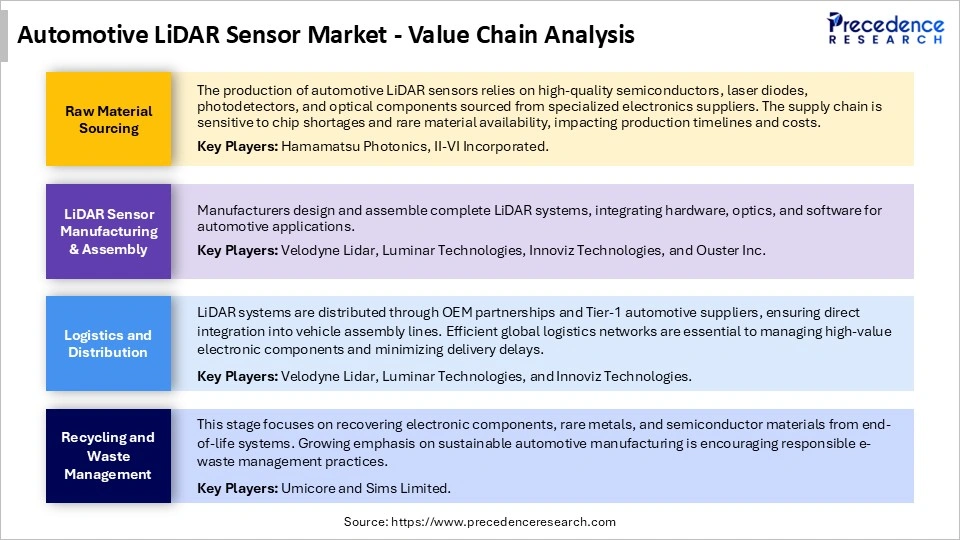
Automotive LiDAR Sensor Market Key Players
- Velodyne (Ouster)
- Luminar Technologies
- RoboSense
- Hesai Technology
- Innoviz Technologies
- Valeo
- Continental AG
- DENSO
- Ibeo
- Quanergy Systems
- Leddartech
- Trilumina
- Phantom Intelligence
- Leishen
- Cepton Inc.
Recent Developments
- In January 2026, Hesai Technology announced plans at CES 2026 to double its annual production capacity to 4 million units. The company is expanding to meet surging global demand for high-performance automotive LiDAR in mass-market ADAS vehicles. This strategy solidifies Hesai’s position as a high-volume leader in the LiDAR sensor market.
- In January 2026, Hesai Technology announced the launch of its next-generation L3-series LiDAR suite, including the ultra-long-range ETX and solid-state FTX sensors, at CES 2026. These sensors, designed for Physical AI applications, aim to enable advanced autonomous driving capabilities in mass-market vehicles.
- In January 2026, Innoviz Technologies announced the world premiere of InnovizThree, a high-performance LiDAR sensor at CES 2026. The new sensor features a 300-meter detection range and ultra-high resolution designed for L3/L4 autonomous driving applications. It boasts a compact form factor and lower power consumption, enabling seamless integration into mass-market vehicles.
Segments Covered in the Report
By Technology Type
- Solid-State LiDAR
- Mechanical/Scanning LiDAR
By Range
- Long-Range (>150-200 m)
- Medium-Range (50-150 m)
- Short-Range (≤50-m)
By Vehicle Type
- Passenger Cars
- Light Commercial/HCV/Robo-Taxis
- EV & Autonomous Shuttles
By Application
- ADAS
- Autonomous Driving
By End User
- OEMs
- Tier-1 Suppliers
- Aftermarket
By Region
- North America
- Europe
- Asia-Pacific
- Latin America
- Middle East & Africa
Access the free sample report: https://www.precedenceresearch.com/sample/8003
