
 by
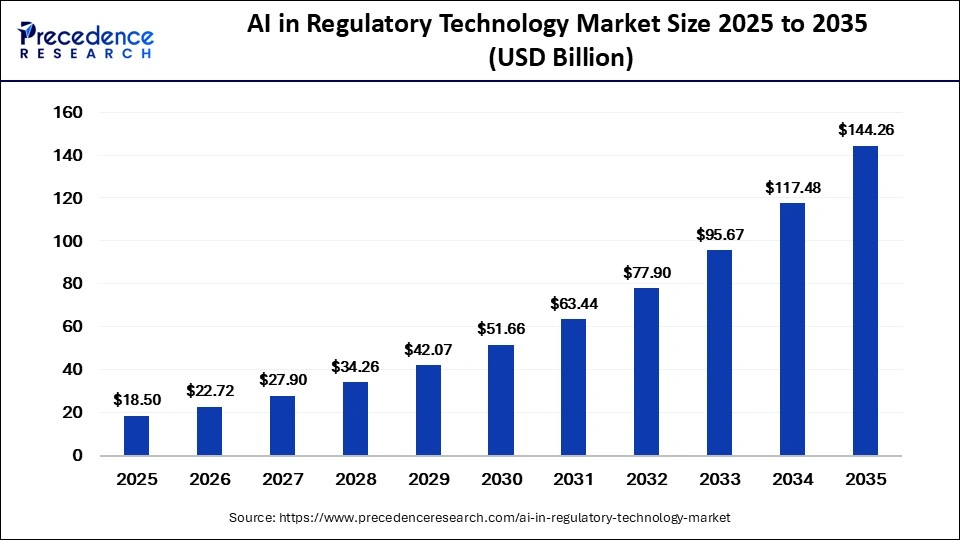
by The global AI in Regulatory Technology market is projected to reach USD 144.26 billion by 2035 at a CAGR of 22.8%. Explore AI-driven compliance automation trends, market dynamics, segmentation, regional insights, and future opportunities.
Read Also: Computational Medicine and Drug Discovery Software Market
AI in Regulatory Technology Market: Transforming Global Compliance Through Intelligent Automation
The global regulatory environment is becoming increasingly complex as governments and industry authorities continue introducing stricter compliance standards related to cybersecurity, financial transparency, ESG reporting, anti-money laundering (AML), artificial intelligence governance, and data privacy. Organizations across banking, healthcare, insurance, retail, telecommunications, and government sectors are under growing pressure to modernize compliance infrastructure while reducing operational risks and regulatory costs.
Traditional compliance systems often rely on:
- Manual document review
- Fragmented reporting workflows
- Reactive auditing processes
- Labor-intensive monitoring systems
These outdated methods are becoming inefficient in the modern digital economy, where regulations evolve rapidly and data volumes continue expanding exponentially.
As a result, enterprises are increasingly deploying AI-powered Regulatory Technology (RegTech) solutions that use artificial intelligence, machine learning, natural language processing, predictive analytics, and robotic process automation to improve regulatory compliance, fraud detection, and risk management.
The growing shift toward intelligent automation is positioning the AI in Regulatory Technology market as one of the fastest-growing sectors within the global fintech and enterprise AI ecosystem.
Market Overview: Strong Growth Fueled by Intelligent Compliance Systems
The global AI in Regulatory Technology market size accounted for USD 18.50 billion in 2025 and is projected to increase from USD 22.72 billion in 2026 to approximately USD 144.26 billion by 2035, expanding at a remarkable CAGR of 22.80% during the forecast period.
The market’s rapid growth is being driven by:
- Increasing regulatory complexity worldwide
- Rising financial fraud and cyber threats
- Growing adoption of AI-powered automation
- Expansion of digital banking ecosystems
- Rising demand for real-time compliance monitoring
- Increasing focus on operational efficiency and cost reduction
Organizations are rapidly transitioning from reactive compliance management to proactive, AI-driven regulatory intelligence platforms capable of automating risk analysis and regulatory reporting at scale.
Understanding AI in Regulatory Technology
AI in Regulatory Technology refers to the application of advanced AI-driven technologies to automate and improve regulatory compliance processes.
Modern RegTech platforms integrate:
- Artificial intelligence (AI)
- Machine learning (ML)
- Natural language processing (NLP)
- Robotic process automation (RPA)
- Predictive analytics
- Cloud computing
These technologies help organizations automate:
- Compliance management
- Risk analysis
- Fraud detection
- AML transaction monitoring
- KYC verification
- Regulatory reporting
- Audit management
- Governance oversight
AI-powered systems can process massive volumes of structured and unstructured data significantly faster than traditional compliance workflows while improving accuracy and reducing human error.
Key Market Trends
1. AI-Powered Compliance Automation Becoming Industry Standard
Financial institutions and enterprises are increasingly adopting AI technologies to automate highly complex compliance operations.
AI-powered platforms help organizations:
- Minimize manual workloads
- Reduce reporting errors
- Improve audit readiness
- Accelerate regulatory response times
- Strengthen operational transparency
The growing shift from document-heavy manual systems to automated AI-driven infrastructure is significantly accelerating market expansion.
2. Rapid Growth of AML and Fraud Detection Solutions
AML and transaction monitoring solutions accounted for approximately 18% market share in 2025 and are projected to grow at the fastest CAGR through 2035.
Financial institutions increasingly deploy AI-driven fraud detection systems to:
- Detect suspicious activities in real time
- Reduce false-positive alerts
- Improve financial crime prevention
- Enhance customer verification accuracy
Machine learning algorithms continuously learn from transaction data and behavioral patterns, enabling more adaptive and scalable fraud detection capabilities.
The rapid increase in AI-assisted phishing attacks and cybercrime is further accelerating demand for advanced AI-powered compliance infrastructure.
3. Natural Language Processing (NLP) Emerging as a Major Growth Engine
Natural language processing accounted for approximately 25% market share in 2025 and is expected to grow at the fastest rate during the forecast period.
NLP technologies are increasingly used for:
- Regulatory document analysis
- Legal text interpretation
- Automated policy monitoring
- Compliance reporting
- Risk intelligence extraction
As regulations become increasingly complex across global jurisdictions, NLP tools help organizations interpret massive volumes of unstructured compliance data more efficiently.
4. Cloud-Based RegTech Platforms Dominating the Market
Cloud-based deployment dominated the market with approximately 70% market share in 2025.
Cloud-native RegTech solutions provide:
- Real-time scalability
- Lower infrastructure costs
- Faster deployment cycles
- Global compliance accessibility
- Continuous regulatory updates
Organizations increasingly prefer cloud-based infrastructure due to its flexibility and ability to support large-scale compliance analytics environments.
5. AI Governance and Explainability Becoming Strategic Priorities
As governments continue developing AI governance frameworks, organizations are increasingly focused on:
- Explainable AI
- Bias detection
- Algorithm transparency
- Ethical AI governance
- AI auditability
The emergence of regulations such as the EU AI Act is accelerating demand for AI governance solutions capable of monitoring and auditing enterprise AI systems.
Industry experts increasingly emphasize that AI systems must be designed with compliance, auditability, and explainability integrated from the beginning rather than added later.
Market Dynamics
Market Drivers
Increasing Global Regulatory Complexity
Governments worldwide continue introducing stricter regulations related to:
- Financial transparency
- ESG compliance
- Data privacy
- Cybersecurity
- AI governance
- Consumer protection
Organizations operating globally must comply with multiple overlapping regulatory frameworks, significantly increasing demand for intelligent compliance automation systems.
Rising Sophisticated Fraud and Cyber Threats
Fraudsters increasingly use:
- Generative AI
- Deepfake technologies
- Voice cloning
- Automated attack systems
to conduct advanced cybercrime operations.
AI-powered compliance systems are becoming critical for:
- Real-time threat detection
- AML monitoring
- Transaction analysis
- Fraud prevention
The growing sophistication of cyber threats is one of the market’s strongest growth drivers.
Expansion of Digital Financial Ecosystems
The rapid growth of:
- Digital banking
- Fintech platforms
- Online payments
- Cryptocurrency ecosystems
- Embedded finance services
is creating increasingly complex compliance environments.
AI-powered RegTech solutions help financial institutions manage regulatory obligations more efficiently while improving customer onboarding and monitoring capabilities.
Demand for Operational Efficiency
Traditional compliance operations often involve:
- Large compliance teams
- Manual auditing workflows
- Repetitive reporting tasks
- High operational costs
AI automation helps organizations improve efficiency while reducing compliance-related labor costs.
Market Challenges
Fragmented Global Regulations
Regulatory fragmentation across regions such as:
- United States
- Europe
- China
- India
creates significant implementation challenges for global enterprises.
Organizations frequently struggle to maintain consistent compliance across multiple jurisdictions with differing legal requirements.
Legacy System Integration Challenges
Many enterprises continue operating outdated legacy infrastructure that can be difficult to integrate with advanced AI-driven compliance systems.
Complex integration processes can:
- Increase implementation costs
- Slow deployment timelines
- Create operational inefficiencies
Data Privacy and Cybersecurity Risks
RegTech platforms process highly sensitive:
- Financial records
- Customer identity data
- Transaction histories
- Healthcare information
Organizations must maintain strong cybersecurity frameworks while complying with strict data protection regulations such as GDPR and sector-specific compliance requirements.
Regional Insights
North America – Market Leader
North America dominated the market with approximately 40% share in 2025.
The region benefits from:
- Advanced fintech ecosystems
- Strong AI adoption
- Large financial institutions
- Strict regulatory environments
The United States remains the global leader in AI-driven compliance innovation.
Asia Pacific – Fastest Growing Region
Asia Pacific is expected to grow at the fastest CAGR during the forecast period.
Growth Drivers Include:
- Rapid fintech expansion
- Increasing digital banking adoption
- Government digital transformation initiatives
- Rising AI investments
Countries such as China, India, Singapore, Japan, and South Korea are driving regional expansion.
Europe
Europe continues experiencing strong growth due to:
- GDPR enforcement
- EU AI governance initiatives
- ESG compliance regulations
- Financial transparency standards
The region’s strong regulatory environment is accelerating demand for AI-powered compliance systems.
Competitive Landscape
The AI in Regulatory Technology market is becoming increasingly competitive as:
- Fintech companies
- AI software vendors
- Enterprise compliance providers
- Cloud infrastructure firms
expand intelligent compliance automation capabilities.
Companies are focusing on:
- AI-powered AML systems
- Automated regulatory reporting
- Explainable AI governance
- Predictive compliance analytics
- Cloud-native RegTech platforms
The industry is also witnessing growing demand for AI governance infrastructure as organizations prepare for stricter global AI regulations.
Future Outlook: Toward Autonomous Compliance Ecosystems
The future of regulatory compliance will increasingly depend on intelligent AI-driven automation systems.
Key Future Trends
- Autonomous compliance monitoring
- Explainable AI governance
- AI-powered regulatory intelligence
- Real-time fraud prevention
- Predictive compliance analytics
- Multi-jurisdiction regulatory orchestration
As governments continue introducing new AI regulations worldwide, intelligent compliance infrastructure will become essential for modern enterprises.
Industry discussions increasingly suggest that AI governance, compliance management, and risk intelligence will evolve into strategic enterprise functions over the next decade.
Conclusion
The AI in Regulatory Technology market is rapidly evolving into a foundational pillar of modern enterprise governance and compliance management. As organizations face rising regulatory complexity, increasing cyber threats, and expanding digital operations, AI-powered RegTech platforms are enabling faster, smarter, and more scalable compliance ecosystems.
Get a Sample Copy: https://www.precedenceresearch.com/sample/8387
For inquiries regarding discounts, bulk purchases, or customization requests, please contact us at sales@precedenceresearch.com
