
 by
by The Cleaning Services Market is one of the most essential and steadily expanding sectors within the global service economy. It plays a critical role in maintaining hygiene, safety, and operational efficiency across residential, commercial, industrial, and institutional environments.
In recent years, the industry has undergone significant transformation driven by increased awareness of health and sanitation, post-pandemic hygiene standards, and the rapid expansion of commercial infrastructure worldwide. Cleaning services now extend far beyond traditional janitorial work, incorporating advanced technologies such as automation, robotics, IoT-based monitoring systems, and eco-friendly cleaning solutions.
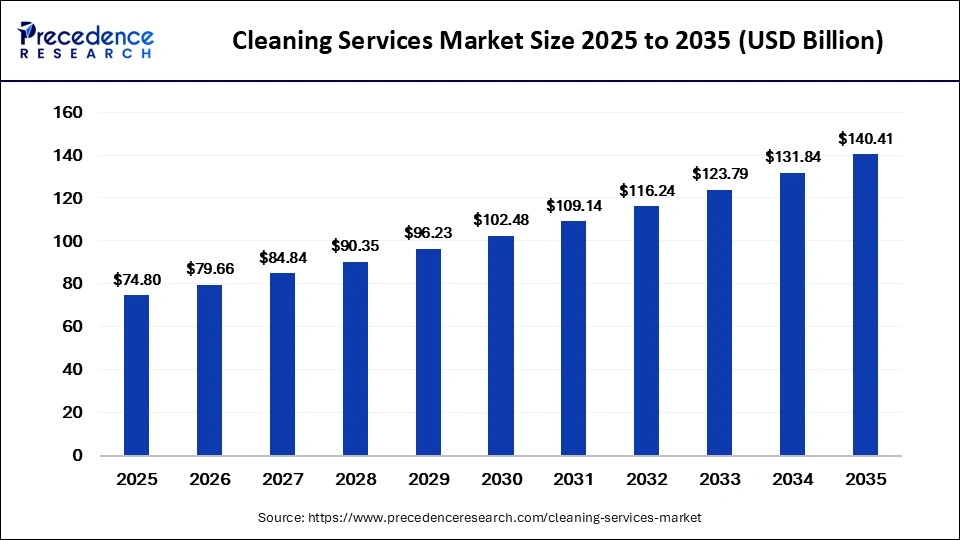
As a result, the market is evolving into a structured, technology-enabled industry that supports a wide range of end-use sectors including healthcare, hospitality, education, retail, and corporate offices.
Read Also: ESG Software Market
Market Overview
The global Cleaning Services Market is witnessing strong growth, supported by rising demand for outsourced facility management and professional cleaning solutions.
- Market Size (2025): USD 442.09 Billion
- Market Size (2026): USD 470.78 Billion
- Forecast Market Size (2033): USD 770.76 Billion
- CAGR (2026–2033): 7.3%
This growth reflects a consistent shift toward outsourced cleaning operations, particularly in commercial and institutional sectors, where hygiene compliance is critical for business continuity.
North America currently holds the largest market share, while Asia-Pacific is expected to grow at the fastest rate due to rapid urbanization and infrastructure expansion.
Key Market Drivers
1. Rising Hygiene Awareness Post-Pandemic
The COVID-19 pandemic permanently changed global hygiene standards. Businesses and individuals now prioritize cleanliness as a core requirement rather than a secondary service.
This has increased demand for:
- Regular disinfection services
- Deep cleaning solutions
- Hospital-grade sanitation protocols
- High-frequency commercial cleaning
2. Growth in Commercial Infrastructure
Expansion in office spaces, retail outlets, hotels, hospitals, and educational institutions is a major driver of cleaning service demand.
As new buildings and facilities are constructed globally, they require:
- Ongoing maintenance
- Specialized cleaning contracts
- Professional facility management services
3. Rising Urbanization and Dual-Income Households
Urban lifestyles are contributing significantly to residential cleaning demand. Busy work schedules and dual-income households are driving outsourcing of household cleaning tasks.
Key impacts include:
- Growth in maid services and home cleaning apps
- Increased demand for scheduled cleaning contracts
- Higher adoption of on-demand cleaning platforms
4. Outsourcing of Facility Management Services
Organizations are increasingly outsourcing cleaning operations to reduce costs and improve efficiency.
Benefits include:
- Reduced operational burden
- Access to trained professionals
- Scalable service models
- Compliance with safety standards
5. Expansion of Real Estate and Hospitality Sectors
The growth of hotels, resorts, coworking spaces, and commercial complexes is directly fueling cleaning service demand.
Large hospitality chains and corporate buildings require:
- Continuous cleaning operations
- High-standard sanitation compliance
- Specialized floor, carpet, and upholstery care
Market Trends
1. Adoption of Green Cleaning Solutions
Sustainability is becoming a major industry trend. Cleaning companies are increasingly using:
- Biodegradable chemicals
- Eco-certified cleaning products
- Water-efficient cleaning systems
Many clients now prefer environmentally responsible service providers.
2. Integration of Cleaning Automation and Robotics
Technological innovation is reshaping the industry with:
- Robotic floor cleaners
- Automated vacuum systems
- AI-based scheduling tools
- IoT-enabled monitoring systems
These technologies improve efficiency and reduce labor dependency.
3. Rise of Contract-Based Cleaning Services
Contractual cleaning models are becoming the dominant service structure, especially in commercial spaces.
This ensures:
- Long-term service agreements
- Predictable revenue streams for companies
- Standardized service quality
4. Digital Transformation in Service Booking
Mobile apps and online platforms are streamlining cleaning service bookings, offering:
- On-demand scheduling
- Transparent pricing
- Customer reviews and ratings
- Subscription-based models
5. Increasing Focus on Specialized Cleaning
Demand is growing for niche cleaning services such as:
- Healthcare facility sanitation
- Industrial cleaning
- Post-construction cleaning
- Data center cleaning
Market Restraints
1. High Labor Dependency
The cleaning services industry remains heavily dependent on manual labor, leading to:
- High employee turnover rates
- Training challenges
- Workforce management issues
2. Price Competition and Low Margins
The market is highly fragmented, resulting in:
- Intense pricing competition
- Low profit margins
- Difficulty scaling for small providers
3. Regulatory Compliance Requirements
Service providers must comply with:
- Occupational safety standards
- Environmental regulations
- Chemical handling rules
This increases operational complexity.
4. Seasonal Demand Fluctuations
Demand can vary based on:
- Economic conditions
- Real estate cycles
- Tourism activity
Market Opportunities
1. Growth of AI and Smart Cleaning Technologies
The integration of AI in cleaning operations enables:
- Predictive maintenance
- Smart scheduling
- Route optimization for cleaning staff
2. Expansion in Emerging Markets
Asia-Pacific, Latin America, and Middle East regions offer significant growth opportunities due to:
- Rapid urban development
- Increasing middle-class population
- Infrastructure investments
3. Healthcare and Institutional Cleaning Demand
Hospitals, clinics, and laboratories require strict hygiene standards, creating high-value contracts for specialized cleaning firms.
4. Corporate ESG Commitments
Companies are investing in sustainable cleaning practices aligned with ESG goals, increasing demand for:
- Green-certified cleaning services
- Low-carbon cleaning operations
Market Segmentation
By Type
- Floor cleaning services
- Window cleaning services
- Carpet & upholstery cleaning
- Maid services
- Disinfection & sanitization services
By End Use
Commercial Segment (Dominant)
Includes offices, malls, hotels, and industrial facilities requiring regular maintenance.
Residential Segment
Driven by urban lifestyles and increasing outsourcing of household chores.
Institutional Segment
Includes schools, hospitals, and government buildings with strict hygiene requirements.
By Region
North America
Leads the global market due to high outsourcing rates and advanced cleaning technologies.
Asia-Pacific
Fastest-growing region driven by urbanization, construction growth, and rising disposable income.
Europe
Strong demand supported by strict hygiene regulations and sustainability initiatives.
Rest of the World
Gradual growth driven by infrastructure expansion and urban development.
Competitive Landscape
The Cleaning Services Market is highly fragmented with numerous global and regional players. Key companies include:
- ABM Industries Inc.
- Sodexo
- Aramark Corporation
- Jani-King Inc.
- ServiceMaster Global Holdings
- CleanNet USA
- Stanley Steemer International
- Chem-Dry
- Pritchard Industries Inc.
- Anago Cleaning Systems
These companies focus on:
- Expanding commercial contracts
- Adopting green cleaning technologies
- Investing in workforce training
- Digital transformation of service delivery
Recent Developments
- Rising adoption of robotic cleaning systems in commercial buildings
- Expansion of green cleaning product lines by major service providers
- Increasing government initiatives promoting hygiene standards
- Growth of subscription-based residential cleaning platforms
Future Outlook (2026–2035)
The Cleaning Services Market is expected to evolve into a highly technology-driven and sustainability-focused industry.
Key future developments include:
- AI-powered cleaning automation
- Fully integrated smart facility management systems
- Expansion of eco-friendly cleaning standards
- Increased consolidation through mergers and acquisitions
- Growth of hybrid human-robot cleaning models
By 2035, cleaning services will no longer be purely labor-driven but will operate as technology-enhanced facility intelligence systems.
Conclusion
The Cleaning Services Market is undergoing steady but significant transformation, driven by urbanization, hygiene awareness, and technological innovation. With strong projected growth through 2033 and beyond, the industry is evolving from traditional janitorial services into a modern, tech-enabled facility management ecosystem.
Companies that adopt automation, sustainability practices, and digital platforms early will be best positioned to capture long-term growth opportunities in this expanding global market.
Get a Sample Copy: https://www.precedenceresearch.com/sample/8422
For inquiries regarding discounts, bulk purchases, or customization requests, please contact us at [email protected]
