
 by
by The global precision neurology market is witnessing significant growth due to advances in genomics, biomarker research, artificial intelligence, and personalized medicine. Increasing prevalence of neurological disorders and rising investments in precision therapies are transforming diagnosis, treatment, and patient outcomes across the neuroscience landscape.
What is the Precision Neurology Market Size?
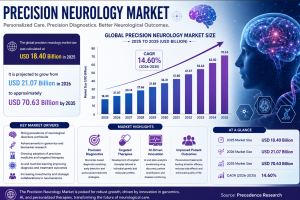
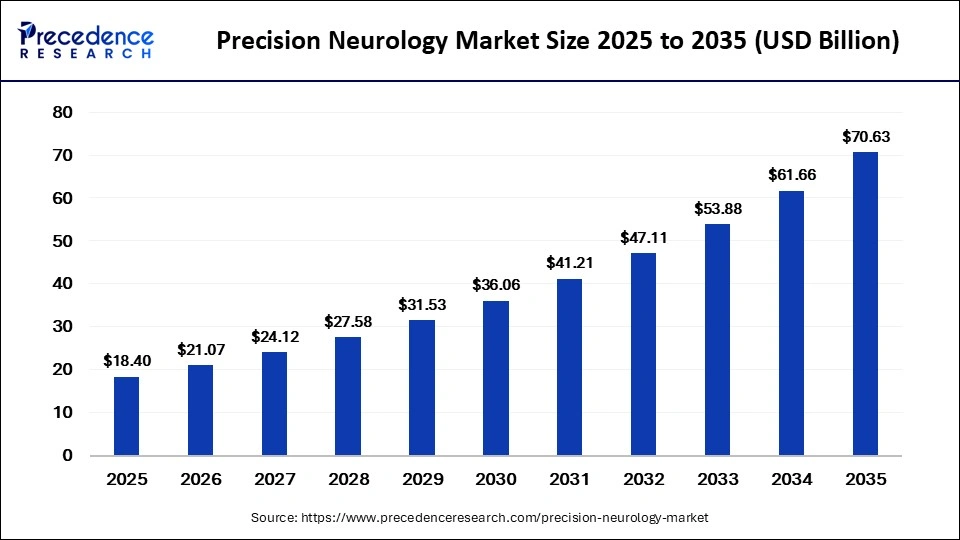
The global precision neurology market size was calculated at USD 18.40 billion in 2025 and is predicted to increase from USD 21.07 billion in 2026 to approximately USD 70.63 billion by 2035, expanding at a CAGR of 14.60% from 2026 to 2035. The increasing prevalence of neurological disorders and advances in precision healthcare research are key drivers of market growth.
Market Highlights
- The global precision neurology market was valued at USD 18.40 billion in 2025 and is projected to reach USD 70.63 billion by 2035, growing at a robust CAGR of 14.60% from 2026 to 2035.
- North America dominated the market in 2025, accounting for 41% of the global revenue share, supported by strong investments in precision medicine, genomics, and neuroscience research.
- Asia-Pacific is anticipated to register the fastest growth during the forecast period, expanding at a CAGR of 19.8%, driven by increasing healthcare expenditure and rising adoption of advanced neurological diagnostics.
- Based on technology, the genomics segment emerged as the leading contributor, capturing 28% of the market share in 2025, owing to the growing use of genomic sequencing in neurological disease diagnosis and treatment.
- The AI and machine learning analytics segment is expected to witness the highest growth, advancing at a CAGR of 24.5% between 2026 and 2035 as AI-powered tools become increasingly integrated into precision neurology workflows.
- By therapeutic area, the Alzheimer’s disease segment held the largest share of 30% in 2025 and is also projected to record the fastest growth, with a CAGR of 17.0% over the forecast period, fueled by rising disease prevalence and ongoing therapeutic innovations.
- In terms of application, the personalized diagnostics segment accounted for the largest market share of 26% in 2025, reflecting the increasing emphasis on early and accurate disease detection.
- The precision therapeutics segment is anticipated to grow at the fastest rate, registering a CAGR of 18.5% from 2026 to 2035, driven by advances in targeted therapies and biomarker-based treatment approaches.
- By end-use, hospitals represented the largest revenue-generating segment, holding 36% of the market share in 2025, supported by their extensive use of precision diagnostic and treatment technologies.
- Pharmaceutical and biotechnology companies are expected to emerge as the fastest-growing end-use segment, expanding at a CAGR of 18.8% throughout the forecast period, owing to increasing investments in drug discovery, genomics, and AI-enabled neurological research.
What is Driving the Growth of the Precision Neurology Market?
Precision neurology is an emerging approach to diagnosing and treating neurological disorders by tailoring therapies according to an individual’s genetic profile, biomarkers, lifestyle, and disease characteristics. Unlike conventional approaches, precision neurology focuses on delivering personalized interventions that improve treatment effectiveness and minimize adverse effects.
The increasing burden of neurological diseases such as Alzheimer’s disease, Parkinson’s disease, multiple sclerosis, epilepsy, Huntington’s disease, and rare genetic disorders has accelerated the adoption of precision medicine. Advances in genomics, molecular diagnostics, and targeted therapeutics are enabling healthcare providers to offer more individualized care.
Growing investments from pharmaceutical companies, biotechnology firms, and research organizations are further fueling innovation in the precision neurology market.
How is Artificial Intelligence Transforming the Precision Neurology Market?
Artificial Intelligence (AI) is playing a crucial role in reshaping precision neurology by improving disease diagnosis, patient stratification, and therapeutic development. AI-powered algorithms analyze large volumes of clinical, imaging, and genetic data to identify patterns associated with neurological disorders. Machine learning models are helping clinicians predict disease progression, optimize treatment plans, and enhance patient monitoring.
Deep learning technologies are also improving the interpretation of MRI and PET scans, enabling earlier detection of neurodegenerative diseases. AI-driven drug discovery platforms are accelerating the development of targeted therapies while reducing research costs and timelines. Furthermore, wearable devices and digital biomarkers supported by AI are enabling continuous monitoring and personalized disease management.
Market Scope
| Report Coverage | Details |
| Market Size in 2025 | USD 18.40 Billion |
| Market Size in 2026 | USD 21.07 Billion |
| Market Size by 2035 | USD 70.63 Billion |
| Market Growth Rate from 2026 to 2035 | CAGR of 14.60% |
| Dominating Region | North America |
| Fastest Growing Region | Asia Pacific |
| Base Year | 2025 |
| Forecast Period | 2026 to 2035 |
| Segments Covered | Technology, Therapeutic Area, Application, End-use, Delivery Model, and Region |
| Regions Covered | North America, Europe, Asia-Pacific, Latin America, and Middle East & Africa |
What are the Major Trends Influencing the Precision Neurology Market?
Expansion of Genomic Medicine
Genetic testing and genomic sequencing are becoming increasingly important for identifying disease-causing mutations and enabling targeted therapies for neurological conditions.
Growing Adoption of Biomarker-Based Diagnostics
Biomarkers are improving early disease detection and helping clinicians personalize treatment strategies, particularly for Alzheimer’s disease and Parkinson’s disease.
Increasing Development of Targeted Therapies
Pharmaceutical companies are focusing on developing therapies that address specific molecular mechanisms involved in neurological disorders, improving efficacy and patient outcomes.
Rising Demand for Digital Health Solutions
Wearable technologies, remote monitoring systems, and mobile health applications are supporting real-time disease management and enhancing patient engagement.
Emergence of Gene Therapies
Gene-editing technologies and RNA-based therapies are opening new avenues for treating rare and inherited neurological diseases.
Which Regions are Leading the Precision Neurology Market?
North America dominates the market due to advanced healthcare infrastructure, strong biotechnology ecosystems, high healthcare spending, and substantial investments in neuroscience research. The United States remains a leader in precision medicine and AI-driven healthcare innovation.
Europe represents a major market supported by increasing government funding, growing adoption of genomic medicine, and expanding research collaborations. Countries such as Germany, the United Kingdom, and France are at the forefront of neurological research.
Asia-Pacific is expected to witness the fastest growth during the forecast period. Rising healthcare expenditure, increasing awareness of neurological diseases, and expanding access to genetic testing are driving growth across China, Japan, India, and South Korea.
The market in Latin America is gradually expanding due to improving healthcare infrastructure and growing investments in advanced diagnostics and personalized medicine.
Increasing healthcare modernization initiatives and rising awareness regarding neurological disorders are contributing to market growth in the Middle East and Africa.
Who are the Key Players Operating in the Precision Neurology Market?
Several pharmaceutical, biotechnology, and healthcare technology companies are investing heavily in precision medicine and neuroscience innovation. Key players include:
- Roche Holding AG
- Biogen Inc.
- Novartis AG
- Eli Lilly and Company
- Pfizer Inc.
- AstraZeneca PLC
- Ionis Pharmaceuticals
- Neurocrine Biosciences
- Amgen Inc.
- Abbott Laboratories
- Thermo Fisher Scientific Inc.
- Illumina Inc.
- Siemens Healthineers AG
- GE HealthCare Technologies Inc.
- Quest Diagnostics Incorporated
These companies are focusing on strategic collaborations, biomarker discovery, AI-enabled diagnostics, and targeted therapies to strengthen their market presence.
What Does the Future Hold for the Precision Neurology Market?
The future of the precision neurology market is expected to be shaped by advancements in artificial intelligence, digital biomarkers, gene therapies, and multi-omics technologies. Personalized medicine is likely to become the standard of care for many neurological disorders, enabling earlier intervention and improved patient outcomes.
Increasing collaboration among pharmaceutical companies, academic institutions, and technology providers will accelerate the development of innovative therapies and diagnostic tools. The integration of AI with genomics and neuroimaging is expected to create significant opportunities for transforming neurological healthcare over the next decade.
Why is the Precision Neurology Market Expected to Witness Strong Growth?
The precision neurology market is entering a transformative era driven by breakthroughs in genomics, artificial intelligence, and targeted therapeutics. As healthcare systems increasingly shift toward personalized medicine, the market is expected to experience robust growth, creating opportunities for pharmaceutical companies, diagnostic providers, and digital health innovators worldwide.
By combining advanced diagnostics, AI-powered analytics, and precision therapies, the industry is poised to redefine the management of neurological disorders and improve the quality of life for millions of patients globally.
Recent Developments
- In April 2026, Cedars-Sinai Guerin Children’s launched the first Neuro Neonatal Intensive Care Unit in the Los Angeles region, bringing specialized neurological care to newborns during a critical stage of early brain development.
- In March 2026, Alamar Biosciences launched the NULISAseq™ Neuro 220 Panel, its largest precision proteomics panel, offering the sensitivity and specificity needed to advance neurological disease research.
Segments Covered in the Report
By Technology
- Genomics
- Whole Genome Sequencing
- Targeted Gene Panels
- Pharmacogenomics
- Proteomics
- Biomarker-based Diagnostics
- AI & Machine Learning Analytics
- Neuroimaging Technologies
- MRI
- PET
- Functional Neuroimaging
By Therapeutic Area
- Alzheimer’s Disease
- Parkinson’s Disease
- Multiple Sclerosis
- Epilepsy
- Amyotrophic Lateral Sclerosis (ALS)
- Autism Spectrum Disorders
- Stroke
- Other Neurological Disorders
By Application
- Personalized Diagnostics
- Precision Therapeutics
- Drug Discovery & Development
- Disease Risk Prediction
- Patient Stratification
- Monitoring & Prognostics
By End-use
- Hospitals
- Specialty Neurology Clinics
- Academic & Research Institutes
- Pharmaceutical & Biotechnology Companies
- Diagnostic Laboratories
By Delivery Model
- Hospital-based Precision Neurology
- Cloud-based Neurology Platforms
- AI-assisted Neurology Solutions
By Region
- North America
- Latin America
- Europe
- Asia-pacific
- Middle and East Africa
Get Sample Link : https://www.precedenceresearch.com/sample/8434
Also Read : Digital Infrastructure Market
