
 by
by The global digital infrastructure market is experiencing rapid expansion, fueled by the proliferation of artificial intelligence, cloud computing, edge computing, 5G networks, and data center investments. Increasing demand for scalable, secure, and resilient digital ecosystems is accelerating innovation and transforming the future of enterprise connectivity and computing.
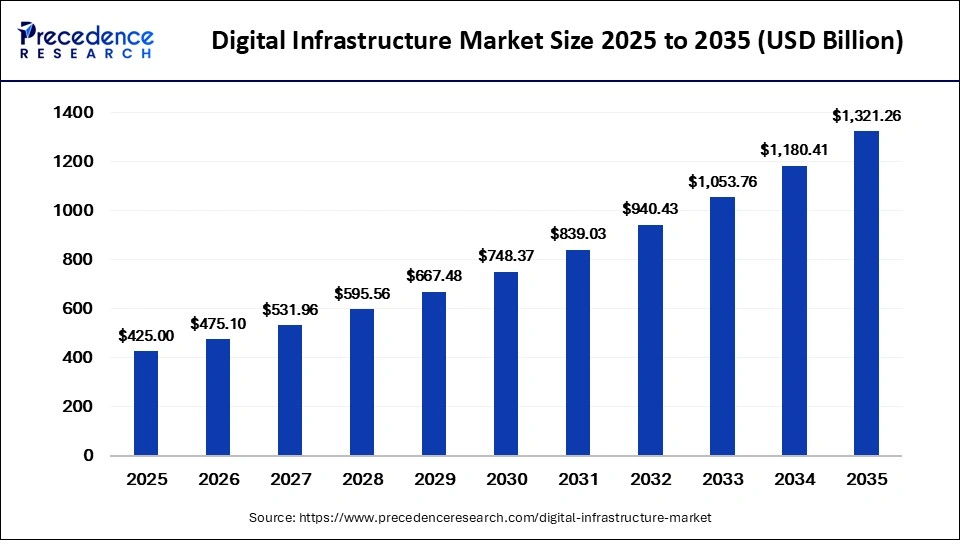
Digital Infrastructure Market Size and Forecast 2026 to 2035
The global digital infrastructure market size accounted for USD 425.00 billion in 2025 and is predicted to increase from USD 475.10 billion in 2026 to approximately USD 1,321.26 billion by 2035, expanding at a CAGR of 11.80% from 2026 to 2035. The market is driven by the increasing AI and machine learning workloads. These advanced technologies demand massive parallel processing power, thus forcing data centers to upgrade to specialized hardware, high-density server racks, and even advanced liquid cooling systems.
Market Hightlights
- North America dominated the market with a share of 36.00% in 2025.
- Asia Pacific is expected to grow at the fastest CAGR of 14.5% during the forecast period.
- By infrastructure type, the data center infrastructure segment led the market with a share of 31.00% in 2025.
- By infrastructure type, the edge infrastructure segment is expected to grow at a 15.2% CAGR between 2026 and 2035.
- By component, the hardware segment accounted for the largest market share of 58.00% in 2025.
- By component, the software segment is expected to grow at a 13.8% CAGR between 2026 and 2035.
- By deployment model, the cloud-based segment held the market share of 44.00% in 2025.
- By deployment model, the on-premise segment held the second-largest market share in 2025 and is expected to grow at a 7.9% CAGR between 2026 and 2035.
- By end-use industry, the IT & telecommunications segment accounted for a revenue share of 27.00% in the market in 2025.
- By end-use industry, the retail & e-commerce segment is expected to grow at the fastest CAGR of 13.2% between 2026 and 2035.
- By technology, the 5G infrastructure segment held a major market share of 24.00% in 2025.
- By technology, the artificial intelligence infrastructure segment is expected to grow at the fastest CAGR of 18.7% between 2026 and 2025.
Digital Infrastructure Market Overview
Digital infrastructure comprises the foundational technologies and systems that support digital services, including data centers, cloud platforms, telecommunication networks, fiber-optic connectivity, edge computing infrastructure, and cybersecurity solutions. These assets enable organizations to process, store, and transmit vast amounts of data efficiently.
The digital infrastructure market has become a critical component of the global digital economy. The growing adoption of cloud-based applications, increasing internet penetration, rapid digital transformation initiatives, and the emergence of AI-driven workloads are creating unprecedented demand for advanced infrastructure solutions.
Enterprises across industries are investing heavily in next-generation infrastructure to support data-intensive applications, enhance operational efficiency, and ensure secure and reliable connectivity. Governments and private organizations are also accelerating investments in smart cities, broadband networks, and digital ecosystems to support economic growth and technological advancement.
Key Market Trends
Growing Adoption of Artificial Intelligence Infrastructure
The explosive growth of generative AI and machine learning applications is driving demand for high-performance computing environments, advanced GPUs, and AI-optimized data centers. Enterprises are increasingly investing in infrastructure capable of supporting large-scale AI workloads.
Expansion of Hyperscale Data Centers
Hyperscale data centers continue to expand globally as cloud service providers and technology companies seek greater capacity and scalability. Rising demand for cloud services and digital applications is encouraging substantial investments in modern data center infrastructure.
Accelerating Deployment of 5G Networks
Telecommunication companies are rapidly deploying 5G infrastructure to deliver faster connectivity, lower latency, and improved network performance. The expansion of 5G is expected to support applications such as autonomous vehicles, industrial IoT, and smart cities.
Increasing Focus on Edge Computing
Edge computing is gaining momentum as organizations seek to process data closer to the source. This approach reduces latency, enhances real-time decision-making, and supports applications requiring immediate response times.
Rising Importance of Sustainable Infrastructure
Data center operators and infrastructure providers are increasingly adopting renewable energy, liquid cooling technologies, and energy-efficient architectures to minimize environmental impact and improve operational sustainability.
Market Scope
| Report Coverage | Details |
| Market Size in 2025 | USD 425.00 Billion |
| Market Size in 2026 | USD 475.10 Billion |
| Market Size by 2035 | USD 1,321.26 Billion |
| Market Growth Rate from 2026 to 2035 | CAGR of 11.80% |
| Dominating Region | North America |
| Fastest Growing Region | Asia Paicfic |
| Base Year | 2025 |
| Forecast Period | 2026 to 2035 |
| Segments Covered | Infrastructure Type, Component, Deployment Model, End-Use Industry, Technology, and Region |
| Regions Covered | North America, Europe, Asia-Pacific, Latin America, and Middle East & Africa |
Impact of Artificial Intelligence on the Digital Infrastructure Market
Artificial Intelligence is reshaping the digital infrastructure landscape by creating new requirements for computing power, storage capacity, and network performance.
AI-powered infrastructure management platforms are improving resource allocation, predictive maintenance, energy efficiency, and cybersecurity. Machine learning algorithms enable data center operators to optimize workloads, reduce downtime, and enhance overall system reliability.
Generative AI applications are significantly increasing demand for high-density computing clusters, advanced semiconductor technologies, and high-bandwidth networking solutions. AI is also transforming network operations by enabling autonomous management, traffic optimization, and intelligent threat detection.
Furthermore, AI-driven analytics are helping enterprises manage complex digital environments more effectively, allowing organizations to maximize performance while reducing costs.
Regional Insights
North America dominates the digital infrastructure market due to the presence of major cloud service providers, advanced telecommunications networks, strong AI adoption, and significant investments in hyperscale data centers. The United States remains a global leader in digital infrastructure innovation.
Europe represents a substantial market driven by increasing investments in data sovereignty, cloud services, and sustainable infrastructure initiatives. Countries such as Germany, the United Kingdom, France, and the Netherlands are major contributors to regional growth.
Asia-Pacific is expected to witness the fastest growth during the forecast period. Rapid digitalization, expanding internet penetration, growing cloud adoption, and large-scale 5G deployments are supporting market expansion across China, India, Japan, South Korea, and Southeast Asia.
Latin America is emerging as a promising market due to increasing investments in broadband connectivity, data centers, and cloud infrastructure. Digital transformation initiatives are creating opportunities across various industries.
The Middle East and Africa region is experiencing robust growth, supported by smart city projects, increasing government investments in digital transformation, and expanding telecommunications infrastructure.
Competitive Landscape
The digital infrastructure market is highly competitive and characterized by strategic partnerships, mergers, acquisitions, and continuous technological advancements.
Major companies operating in the market include:
- Amazon Web Services (AWS)
- Microsoft Corporation
- Google LLC
- Cisco Systems Inc.
- Oracle Corporation
- IBM Corporation
- Equinix Inc.
- Digital Realty Trust Inc.
These companies are focusing on AI infrastructure, cloud platforms, edge computing, data center modernization, and advanced networking technologies to strengthen their competitive positions.
Future Outlook
The future of the digital infrastructure market will be shaped by artificial intelligence, cloud-native technologies, edge computing, quantum computing, and 6G networks. The increasing volume of digital data and the growing demand for high-speed connectivity are expected to drive sustained investments across the ecosystem.
Emerging technologies such as autonomous networks, AI-powered cybersecurity, digital twins, and sustainable data center architectures are anticipated to unlock new growth opportunities and redefine the digital landscape over the next decade.
Conclusion
The digital infrastructure market is entering a transformative phase fueled by AI, cloud computing, 5G, and hyperscale data center expansion. As enterprises accelerate digital transformation and demand for intelligent connectivity continues to rise, infrastructure providers and technology companies are expected to play a pivotal role in shaping the future digital economy.
Get Sample Link : https://www.precedenceresearch.com/sample/8466
Also Read : Drug Discovery Market
