
 by
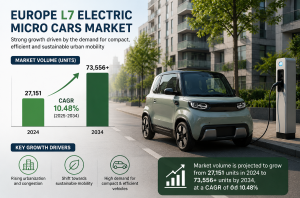
by The Europe L7 electric micro cars market volume surpassed 27,151 units in 2024 and is projected to reach more than 73,556 units by 2034, expanding at a CAGR of 10.48% during the forecast period. The growth reflects a major shift in consumer priorities, where efficiency, affordability, and convenience are becoming more important than vehicle size and power.
The European electric vehicle industry is at a turning point. For the last decade, the conversation around electrification has largely focused on premium electric cars, long-range batteries, and high-performance EVs. However, a new mobility segment is emerging that aligns far more closely with how people actually travel in Europe’s cities. L7 electric micro cars are increasingly becoming the preferred solution for urban commuters seeking affordable, sustainable, and practical transportation. As European cities become more crowded and governments intensify their push toward carbon neutrality, these compact electric vehicles are creating a new chapter in the region’s mobility transformation.
Europe L7 Electric Micro Cars Market Overview
The growing preference for compact, energy-efficient, and environmentally friendly vehicles is reshaping urban transportation throughout Europe. As governments strengthen emission regulations and consumers seek affordable personal mobility options, L7 electric micro cars are emerging as a practical solution for daily commuting and short-distance travel.
Market Scope
| Report Highlights | Details |
|---|---|
| Market Volume in 2024 | 27,151 Units |
| Market Volume in 2025 | 29,996 Units |
| Market Volume by 2034 | 73,556 Units |
| Growth Rate (2025–2034) | CAGR of 10.48% |
| Leading Country (2024) | Germany |
| Fastest Growing Country | United Kingdom |
| Dominant Range Segment | Medium Range (61–100 KM) – 45.55% Share |
| Dominant Battery Type | Lithium-Ion Battery – 72.31% Share |
| Leading Seat Configuration | 2 Seats – 54.34% Share |
A Market Built for Modern European Cities
Europe’s urban infrastructure was never designed for large vehicles dominating city centers. Narrow streets, limited parking availability, congestion charges, low-emission zones, and rising transportation costs have created significant challenges for conventional automobiles. At the same time, urban residents are increasingly looking for personal transportation options that provide flexibility without contributing to traffic and pollution problems.
L7 electric micro cars offer a solution specifically tailored to these urban realities. Their compact dimensions allow drivers to navigate crowded city streets with ease while requiring significantly less parking space than traditional passenger vehicles. Because these vehicles are lightweight and powered by electric drivetrains, they consume less energy and generate substantially lower emissions compared to conventional cars. In many European cities, where the average daily commute is relatively short, a microcar offers all the mobility consumers need without the unnecessary costs associated with larger vehicles.
The growing popularity of microcars reflects a broader change in mobility thinking. Consumers are no longer asking how much vehicle they can buy; they are asking how much vehicle they actually need.
Why L7 Electric Micro Cars Are Different from Traditional EVs
- The success of electric mobility does not necessarily require bigger batteries or larger vehicles.
- L7 electric micro cars offer a fundamentally different value proposition.
| Traditional EV | L7 Electric Micro Car |
|---|---|
| Large battery packs | Smaller battery packs |
| Higher purchase cost | Affordable ownership |
| Designed for long-distance travel | Optimized for urban trips |
| Heavy vehicle weight | Lightweight construction |
| Larger parking requirements | Easy city parking |
| Higher charging demand | Faster charging and lower energy consumption |
The Rise of Personal Urban Mobility
One of the most powerful forces behind the growth of the L7 electric micro car market is the increasing demand for personal mobility. While public transportation remains essential across Europe, many commuters seek a transportation option that offers independence, flexibility, and comfort. The shift toward hybrid work models has also changed commuting patterns, creating demand for vehicles designed for short, frequent trips rather than long-distance travel.
L7 electric micro cars fill this gap effectively. They provide protection from weather conditions, greater safety than two-wheelers, and lower operating costs than traditional cars. Their affordability makes them attractive to younger consumers, first-time vehicle owners, students, and urban professionals who prioritize practicality over luxury.
A particularly interesting trend is the growing acceptance of microcars among younger generations. In several European markets, compact electric vehicles are increasingly viewed as lifestyle products rather than merely transportation tools. This shift is helping transform the image of microcars from niche vehicles into mainstream urban mobility solutions.
Download the Sample: https://www.precedenceresearch.com/sample/5700
Why Europe is the Perfect Environment for Microcar Growth
- Europe’s commitment to sustainability has created one of the world’s most favorable environments for electric mobility innovation. Governments across the region continue to introduce policies that encourage the adoption of zero-emission transportation. Subsidies, tax incentives, parking benefits, and low-emission regulations are encouraging consumers to move away from traditional internal combustion vehicles.
- At the same time, rising fuel prices and increasing environmental awareness are pushing consumers toward more efficient transportation alternatives. Unlike larger EVs that often require substantial investments, L7 electric micro cars provide a more accessible entry point into electric mobility.
- The market is also benefiting from a broader shift in urban planning. European cities are increasingly prioritizing pedestrian-friendly spaces, cycling infrastructure, and sustainable transportation systems. In this evolving mobility ecosystem, compact electric vehicles fit naturally between public transport and traditional passenger cars.
Artificial Intelligence Is Making Microcars Smarter
- One of the least discussed but most important trends shaping the future of the L7 electric micro car market is the integration of Artificial Intelligence. While AI is often associated with autonomous driving, its impact on electric microcars extends far beyond self-driving technology.
- Modern AI systems are enabling smarter battery management, predictive maintenance, intelligent route planning, and personalized driving experiences. AI-powered algorithms can monitor vehicle performance in real time, helping owners identify maintenance requirements before issues become costly repairs. This not only improves vehicle reliability but also reduces ownership costs.
- Battery optimization is another critical application. AI can analyze driving patterns, traffic conditions, weather data, and charging behavior to maximize battery efficiency and extend driving range. For urban drivers who rely on microcars for daily transportation, these improvements can significantly enhance convenience and confidence.
- Europe’s regulatory framework is also encouraging responsible AI deployment in mobility applications. The EU Artificial Intelligence Act, which entered into force in 2024, establishes safety and governance standards for high-risk AI systems, including those used in transportation technologies. This regulatory clarity is expected to accelerate innovation while maintaining public trust in AI-powered mobility solutions.
Five Powerful Forces Driving Market Growth
1. Europe’s Net-Zero Ambitions
- The European Union continues to strengthen regulations aimed at reducing transportation emissions.
- L7 electric micro cars fit perfectly within these sustainability initiatives by offering zero-emission transportation while consuming fewer resources than conventional electric cars.
- The European regulatory environment continues to favor lightweight electric mobility solutions, making microcars increasingly attractive for consumers and manufacturers alike.
Governments are encouraging consumers to adopt low-emission vehicles through:
- Tax incentives
- EV subsidies
- Registration benefits
- Urban access privileges
- Low-emission zones
2. Rising Urban Congestion
- Traffic congestion is becoming one of Europe’s most expensive urban challenges.
- For many city residents, convenience is becoming more important than vehicle size.
- As urban populations continue to grow, demand for compact mobility solutions is expected to accelerate.
Microcars address this issue through:
- Smaller vehicle footprints
- Easier maneuverability
- Reduced parking requirements
- Better traffic flow efficiency
3. Affordability Is Becoming a Competitive Advantage
- One of the biggest barriers to EV adoption remains cost.
- While many electric vehicles still exceed €30,000, manufacturers are increasingly focusing on affordable micro mobility solutions.
- As affordability becomes a priority, L7 electric micro cars could attract first-time EV buyers who find traditional electric vehicles financially out of reach.
Recent industry developments demonstrate this trend:
- Citroën continues expanding its Ami lineup.
- Renault is investing heavily in compact electric mobility solutions.
- Stellantis announced plans for affordable urban EVs targeting approximately €15,000 price points.
- European policymakers are evaluating regulatory changes to make small electric vehicles more affordable.
4. Government Support Is Expanding
- European governments increasingly recognize that sustainable transportation requires multiple vehicle categories not just passenger cars.
- The United Kingdom’s Local Electric Vehicle Infrastructure (LEVI) initiative and Germany’s tax incentive programs are examples of policy support encouraging EV adoption.
Germany remains the dominant market in Europe due to:
- Strong automotive manufacturing capabilities
- Extensive charging infrastructure
- Supportive regulatory frameworks
- High consumer awareness
5. Technology Is Improving Faster Than Ever
- The technology gap between microcars and traditional vehicles is rapidly narrowing.
- Battery technology improvements continue to increase range while reducing costs, making microcars more practical for everyday use. Lithium-ion batteries currently account for over 72% of the market due to their superior energy density, durability, and charging performance.
Modern L7 electric micro cars now feature:
- Lithium-ion battery systems
- Regenerative braking
- Connected vehicle technologies
- Digital dashboards
- Smartphone integration
- Advanced driver assistance features
