
 by
by Driven by increasing demand for high-speed and energy-efficient memory solutions, the global Magnetoresistive Random Access Memory (MRAM) market is expected to expand from USD 1.52 billion in 2025 to approximately USD 16.46 billion by 2035. The market is anticipated to reach USD 2.19 billion in 2026 and grow at a CAGR of 25.1% between 2026 and 2035.
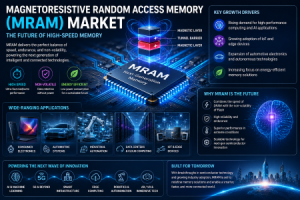
Understanding Magnetoresistive Random Access Memory Market Technology
MRAM is a non-volatile memory technology that stores information using magnetic states rather than electrical charges. Unlike conventional memory technologies, MRAM retains stored data even when power is removed.
The core component of MRAM is the Magnetic Tunnel Junction (MTJ), which consists of two magnetic layers separated by an insulating barrier. Data is stored based on the orientation of these magnetic layers.
Key advantages include:
- High-speed read and write operations
- Non-volatility
- Low power consumption
- Exceptional endurance
- High reliability
- Resistance to radiation and extreme temperatures
The Growing Role of MRAM in Artificial Intelligence and Machine Learning
Artificial intelligence (AI) and machine learning (ML) applications require rapid access to massive volumes of data while maintaining energy efficiency. MRAM addresses these needs by providing high-speed data processing capabilities and persistent data storage. AI accelerators, edge AI devices, and machine learning systems can benefit from MRAM’s low latency and fast switching speeds, enabling quicker decision-making and real-time analytics. Additionally, MRAM’s non-volatile characteristics help preserve critical model data during power interruptions, making it an increasingly valuable component in AI-driven infrastructures and intelligent edge computing environments.
Challenges Limiting Large-Scale MRAM Commercialization
Despite its advantages, MRAM faces several challenges that limit widespread adoption. One of the primary obstacles is the high manufacturing cost associated with producing magnetic tunnel junctions and integrating MRAM into advanced semiconductor processes. Scaling MRAM technology to achieve higher memory densities while maintaining performance and reliability also presents technical difficulties. Furthermore, MRAM competes with established memory technologies such as DRAM, NAND flash, and emerging alternatives like ReRAM and Phase Change Memory (PCM). Overcoming these cost and scalability challenges will be critical for accelerating large-scale commercialization and broader market penetration.
How MRAM Supports Energy-Efficient Electronic Devices
Energy efficiency has become a key priority across the electronics industry, and MRAM offers several advantages in this area. Because MRAM does not require constant power to retain stored information, it significantly reduces standby power consumption compared to traditional volatile memory technologies. Its fast write and read operations also minimize energy usage during data processing. These characteristics help extend battery life in portable devices, reduce energy costs in data centers, and support sustainable technology development. As manufacturers seek greener and more efficient electronic solutions, MRAM is becoming an important technology for reducing overall power consumption.
Get Sample Link: https://www.precedenceresearch.com/sample/3991
Major Magnetoresistive Random Access Memory Market Technologies
Spin-Transfer Torque MRAM (STT-MRAM)
STT-MRAM currently dominates the market due to:
- Lower power consumption
- Better scalability
- Faster switching speeds
- Compatibility with advanced semiconductor nodes
The technology is widely used in enterprise storage, consumer electronics, and embedded memory solutions. STT-MRAM accounted for the largest market share in 2025.
Toggle MRAM
Toggle MRAM remains popular in aerospace, defense, and industrial applications where reliability and endurance are critical requirements.
Although it offers excellent durability, scalability limitations have encouraged many manufacturers to transition toward STT-MRAM technologies.
Emerging MRAM Innovations
New technologies under development include:
- Spin-Orbit Torque MRAM (SOT-MRAM)
- Voltage-Controlled MRAM (VC-MRAM)
These innovations aim to further improve energy efficiency, speed, and storage density while reducing manufacturing complexity.
Regional Magnetoresistive Random Access Memory Market Insights
Asia-Pacific Leads Global Adoption
Asia-Pacific currently represents the largest MRAM market, accounting for more than 42% of global revenue. The region benefits from:
- Strong semiconductor manufacturing infrastructure
- Rapid consumer electronics production
- Expanding data center investments
- Growing adoption of advanced technologies
Countries such as China, South Korea, Japan, and Taiwan continue to invest heavily in semiconductor innovation.
North America’s Innovation Leadership
North America remains a major hub for MRAM research and commercialization due to:
- Advanced semiconductor companies
- Strong R&D spending
- Growing AI ecosystem
- Defense and aerospace investments
The region continues to drive innovation in next-generation memory technologies.
Europe’s Automotive Advantage
Europe’s automotive sector is creating significant demand for MRAM, particularly in electric vehicles and autonomous driving technologies.
Magnetoresistive Random Access Memory Market Competitive Landscape
Several major companies are actively investing in MRAM development and commercialization, including:
- Samsung Electronics
- Everspin Technologies
- Intel Corporation
- IBM Corporation
- SK Hynix
- Toshiba Corporation
- Fujitsu
These companies are focusing on enhancing memory density, reducing power consumption, and accelerating MRAM integration into advanced semiconductor processes.
Challenges Facing the MRAM Market
Despite its promising future, MRAM faces several challenges:
High Manufacturing Costs
MRAM production requires sophisticated fabrication processes that can increase manufacturing expenses compared to conventional memory technologies.
Competition from Alternative Memories
MRAM competes with several emerging memory technologies, including:
- Resistive RAM (ReRAM)
- Phase Change Memory (PCM)
- Ferroelectric RAM (FeRAM)
Manufacturers must continue innovating to maintain competitive advantages.
Scaling Complexities
As semiconductor nodes become smaller, maintaining performance and reliability while reducing costs remains a technical challenge.
Embedded MRAM The Next Semiconductor Revolution
Embedded MRAM (eMRAM) is rapidly gaining traction as semiconductor manufacturers seek alternatives to embedded flash memory.
Traditional flash memory struggles to scale below advanced process nodes. MRAM offers:
- Better scalability
- Faster operation
- Lower power consumption
- Improved endurance
Recent industry developments have demonstrated successful MRAM integration into advanced semiconductor manufacturing processes, making eMRAM a promising replacement for embedded flash in future chips.
Why MRAM is Emerging as the Next Generation Memory Technology
Magnetoresistive Random Access Memory (MRAM) is gaining recognition as a next-generation memory solution because it combines the best features of conventional memory technologies. Unlike DRAM, MRAM retains data even when power is turned off, and unlike flash memory, it offers significantly faster read and write speeds. Its exceptional endurance, low latency, and non-volatile nature make it highly attractive for modern computing systems. As industries demand memory solutions that deliver higher performance while reducing power consumption, MRAM is emerging as a strong candidate to replace or complement traditional memory technologies in a wide range of applications.
Also Read Our Latest Article: Industrial Vacuum Cleaner Market
