
 by
by The global human centric lighting market is witnessing strong growth as organizations increasingly adopt lighting systems designed to enhance human well-being, productivity, and comfort. Human centric lighting technology dynamically adjusts color temperature and brightness throughout the day to align with natural circadian rhythms.
In 2025, the global market size was valued at approximately USD 5.58 billion, and it is projected to reach nearly USD 75.00 billion by 2035, expanding at a CAGR of 29.68% from 2026 to 2035.
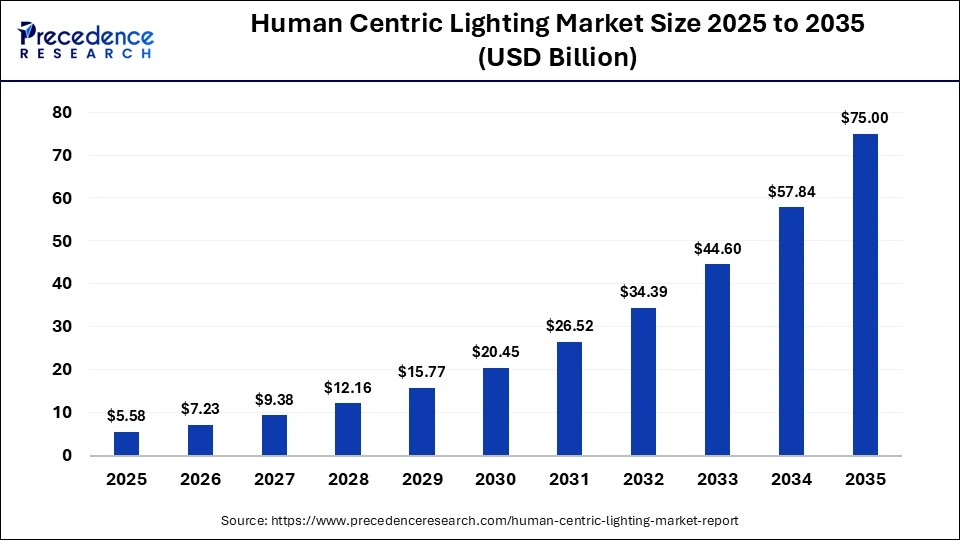
This strong growth is driven by increasing demand for smart infrastructure, energy-efficient lighting solutions, and wellness-focused building designs across commercial, residential, healthcare, and educational sectors.
Read Also: Generative AI in Coding Market
What is Human Centric Lighting?
Human centric lighting refers to advanced lighting systems that replicate natural daylight patterns and adapt dynamically based on time of day, occupancy, and environmental conditions.
These systems aim to:
- Improve sleep quality and circadian rhythm alignment
- Enhance workplace productivity
- Reduce eye strain and fatigue
- Support mental well-being
- Improve patient recovery in healthcare environments
Key Market Drivers
Rising Adoption of Smart Buildings and IoT Lighting
The integration of IoT, sensors, and automation systems in lighting infrastructure is significantly driving adoption. Smart lighting systems allow real-time adjustments based on occupancy and daylight availability.
Growing Focus on Employee Wellness
Organizations are increasingly investing in workplace environments that enhance productivity and reduce fatigue, making human centric lighting a key component of modern office design.
Expansion of Smart Cities and Green Buildings
Government initiatives promoting energy efficiency and sustainable infrastructure are accelerating deployment of adaptive lighting systems across urban developments.
Increasing Healthcare Applications
Hospitals are adopting HCL systems to support patient recovery, reduce stress levels, and improve overall comfort in clinical environments.
Market Challenges
Despite strong growth, the market faces several challenges:
- High installation and system integration costs
- Limited awareness in emerging economies
- Complex retrofitting in existing infrastructure
- Cybersecurity risks in connected lighting systems
Market Segmentation
By Product Type
- Fixtures (largest share)
- Controllers
- Sensors
- Software and services
- Drivers and microcontrollers
Fixtures dominate due to widespread use in both new installations and retrofit projects.
By Installation Type
- New installations (dominant segment)
- Retrofit installations (fastest growing segment)
New construction projects remain the primary demand driver, while retrofit systems are gaining momentum in upgrading older buildings.
By Application
- Commercial (largest segment)
- Residential
- Healthcare
- Education
- Industrial
Commercial spaces lead adoption due to strong emphasis on productivity, employee well-being, and energy optimization.
Regional Insights
Europe – Market Leader
Europe dominates the market due to strict energy efficiency regulations, advanced smart building infrastructure, and strong adoption of sustainable lighting technologies.
Asia-Pacific – Fastest Growing Region
Asia-Pacific is expected to witness the highest growth due to rapid urbanization, smart city development, and increasing indoor workforce populations.
North America – Innovation Hub
North America benefits from high adoption of IoT-enabled lighting systems and strong presence of leading lighting technology companies.
Key Market Trends
AI-Enabled Lighting Systems
Artificial intelligence is being integrated into lighting systems to optimize brightness and color temperature based on human behavior and environmental conditions.
IoT-Connected Smart Lighting
Connected lighting systems enable remote control, predictive maintenance, and energy optimization through cloud platforms.
Wellness-Oriented Infrastructure Design
Lighting is increasingly being designed to support circadian health, cognitive performance, and emotional well-being.
Energy Efficiency and Sustainability
HCL systems are contributing to reduced energy consumption and helping organizations meet sustainability goals.
Competitive Landscape
The market is highly competitive with major players focusing on innovation and smart lighting ecosystems.
Key Companies Include:
- Signify Holding
- Siemens AG
- Schneider Electric
- Acuity Brands
- OSRAM
- Zumtobel Group
- Lutron Electronics
- ABB Ltd.
- Eaton Corporation
- Wipro Lighting
These companies are investing heavily in AI-driven lighting systems, IoT integration, and sustainable smart infrastructure solutions.
Recent Developments
- In 2026, OPPLE Lighting introduced advanced Software Defined Lighting (SDL) technology enabling dynamic daylight simulation and improved occupant well-being.
- Signify launched NatureConnect, a solution designed to replicate natural light patterns and improve circadian rhythm alignment.
- Lutron Electronics introduced advanced dimming systems to enhance LED performance and user comfort.
Future Outlook
The future of the human centric lighting market is highly promising as demand for smart buildings and wellness-focused environments continues to rise. Over the next decade, HCL systems will become a standard component of modern architectural design.
Key future developments include:
- AI-driven fully autonomous lighting environments
- Greater integration with smart city infrastructure
- Expansion in residential wellness lighting
- Advanced personalization based on biometric data
Conclusion
The human centric lighting market is undergoing rapid transformation driven by technological innovation, sustainability goals, and increasing awareness of human well-being. With strong projected growth through 2035, HCL systems are set to redefine the future of architectural lighting and smart building design.
Get a Sample Copy: https://www.precedenceresearch.com/sample/8227
For inquiries regarding discounts, bulk purchases, or customization requests, please contact us at [email protected]
