
 by
by The global Huntingtons disease market is witnessing substantial growth driven by advances in gene therapies, increasing research investments, improved diagnostic capabilities, and growing awareness of neurodegenerative disorders. Emerging technologies such as artificial intelligence, biomarker discovery, and precision medicine are transforming disease management and accelerating the development of innovative treatment options for patients worldwide.
Huntingtons Disease Market Size and Forecast 2026 to 2035
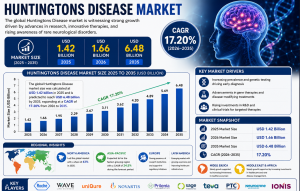
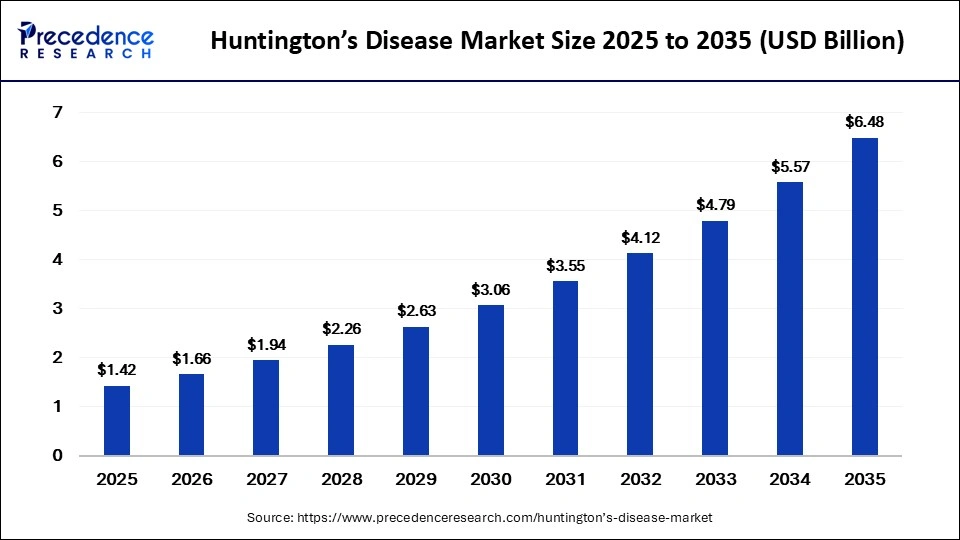
The global huntingtons disease market size was calculated at USD 1.42 billion in 2025 and is predicted to increase from USD 1.66 billion in 2026 to approximately USD 6.48 billion by 2035, expanding at a CAGR of 17.20% from 2026 to 2035. The increasing prevalence of Huntington’s disease, along with advances in clinical research and drug development, is a key driver of market growth.
Market Highlights
- North America led the Huntington’s disease market with a share of 43% in 2025.
- Asia-Pacific is expected to be the fastest-growing region with a CAGR of 24.5% in the forecasted period.
- By therapy type, the symptomatic treatments segment held a dominant position in the market with a 48% share in 2025.
- By therapy type, the gene therapies segment is expected to grow with the highest CAGR of 28.5% in the predictive window.
- By disease stage, the mid-stage Huntington’s disease segment led the global market with a share of 42% in 2025.
- By disease stage, the early-stage Huntington’s disease segment is expected to be the fastest-growing with a CAGR of 21.5% in the foreseeable period.
- By route of administration, the oral segment accounted for the highest revenue share of 52% in 2025.
- By route of administration, the intrathecal segment is expected to be the fastest-growing segment with a CAGR of 27.5% in the foreseeable period.
- By end-user, the hospitals segment led the global market with a share of 39% in 2025.
- By end-user type, the home care settings segment is expected to grow at the highest CAGR of 19.5% in the fiscal period.
Huntingtons Disease Market Overview
Huntington’s disease (HD) is a rare, inherited neurodegenerative disorder caused by a mutation in the huntingtin (HTT) gene. The disease progressively damages nerve cells in the brain, leading to cognitive decline, psychiatric symptoms, and impaired motor function. Symptoms typically emerge between the ages of 30 and 50, although juvenile-onset cases can occur earlier.
The Huntington’s disease market has gained significant attention in recent years due to increasing research efforts aimed at developing disease-modifying therapies. While currently available treatments primarily focus on symptom management, advances in gene silencing technologies, RNA-targeted therapies, and cell-based approaches are creating new opportunities for long-term disease control.
Growing investments from pharmaceutical companies, research institutions, and patient advocacy organizations are accelerating drug discovery and clinical development programs. Additionally, increasing adoption of genetic testing and improved understanding of disease biology are supporting earlier diagnosis and intervention strategies.
Key Market Trends
Expansion of Gene Therapy Development
Gene therapies are emerging as one of the most promising treatment approaches for Huntington’s disease. Pharmaceutical and biotechnology companies are actively exploring gene-silencing technologies designed to reduce the production of mutant huntingtin protein, which is responsible for disease progression.
Growing Focus on Biomarker Research
Researchers are increasingly focusing on identifying reliable biomarkers that can detect disease progression at earlier stages. Biomarker discoveries are expected to improve clinical trial efficiency, enable personalized treatment approaches, and support regulatory approvals for novel therapies.
Increased Adoption of Genetic Testing
The use of advanced genetic testing is expanding globally, allowing healthcare providers to diagnose Huntington’s disease more accurately and identify individuals at risk before symptom onset. Early diagnosis supports better patient management and participation in clinical trials.
Rising Clinical Trial Activity
The Huntington’s disease therapeutic pipeline continues to expand with numerous investigational therapies entering clinical development. Increased collaboration between pharmaceutical companies, academic institutions, and patient organizations is accelerating innovation across the market.
Shift Toward Personalized Medicine
Precision medicine approaches are becoming increasingly important in Huntington’s disease treatment. Researchers are leveraging genetic and molecular insights to develop therapies tailored to individual patient characteristics and disease progression patterns.
Market Report Coverage and Key Metrics
| Report Coverage | Details |
| Market Size in 2025 | USD 1.42 Billion |
| Market Size in 2026 | USD 1.66 Billion |
| Market Size by 2035 | USD 6.48 Billion |
| Market Growth Rate from 2026 to 2035 | CAGR of 17.20% |
| Dominating Region | North America |
| Fastest Growing Region | Asia Pacific |
| Base Year | 2025 |
| Forecast Period | 2026 to 2035 |
| Segments Covered | Therapy Type, Disease Stage, Route of Administration, End-User, Distribution Channel, and Region |
| Regions Covered | North America, Europe, Asia-Pacific, Latin America, and Middle East & Africa |
Impact of Artificial Intelligence on the Huntingtons Disease Market
Artificial Intelligence (AI) is revolutionizing Huntington’s disease research, diagnosis, and therapeutic development.
Machine learning algorithms are being used to analyze large datasets containing genetic information, neuroimaging scans, and clinical records. These advanced analytical tools help researchers identify disease patterns, predict progression rates, and uncover potential therapeutic targets.
AI is also improving clinical trial recruitment by identifying suitable patient populations more efficiently. Predictive analytics models can forecast disease progression, enabling more accurate patient stratification and outcome assessment.
In diagnostic applications, AI-powered neuroimaging tools are enhancing the detection of subtle brain changes associated with Huntington’s disease. These technologies support earlier diagnosis and provide valuable insights into treatment effectiveness.
Furthermore, AI-driven drug discovery platforms are accelerating the identification of novel compounds, reducing research timelines and increasing the probability of successful therapeutic development.
Regional Insights
North America dominates the Huntington’s disease market due to its strong healthcare infrastructure, extensive research activities, high healthcare spending, and presence of leading biotechnology and pharmaceutical companies. The United States remains a major center for clinical trials and innovative therapy development.
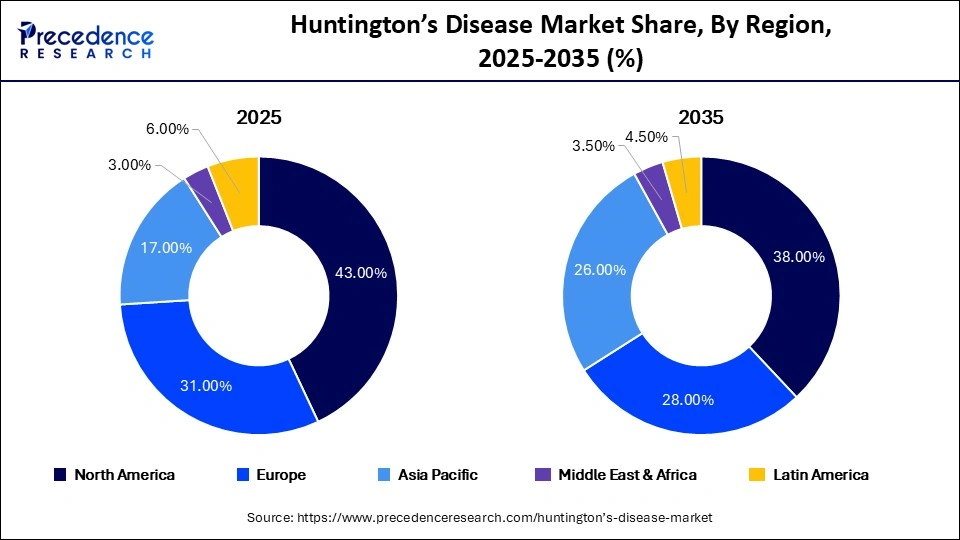
Europe represents a significant market share supported by favorable government initiatives, growing investments in neurological research, and strong patient advocacy networks. Countries such as Germany, France, and the United Kingdom continue to lead regional innovation.
Asia-Pacific is expected to witness the fastest growth during the forecast period. Increasing healthcare expenditure, expanding genetic testing capabilities, improving access to advanced therapies, and rising awareness of rare diseases are driving market expansion across China, Japan, India, and South Korea.
The Latin American market is experiencing steady growth due to improving healthcare infrastructure, increasing awareness programs, and enhanced access to diagnostic services for rare neurological disorders.
The Middle East and Africa region is gradually expanding as governments invest in healthcare modernization and rare disease management programs. Growing awareness and improved diagnostic capabilities are expected to support future market growth.
Get Sample Link : https://www.precedenceresearch.com/sample/8455
Competitive Landscape
The Huntington’s disease market is characterized by ongoing innovation and strategic collaborations among biotechnology and pharmaceutical companies. Organizations are focusing on gene therapies, RNA-targeted treatments, small molecule drugs, and biomarker development to strengthen their market positions.
Key market participants include Roche, Wave Life Sciences, uniQure, Novartis, Prilenia Therapeutics, Sage Therapeutics, Teva Pharmaceuticals, PTC Therapeutics, Annexon Biosciences, Voyager Therapeutics, Neurocrine Biosciences, Ionis Pharmaceuticals, Pfizer, and AstraZeneca.
Future Outlook
The future of the Huntington’s disease market appears highly promising as scientific advancements continue to improve understanding of disease mechanisms. The convergence of gene therapies, artificial intelligence, biomarker-driven diagnostics, and personalized medicine is expected to transform patient care over the next decade.
As clinical research progresses and innovative therapies move closer to commercialization, the market is likely to experience substantial growth, creating new opportunities for pharmaceutical companies, healthcare providers, investors, and patients worldwide.
Conclusion
The Huntingtons disease market is entering a period of accelerated innovation driven by advances in genetic medicine, biomarker discovery, and AI-powered healthcare solutions. With increasing research investments and a growing pipeline of disease-modifying therapies, the market is poised to deliver meaningful improvements in diagnosis, treatment, and patient outcomes in the years ahead.
Also Read Our Latest Post : Endoscopy Devices Market
