
 by
by The global inorganic scintillators market is witnessing steady yet impactful growth as industries increasingly rely on advanced radiation detection and imaging technologies. The market size was valued at USD 780.00 million in 2025 and is projected to grow from USD 833.82 million in 2026 to USD 1,520.10 million by 2035, expanding at a CAGR of 6.90% during the forecast period.
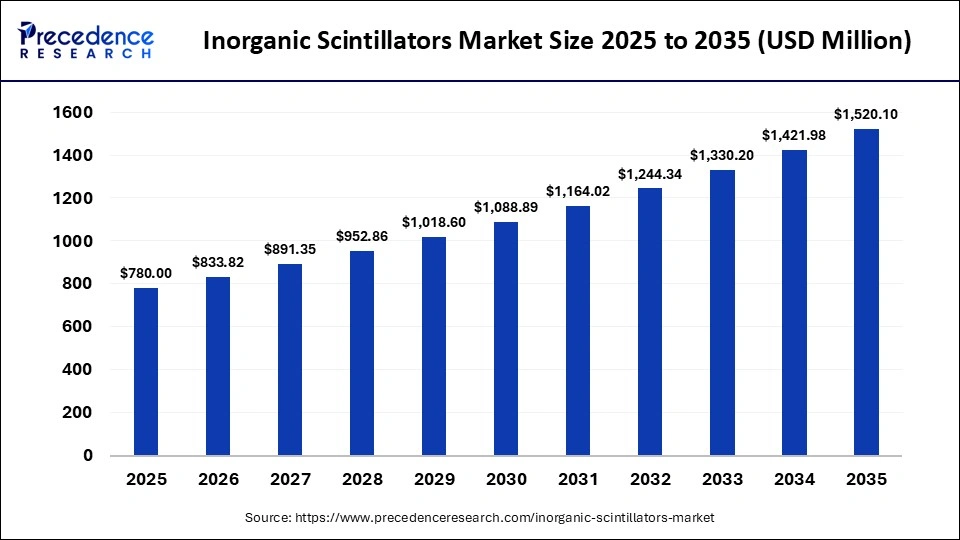
This growth trajectory is primarily driven by the rising adoption of medical imaging systems, increasing demand for radiation detection in nuclear and defense sectors, and ongoing advancements in high-performance scintillator materials that enhance sensitivity and accuracy.
Read Also: Sovereign AI Infrastructure Market
Quick Insights: What Defines the Market Landscape?
The inorganic scintillators market is currently shaped by increasing demand for high-precision radiation detection technologies across healthcare and industrial sectors. North America leads the global market with around 38% share, while Asia Pacific is emerging as the fastest-growing region with strong infrastructure expansion. Sodium iodide (NaI) dominates material usage with approximately 35% share due to its cost-effectiveness and efficiency. Medical imaging accounts for nearly 40% of applications, making it the leading segment, while healthcare and diagnostics dominate end-use with around 45% share. Photomultiplier tube (PMT)-based systems lead detection technology with a 55% share, whereas silicon photomultiplier (SiPM) systems are witnessing the fastest growth.
How is AI Influencing the Inorganic Scintillators Market?
Artificial intelligence is increasingly enhancing the capabilities of scintillator-based imaging and detection systems. AI-powered imaging algorithms are improving the accuracy and speed of diagnostic processes, particularly in PET, CT, and SPECT imaging, enabling earlier detection of diseases and more precise treatment planning.
In addition, AI-driven analytics are being integrated into radiation detection systems for real-time monitoring and predictive maintenance. These capabilities are particularly valuable in nuclear power plants and security applications, where rapid anomaly detection and operational efficiency are critical.
What are the Key Growth Drivers of the Market?
One of the primary growth drivers is the rising demand for advanced medical imaging technologies. Scintillators play a crucial role in converting radiation into visible light, enabling accurate imaging in diagnostic equipment such as CT and PET scanners.
Another significant factor is the increasing need for radiation detection in nuclear safety and homeland security. Governments and defense agencies are investing in advanced detection systems to monitor radiation levels and mitigate potential threats.
Additionally, the growing prevalence of chronic diseases and the need for early diagnosis are further accelerating the adoption of scintillator-based technologies in healthcare.
What Opportunities and Trends are Shaping the Market?
Are Advanced Scintillator Materials Driving Innovation?
Yes, continuous advancements in material science are leading to the development of high-performance scintillators with improved sensitivity, faster response times, and enhanced durability, opening new opportunities in healthcare and research applications.
Is Medical Imaging Becoming the Core Growth Engine?
Absolutely. With medical imaging accounting for around 40% of the market, the increasing use of PET, CT, and SPECT systems is significantly driving demand for inorganic scintillators.
Will SiPM Technology Replace Traditional PMTs?
Silicon photomultiplier (SiPM) technology is rapidly gaining traction due to its compact size and high efficiency. While PMTs currently dominate, SiPM systems are expected to grow at the fastest rate, signaling a shift in detection technologies.
Regional Analysis: Where is Growth Concentrated?
North America dominates the inorganic scintillators market due to its advanced healthcare infrastructure, strong nuclear energy sector, and presence of leading technology providers.
Asia Pacific is expected to witness the fastest growth, driven by increasing investments in healthcare, nuclear energy, and industrial applications. Europe also holds a significant share, supported by strong research initiatives and regulatory frameworks.
Segmental Analysis: How is the Market Structured?
Material Type Insights
Sodium iodide (NaI) leads the market with a 35% share, driven by its high light yield and cost-effectiveness. Lutetium-based scintillators (LSO/LYSO) are expected to grow at the fastest CAGR of 8.5% due to superior performance in advanced imaging systems.
Application Insights
Medical imaging dominates with a 40% share, followed by nuclear power and radiation detection at 25%. Homeland security and defense account for approximately 15% of the market.
End-Use Insights
Healthcare and diagnostics lead with a 45% share, while energy & nuclear and defense sectors contribute significantly to overall demand.
Detection Technology Insights
PMT-based systems dominate with a 55% share, while SiPM-based systems are projected to grow at the fastest CAGR of 9.5% due to technological advancements.
Competitive Landscape: Leading Companies
The inorganic scintillators market is moderately fragmented, with key players focusing on innovation and strategic partnerships to strengthen their market position.
Major companies include:
- Saint-Gobain Crystals
- Hamamatsu Photonics K.K.
- Hitachi Metals, Ltd.
- Amcrys-H Ltd.
- Rexon Components, Inc.
- Scionix Holland B.V.
- EPIC Crystal Company Limited
- Shanghai SICCAS High Technology Corporation
- Alpha Spectra, Inc.
- Dynasil Corporation of America
- Radiation Monitoring Devices, Inc.
- Korth Kristalle GmbH
- Zecotek Photonics Inc.
- Crytur, spol. s r.o.
- Detec Europe Ltd.
Download a Free Sample PDF: https://www.precedenceresearch.com/sample/8322
For inquiries regarding discounts, bulk purchases, or customization requests, please contact us at [email protected]
