
 by
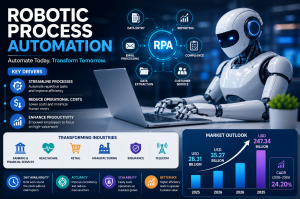
by The global robotic process automation market size was valued at USD 28.31 billion in 2025 and is expected to increase from USD 35.27 billion in 2026 to approximately USD 247.34 billion by 2035, registering a remarkable CAGR of 24.20% during the forecast period from 2026 to 2035. The increasing adoption of automation technologies across industries, combined with the growing need to improve operational efficiency and minimize costs, continues to drive market expansion.
Robotic Process Automation Market Overview
The global robotic process automation (RPA) market is experiencing extraordinary growth as organizations accelerate their digital transformation initiatives and increasingly rely on intelligent automation to optimize business operations. Businesses across banking, healthcare, manufacturing, retail, telecommunications, and government sectors are embracing RPA to automate repetitive tasks, reduce costs, improve productivity, and enhance customer experiences.
Robotic process automation uses software robots, often referred to as bots, to mimic human interactions with digital systems and applications. These bots execute rule-based processes with high accuracy and speed, enabling organizations to eliminate manual workloads and focus their workforce on strategic activities.
Market Size and Forecast
The robotic process automation market is projected to maintain exceptional momentum throughout the forecast period as enterprises seek scalable and intelligent automation solutions.
| Market Indicator | Value |
|---|---|
| Market Size (2025) | USD 28.31 Billion |
| Market Size (2026) | USD 35.27 Billion |
| Forecast Value (2035) | USD 247.34 Billion |
| CAGR (2026–2035) | 24.20% |
| Largest Market | North America |
| Fastest Growing Market | Asia Pacific |
| Base Year | 2025 |
| Forecast Period | 2026–2035 |
The rapid pace of digital transformation, coupled with the growing complexity of enterprise workflows, positions RPA as one of the fastest-growing segments within the broader automation landscape.
Why Organizations Are Investing in RPA
- Organizations today operate in highly competitive environments where efficiency, accuracy, and agility determine success. Traditional manual processes often lead to delays, inconsistencies, and rising operational costs.
- RPA addresses these challenges by automating repetitive tasks such as data entry, invoice processing, claims management, customer onboarding, payroll processing, reconciliation, and report generation. Software bots execute these tasks around the clock without fatigue, enabling businesses to significantly improve throughput and service quality.
- The benefits extend beyond productivity gains. RPA enhances compliance, minimizes human error, accelerates response times, and improves employee satisfaction by freeing workers from mundane activities.
- As enterprises continue to prioritize operational excellence, automation has evolved from an optional initiative to a strategic necessity.
The Growing Role of Artificial Intelligence in RPA
Artificial intelligence is transforming traditional robotic process automation into intelligent automation.
Conventional RPA systems operate using predefined rules and structured data. However, the integration of AI technologies such as machine learning, natural language processing, computer vision, and predictive analytics enables bots to process unstructured information and perform cognitive tasks.
AI-powered RPA solutions can interpret emails, extract information from documents, recognize images, understand human language, and make context-based recommendations. These capabilities allow organizations to automate increasingly sophisticated processes that previously required human judgment.
Machine learning algorithms continuously improve performance by identifying patterns and optimizing workflows over time. This evolution is paving the way for hyperautomation, where multiple technologies work together to automate end-to-end business processes.
Digital Transformation Accelerating Adoption
Digital transformation initiatives have become a major catalyst for RPA deployment worldwide.
- Organizations are investing heavily in technologies that improve agility, enhance customer engagement, and enable rapid adaptation to changing market conditions. Process automation plays a central role in achieving these objectives.
- By automating repetitive activities, businesses can streamline operations, reduce process bottlenecks, and allocate resources more efficiently. Employees gain the flexibility to focus on innovation, relationship building, and high-value decision-making.
- RPA also shortens time-to-market by accelerating product development cycles, improving service delivery, and enabling faster execution of strategic initiatives.
- As enterprises modernize their technology infrastructure, RPA adoption is expected to intensify across industries.
Rising Labor Costs Driving Automation Investments
Escalating labor costs have emerged as another significant factor supporting market growth.
- Organizations face mounting pressure to maintain profitability while managing increasing personnel expenses. Hiring, training, and retaining employees for repetitive operational tasks often results in substantial financial burdens.
- RPA offers an attractive alternative by reducing dependency on manual labor and improving workforce productivity. Software robots perform high-volume tasks with exceptional accuracy and consistency, generating considerable cost savings over time.
- Studies indicate that organizations implementing automation frequently achieve return on investment within the first year of deployment. These financial benefits encourage businesses to expand automation initiatives throughout their operations.
- Beyond cost reduction, RPA enables employees to engage in more meaningful and strategic activities, fostering innovation and improving workplace satisfaction.
Hyperautomation Shaping the Future of Enterprise Operations
Hyperautomation has emerged as one of the most influential trends within the RPA ecosystem.
- Hyperautomation combines RPA with artificial intelligence, process mining, analytics, and workflow orchestration technologies to automate complex business environments.
- Rather than automating isolated tasks, organizations can redesign entire workflows to achieve seamless end-to-end automation. Gartner estimates that hyperautomation initiatives have already transformed a substantial portion of business processes globally.
- The approach delivers improved scalability, greater operational visibility, and enhanced decision-making capabilities.
- As enterprises seek comprehensive automation frameworks, hyperautomation is expected to become a defining force in future RPA deployments.
Healthcare and Pharmaceuticals Offer Significant Opportunities
- Healthcare and pharmaceutical organizations are increasingly adopting RPA to streamline administrative and clinical workflows.
- Applications include patient scheduling, insurance verification, billing, claims processing, electronic medical record management, and supply chain coordination.
- Automation reduces administrative burdens on healthcare professionals while improving accuracy and patient outcomes.
- Studies have demonstrated that automation initiatives contribute to lower costs, fewer errors, and enhanced operational efficiency within healthcare environments.
- As providers seek to optimize resources and improve patient experiences, healthcare represents one of the most promising growth areas for RPA vendors.
Finance and Accounting Remain Key Applications
Finance and accounting represented the largest application segment in 2025.
- Organizations frequently automate accounts payable, accounts receivable, invoice processing, payroll administration, bank reconciliation, and expense management activities.
- These processes involve structured data and well-defined rules, making them ideal candidates for automation.
- RPA enhances financial accuracy, accelerates transaction processing, and supports regulatory compliance while reducing operational expenses.
- Human resources applications are also gaining momentum as companies automate recruitment, onboarding, attendance tracking, and employee lifecycle management.
Recent Developments in the Market
The market has witnessed significant advancements in recent years.
- In April 2025, UiPath introduced its enterprise-grade platform designed to unify AI agents, robots, and human workers within a single intelligent ecosystem.
- Industry certification programs focused on AI-powered robotics and Industry 4.0 competencies have also expanded to address evolving workforce requirements.
- These innovations demonstrate the growing convergence of artificial intelligence and automation technologies.
Future Outlook
The future of the robotic process automation market appears exceptionally bright.
Organizations worldwide continue prioritizing operational efficiency, digital transformation, and customer-centric innovation. RPA has evolved beyond simple task automation into a strategic capability that drives agility, resilience, and competitive differentiation.
The integration of artificial intelligence, cloud computing, process mining, and hyperautomation will further expand automation possibilities across industries. As businesses navigate increasingly complex operating environments, robotic process automation is poised to become a cornerstone of modern enterprise operations, enabling organizations to work smarter, innovate faster, and achieve sustainable growth through 2035.
Check this Report too: Artificial Intelligence Robots Market
Get this report to explore global market size, share, CAGR, and trends, featuring detailed segmental analysis and an insightful competitive landscape overview @ https://www.precedenceresearch.com/sample/1348
You can place an order or ask any questions, please feel free to contact us at sales@precedenceresearch.com |+1 804 441 8440
